

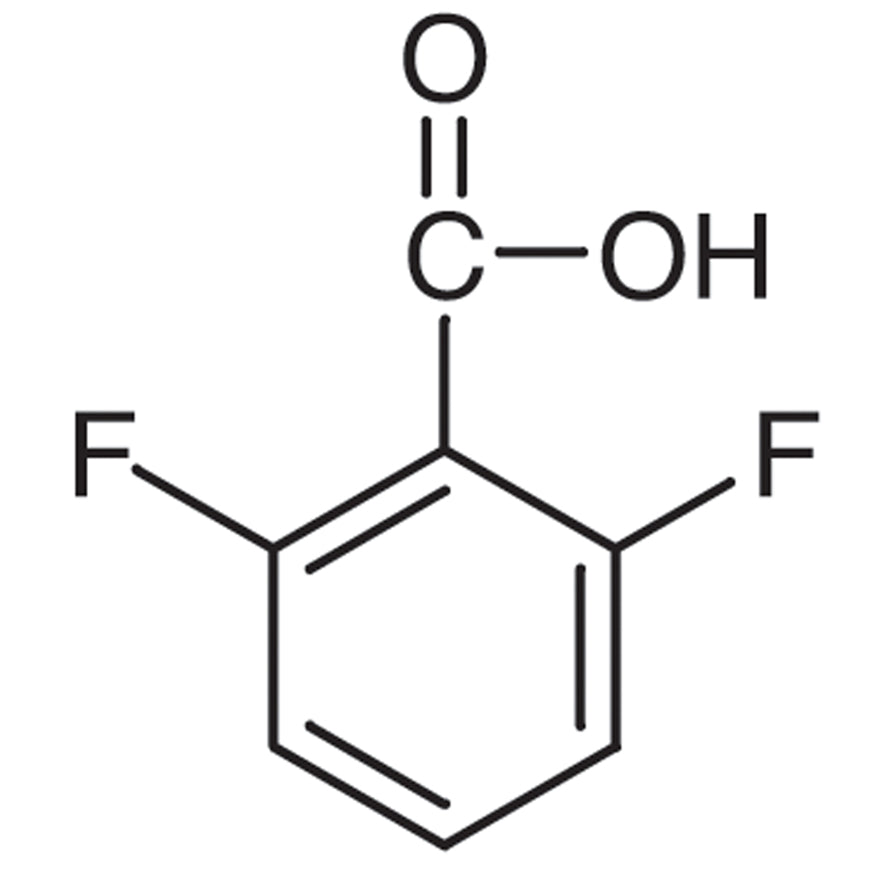
2,6-Difluorobenzoic Acid (CAS 385-00-2) is a benzoic acid that carries two fluorine atoms at the ortho positions, 2 and 6, relative to the carboxylic acid group. Supplied by TCI under catalogue number D1629, it is an important fluorinated building block for synthesis laboratories, especially in the development of agrochemical and pharmaceutical active ingredients. The carboxylic acid group can be converted into an acid chloride, ester, amide, or nitrile. This lets chemists attach the 2,6-difluorophenyl ring to a wide range of target molecules. For example, 2,6-difluorobenzamide derivatives are known structural components of the benzoylurea class of insecticides.
The fluorine atoms have a strong influence on the properties of the molecule. The two ortho fluorines withdraw electrons and increase the acidity of the carboxylic acid group. They also create steric and electronic effects that influence the conformation of the amides made from this acid. In medicinal and agrochemical chemistry, fluorine substitution is often used to improve metabolic stability, lipophilicity, and binding affinity toward biological targets. For these reasons, fluorinated building blocks like this one are in high demand when new compounds are being designed, and the well-defined 2,6-substitution pattern makes this acid a convenient way to introduce those effects.
In Indonesia, this material is used by agrochemical R&D laboratories, pharmaceutical companies, and university medicinal chemistry research groups that design and synthesise new fluorinated compounds. Typical work includes preparing amide and ester libraries for screening, building analogues of known active structures, and studying how ortho-fluorine substitution changes molecular behaviour. It also suits academic groups training students in multi-step synthesis, where a reliable, well-documented TCI starting material helps keep results consistent and reproducible from batch to batch.
TCI brochures (PDF)
- Fluorination Reagents, Fluorinated Building Blocks 2026-03-18 · p. 29
- Acid chloride preparation: the carboxylic acid group converts into the corresponding acid chloride, a reactive intermediate for attaching the 2,6-difluorophenyl ring to amines, alcohols, and other nucleophiles.
- Amide synthesis for agrochemical research: 2,6-difluorobenzamide derivatives are known structural parts of benzoylurea insecticides, which makes this acid a logical starting point for analogue work in that class.
- Ester and nitrile derivatisation: converting the acid into esters or nitriles gives access to more intermediates that carry the fluorinated aromatic ring into later synthetic steps.
- Medicinal chemistry lead optimisation: adding fluorine through this building block helps researchers study effects on metabolic stability, lipophilicity, and binding affinity toward biological targets.
- Structure–property studies: the two ortho fluorines change acidity and amide conformation through steric and electronic effects, which makes this compound useful for systematic studies of substituent influence.
| Brand | TCI (catalogue number D1629) |
|---|---|
| CAS number | 385-00-2 |
| Molecular formula | — |
| Purity | — |
| Category | Chemistry > Building Blocks > Fluorinated Building Blocks |
| Pack sizes | as listed in the options on this product page |
| Physical form | refer to the TCI product label and Certificate of Analysis |
| Storage | keep tightly closed in a cool, dry, well-ventilated place; follow the supplier's Safety Data Sheet |
Store 2,6-Difluorobenzoic Acid in its original, tightly sealed container in a cool, dry, well-ventilated area, away from moisture, direct sunlight, strong bases, and oxidising agents. If you transfer portions, use clean, dry, chemically compatible containers such as glass or suitable plastic bottles, and label them clearly. Handle the material in a fume hood or well-ventilated area, and wear safety glasses, laboratory gloves, and a lab coat. Avoid generating or breathing dust, and avoid contact with skin and eyes. Wash your hands after handling. Always read the TCI Safety Data Sheet before use, and dispose of waste according to local regulations and your institution's procedures.
—
Produk Terkait
-
4-Bromo-2,6-difluorobenzoicAcid TCI B3447
Regular price From Rp 505.050,00Regular priceRp 368.550,00Sale price From Rp 505.050,00 -
3,5-DifluorobenzoicAcid TCI D2596
Regular price From Rp 1.033.200,00Regular priceRp 738.150,00Sale price From Rp 1.033.200,00 -
2,3-DifluorobenzoicAcid TCI D2058
Regular price From Rp 2.121.000,00Regular priceRp 1.498.350,00Sale price From Rp 2.121.000,00 -
3,4-DifluorobenzoicAcid TCI D1908
Regular price From Rp 1.033.200,00Regular priceRp 738.150,00Sale price From Rp 1.033.200,00 -
2,4-DifluorobenzoicAcid TCI D1833
Regular price From Rp 1.431.150,00Regular priceRp 1.016.400,00Sale price From Rp 1.431.150,00 -
2,5-DifluorobenzoicAcid TCI D1699
Regular price Rp 900.900,00Regular priceRp 645.750,00Sale price Rp 900.900,00 -
3-Chloro-2,4-difluorobenzoicAcid TCI C2517
Regular price From Rp 1.272.600,00Regular priceRp 905.100,00Sale price From Rp 1.272.600,00 -
2-Chloro-4,5-difluorobenzoicAcid TCI C1460
Regular price From Rp 955.500,00Regular priceRp 683.550,00Sale price From Rp 955.500,00


