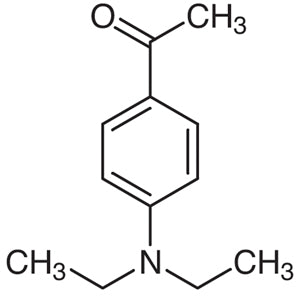
TCI D2084 4'-Diethylaminoacetophenone (CAS 5520-66-1) is a non-heterocyclic building block belonging to the class of aromatic ketones, carrying a diethylamino group positioned para to the acetyl group on the benzene ring. The combination of a strong electron-donating group and an electron-withdrawing group on a single aromatic ring gives the molecule push–pull character, meaning it possesses a distinctive internal electronic polarization. In the laboratory, this compound is widely used as a starting material for the synthesis of fluorescent dyes, chalcones, photoinitiators, and nonlinear optical materials, as well as an intermediate in the preparation of nitrogen-containing heterocyclic compounds studied in medicinal chemistry research.
The property that makes this compound a preferred choice is its dual reactivity, which is readily directed by the chemist. The methyl ketone group can condense with aromatic aldehydes through the Claisen–Schmidt condensation to yield chalcones, which react further to form pyrazolines, pyrimidines, or synthetic flavonoids, and it can also undergo the Mannich reaction as well as halogenation at the alpha position. The diethylamino group, on the other hand, increases the electron density of the ring, shifting light absorption toward longer wavelengths and strengthening the fluorescence character of the resulting derivatives — a highly sought-after quality in dye and optical materials work.
In Indonesian laboratories, this building block is typically encountered in university organic synthesis and medicinal chemistry groups, in research institute laboratories developing fluorescent probes and optical materials, and in industrial R&D units working on photoinitiator and dye formulations. It is normally purchased in research-scale quantities for multi-step synthesis routes, where a single reliable ketone precursor supports several derivative series, making it a practical staple for laboratories that run exploratory synthesis alongside routine characterization work.
- Chalcone synthesis via Claisen–Schmidt condensation: the reactive methyl ketone couples cleanly with aromatic aldehydes, giving push–pull chalcones for further cyclization studies.
- Fluorescent dye preparation: the para diethylamino donor raises ring electron density and red-shifts absorption, producing derivatives with strong, useful fluorescence emission.
- Nitrogen heterocycle construction: chalcone products derived from this ketone convert onward into pyrazolines and pyrimidines investigated widely in medicinal chemistry research programs.
- Nonlinear optical material research: the intrinsic donor–acceptor polarization across one benzene ring makes this molecule a convenient scaffold for optical materials development.
- Photoinitiator intermediate synthesis: the aromatic aminoketone framework serves as a starting structure for photoinitiator chemistry and related light-responsive formulation studies.
| Brand | TCI (Tokyo Chemical Industry) |
|---|---|
| CAS number | 5520-66-1 |
| Molecular formula | — |
| Purity | — |
| Category | Chemistry > Building Blocks > Non-Heterocyclic Building Blocks |
| Pack sizes | available in standard TCI research-scale packaging; please confirm the currently offered pack size when ordering |
| Physical form | — |
| Storage | keep in a tightly closed container in a cool, dark, well-ventilated place |
- Chemical Name: 4'-Diethylaminoacetophenone
- Catalog Code: D2084
Store the container tightly closed in a cool, dry, and well-ventilated area, protected from direct sunlight and away from heat sources, oxidizing agents, and strong acids. Keep the material in its original amber or opaque supplier container where possible, since aromatic aminoketones are best protected from prolonged light exposure. Handle inside a fume hood using nitrile gloves, safety goggles, and a laboratory coat, and avoid inhaling dust or generating aerosols during weighing and transfer. Use clean, dry spatulas to prevent contamination or moisture uptake, reseal the container immediately after use, and label all working solutions clearly. Consult the manufacturer's Safety Data Sheet before first use and dispose of residues and contaminated materials through the laboratory's chemical waste procedures.
—
Produk Terkait
-
4'-AminoacetophenoneHydrochloride TCI A0252
Regular price Rp 2.359.350,00Regular price -
2'-Aminoacetophenone TCI A0250
Regular price From Rp 610.050,00Regular price -
3'-Aminoacetophenone TCI A0249
Regular price Rp 1.326.150,00Regular price -
4,4'-Bis(diethylamino)benzophenone TCI B1275
Regular price From Rp 477.750,00Regular price -
4'-Aminoacetophenone TCI A0251-100G
Regular price Rp 4.161.150,00Regular price -
4-(Diethylamino)benzonitrile TCI D4852
Regular price From Rp 1.749.300,00Regular price -
4'-Dimethylaminoacetophenone TCI D1575
Regular price From Rp 823.200,00Regular price -
3'-Dimethylaminoacetophenone TCI D1446
Regular price Rp 3.048.150,00Regular price