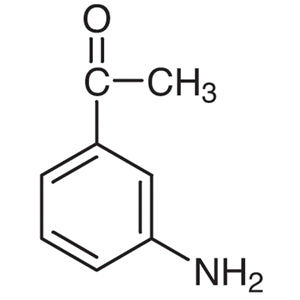
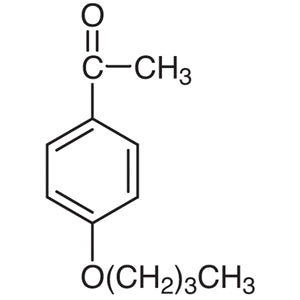
TCI A0251 4'-Aminoacetophenone (CAS 99-92-3) is an aromatic compound that carries an amine group on the benzene ring and an acetyl group at the para position. This combination of an aromatic amine and a ketone makes it a versatile building block in organic chemistry. In the TCI catalogue it belongs to the non-heterocyclic building blocks group, and in the laboratory it is often used as a starting material for dyes, pharmaceutical intermediates, and other aromatic derivatives that need two reactive functional groups.
The two functional groups on this molecule can be used separately or together. The aromatic amine can be diazotized, acylated, or condensed with aldehydes to form Schiff bases, while the ketone, which has alpha hydrogens, can take part in aldol condensation, for example to form chalcones. The para arrangement places the two groups on opposite sides of the ring, so their electronic effects complement each other. These characteristics make it a common choice for researchers who are assembling compound libraries or testing new reactions.
In Indonesia, the 100 g pack of this TCI product suits organic chemistry laboratories in universities, research centres, and industry that carry out synthesis in batches or run repeated experiments. It supports teaching laboratories, method development, and the preparation of intermediates for further reaction steps. Laboratories that need a consistent supply of a well-known building block for multi-step synthesis will find this pack size practical for routine work.
- Dye synthesis: the aromatic amine can be diazotized and coupled, so this compound serves as a starting material for building dye molecules that carry a ketone group.
- Pharmaceutical intermediates: the amine and ketone groups allow stepwise modification, which suits research teams preparing intermediate compounds for later synthetic stages.
- Schiff base formation: the aromatic amine condenses with aldehydes to give imines, which makes this reagent useful for preparing ligands and exploring condensation chemistry.
- Chalcone preparation: the ketone with alpha hydrogens can undergo aldol condensation with aromatic aldehydes, giving chalcone-type products for synthetic and structure studies.
- Compound library building: two reactive groups in one molecule let chemists create many aromatic derivatives, which supports screening work and the testing of new reactions.
| Brand | TCI |
|---|---|
| CAS number | 99-92-3 |
| Molecular formula | — |
| Purity | — |
| Category | Chemistry > Building Blocks > Non-Heterocyclic Building Blocks |
| Pack sizes | 100 g |
| Physical form | — |
| Storage | keep the container tightly closed and follow the supplier label and safety data sheet |
- Product code: A0251
Store 4'-Aminoacetophenone in its original tightly closed container, in a cool, dry, and well-ventilated place away from direct sunlight, heat, and incompatible materials such as strong oxidizing agents. Aromatic amines can change over time when exposed to air and light, so the container should be resealed promptly after each use. Handle the material in a fume hood or a well-ventilated area, and wear gloves, safety glasses, and a laboratory coat to avoid skin contact and inhalation of dust. Avoid creating dust when weighing, and clean up spills carefully. Always consult the supplier's safety data sheet for exact storage conditions, hazard information, and disposal requirements before use.
—
Produk Terkait
-
4'-AminoacetophenoneHydrochloride TCI A0252
Regular price Rp 2.411.850,00Regular priceRp 1.702.050,00Sale price Rp 2.411.850,00 -
2'-Aminoacetophenone TCI A0250
Regular price From Rp 662.550,00Regular priceRp 478.800,00Sale price From Rp 662.550,00 -
3'-Aminoacetophenone TCI A0249
Regular price Rp 1.378.650,00Regular priceRp 979.650,00Sale price Rp 1.378.650,00 -
4'-Diethylaminoacetophenone TCI D2084
Regular price From Rp 2.597.700,00Regular priceRp 1.832.250,00Sale price From Rp 2.597.700,00 -
4'-Benzyloxyacetophenone TCI B3365
Regular price From Rp 530.250,00Regular priceRp 386.400,00Sale price From Rp 530.250,00 -
4'-Butoxyacetophenone TCI B1501
Regular price Rp 1.776.600,00Regular priceRp 1.257.900,00Sale price Rp 1.776.600,00 -
4'-Butylacetophenone TCI B1000
Regular price Rp 1.644.300,00Regular priceRp 1.149.750,00Sale price Rp 1.644.300,00 -
4'-Bromoacetophenone TCI B0537
Regular price From Rp 822.150,00Regular priceRp 590.100,00Sale price From Rp 822.150,00