


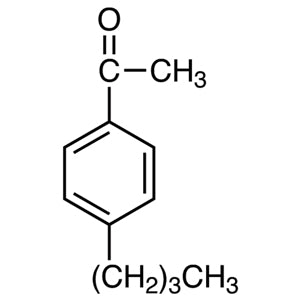
4'-Butylacetophenone is an organic compound widely used in various chemical reactions within laboratory settings. It serves as a key building block in the synthesis of complex organic molecules, offering versatility in chemical transformations. This compound is particularly valuable for its ability to participate in substitution and reduction reactions, making it an essential tool for chemists. Its structural composition includes both a phenyl group and a butyl group, contributing to its stability and reactivity. These features make it a popular choice among researchers working on synthetic chemistry projects.
The compound's physical properties, such as its relatively high boiling and melting points, facilitate processes like isolation and heating, which are common in laboratory procedures. Its non-toxic nature in small doses ensures a safer working environment, especially in controlled laboratory conditions. These characteristics make it a reliable and efficient material for use in both academic and industrial research settings.
In Indonesian laboratories, 4'-Butylacetophenone is commonly utilized in organic chemistry research, particularly in studies related to pharmaceuticals, materials science, and chemical engineering. It plays a crucial role in the development of new compounds with potential applications in medicine and industry. Its availability and reliability make it an important component of laboratory supplies in Indonesia.
- Organic synthesis projects benefit from 4'-Butylacetophenone due to its reactivity and structural versatility, enabling the creation of complex molecules.
- Pharmaceutical research often incorporates this compound for the development of new drug compounds, as it can be modified through various chemical reactions.
- Material science experiments use 4'-Butylacetophenone to synthesize polymers and other advanced materials, leveraging its chemical stability.
- Educational institutions rely on this compound for teaching chemical synthesis techniques, providing students with hands-on experience in organic chemistry.
- Industrial laboratories utilize 4'-Butylacetophenone in the production of specialty chemicals, where its properties support efficient and reproducible reactions.
| Brand | TCI |
|---|---|
| CAS number | 37920-25-5 |
| Molecular formula | — |
| Purity | — |
| Category | Chemistry > Building Blocks > Non-Heterocyclic Building Blocks |
| Pack sizes | Available in various quantities as per supplier specifications |
| Physical form | Liquid or solid, depending on the specific product variant |
| Storage | Store in a cool, dry place away from direct sunlight and incompatible materials |
4'-Butylacetophenone should be stored in a cool, dry environment to maintain its chemical integrity and prevent degradation. It is recommended to use airtight containers to minimize exposure to moisture and air, which can affect its stability. Due to its reactivity, it should be kept away from strong oxidizing agents and incompatible substances. Proper labeling and storage conditions are essential to ensure safety in the laboratory. Always follow standard laboratory safety protocols, including the use of personal protective equipment when handling the compound. Regular monitoring of storage conditions helps maintain the compound's effectiveness and usability in research applications.
—
Produk Terkait
-
4'-tert-Butylacetophenone TCI B6460
Regular price From Rp 1.538.250,00Regular priceRp 1.075.200,00Sale price From Rp 1.538.250,00 -
4'-Methylacetophenone TCI M0135
Regular price From Rp 477.750,00Regular priceRp 333.900,00Sale price From Rp 477.750,00 -
4'-Ethylacetophenone TCI E0318
Regular price From Rp 743.400,00Regular priceRp 519.750,00Sale price From Rp 743.400,00 -
4'-Isobutylacetophenone TCI I0417
Regular price From Rp 2.094.750,00Regular priceRp 1.464.750,00Sale price From Rp 2.094.750,00 -
2-Bromo-2-phenylacetophenone TCI B4471
Regular price From Rp 2.411.850,00Regular priceRp 1.702.050,00Sale price From Rp 2.411.850,00 -
tert-ButylaceticAcid TCI B0826
Regular price Rp 955.500,00Regular priceRp 683.550,00Sale price Rp 955.500,00 -
2-Bromo-4'-phenylacetophenone TCI B0633
Regular price From Rp 1.060.500,00Regular priceRp 757.050,00Sale price From Rp 1.060.500,00 -
2'-Hydroxy-4',6'-dimethoxy-2-phenylacetophenone TCI H1577
Regular price From Rp 1.378.650,00Regular priceRp 979.650,00Sale price From Rp 1.378.650,00


