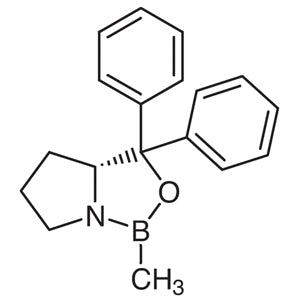
TCI D2130, (R)-5,5-Diphenyl-2-methyl-3,4-propano-1,3,2-oxazaborolidine, is a chiral catalyst belonging to the oxazaborolidine family, widely known among synthetic chemists as the CBS catalyst. The compound is used together with a hydride source such as borane to carry out enantioselective reduction of prochiral ketones, delivering secondary alcohols in which one configuration predominates. Its role in the laboratory is strategically important because many bioactive molecules and active pharmaceutical ingredients display the desired activity in only one enantiomeric form, making control of chirality a fundamental requirement in modern synthesis.
The properties that lead chemists to select this catalyst are its ability to provide high selectivity under relatively mild reaction conditions, its effectiveness in substoichiometric amounts, which conserves material, and the fact that the products it generates are straightforward to separate during post-reaction work-up. The bicyclic framework, bearing two bulky phenyl groups at the 5-position, creates a well-defined steric environment around the boron atom, and it is precisely this environment that directs the approach of hydride to one face of the ketone. Because the catalyst is available both as the (R) form and as its enantiomeric counterpart, the chemist can choose which configuration of the alcohol product to obtain.
In Indonesian laboratories, this catalyst is typically used in organic synthesis and medicinal chemistry research groups at universities, in research institutes, and in pharmaceutical development laboratories where a defined stereochemical outcome is required. It is generally applied on a small preparative scale, in method development and route-scouting work, and in the preparation of chiral intermediates and reference standards, where reagent quantities are modest and consistent enantioselectivity matters more than throughput.
TCI brochures (PDF)
- Hydrogenation Catalysts 2025-11-10 · p. 8
- Asymmetric Organocatalysts 2025-06-12 · p. 9
- Asymmetric Synthesis 2026-03-18 · p. 6
- Boron Compounds 2025-10-07 · p. 28
Related TCI products
- TCI D5912 112022-81-8 (S)-5,5-Diphenyl-2-methyl-3,4-propano-1,3,2-oxazaborolidine (ca. 1mol/L in Toluene)
- TCI D2131 112022-81-8 (S)-5,5-Diphenyl-2-methyl-3,4-propano-1,3,2-oxazaborolidine
- TCI I0801 850661-66-4 (S)-4-Isopropyl-3-(1-naphthylmethyl)-2,5,5-triphenyl-1,3,2-oxazaborolidine (ca. 6% in Toluene, ca. 0.1mol/L)
- TCI B2048 93379-49-8 (+)-4,5-Bis[hydroxy(diphenyl)methyl]-2,2-dimethyl-1,3-dioxolane
- TCI B1614 93379-48-7 (-)-4,5-Bis[hydroxy(diphenyl)methyl]-2,2-dimethyl-1,3-dioxolane
- TCI H0784 144119-12-0 (R)-(-)-2-[Hydroxy(diphenyl)methyl]-1-methylpyrrolidine
- Enantioselective reduction of prochiral ketones — the defined steric environment around boron directs hydride delivery to a single ketone face, giving secondary alcohols with one dominant configuration.
- Synthesis of chiral pharmaceutical intermediates — many active pharmaceutical ingredients are active in only one enantiomeric form, so a catalyst that controls configuration is essential to the route.
- Preparation of chiral secondary alcohol building blocks — the alcohol products serve as stereochemically defined starting points for further transformations in multi-step synthetic sequences.
- Asymmetric synthesis method development — the catalyst works under relatively mild conditions and in substoichiometric amounts, making it economical for screening and optimising reduction protocols.
- Access to a chosen product configuration — because both the (R) form and its enantiomer are available, chemists can select which enantiomeric alcohol a given synthetic route produces.
| Brand | TCI (Tokyo Chemical Industry) |
|---|---|
| CAS number | 112022-83-0 |
| Molecular formula | — |
| Purity | — |
| Category | Chemistry > Asymmetric Synthesis > Chiral Catalysts, Chiral Ligands, Chiral Reagents |
| Pack sizes | available in standard TCI research-scale packaging; please confirm the pack size required when ordering |
| Physical form | — |
| Storage | keep in the tightly closed original container under the conditions stated on the manufacturer's label |
- Chemical name: (R)-5,5-Diphenyl-2-methyl-3,4-propano-1,3,2-oxazaborolidine
Store the container tightly closed in a cool, dry, well-ventilated area, away from moisture, heat, and sources of ignition, and follow the storage conditions printed on the manufacturer's label and safety data sheet. Keep the material in its original container or in a clean, dry, well-sealed vessel that is compatible with boron-containing reagents; transfer under an inert atmosphere where the laboratory protocol calls for it. Handle only in a functioning fume hood, wearing safety glasses, chemically resistant gloves, and a laboratory coat. Because the compound is used together with borane-type hydride sources, keep it separate from water, alcohols, oxidising agents, and other incompatible chemicals. Label all working containers clearly, minimise exposure of the material to air and humidity during weighing, and dispose of residues and contaminated consumables in accordance with institutional chemical waste procedures.
—
Product Categories
Produk Terkait
-
(S)-5,5-Diphenyl-2-methyl-3,4-propano-1,3,2-oxazaborolidine(ca.1mol/LinToluene) TCI D5912
Regular price From Rp 2.359.350,00Regular price -
(S)-5,5-Diphenyl-2-methyl-3,4-propano-1,3,2-oxazaborolidine TCI D2131
Regular price From Rp 1.776.600,00Regular price -
(S)-4-Isopropyl-3-(1-naphthylmethyl)-2,5,5-triphenyl-1,3,2-oxazaborolidine(ca.6%inToluene,ca.0.1mol/L) TCI I0801
Regular price Rp 3.790.500,00Regular price -
(+)-4,5-Bis[hydroxy(diphenyl)methyl]-2,2-dimethyl-1,3-dioxolane TCI B2048
Regular price From Rp 1.829.100,00Regular price -
(-)-4,5-Bis[hydroxy(diphenyl)methyl]-2,2-dimethyl-1,3-dioxolane TCI B1614
Regular price From Rp 1.087.800,00Regular price -
(R)-(-)-2-[Hydroxy(diphenyl)methyl]-1-methylpyrrolidine TCI H0784
Regular price From Rp 1.193.850,00Regular price -
(S)-(+)-2-[Hydroxy(diphenyl)methyl]-1-methylpyrrolidine TCI H0768
Regular price From Rp 1.220.100,00Regular price -
(R)-(+)-alpha,alpha-Diphenyl-2-pyrrolidinemethanolTrimethylsilylEther TCI D3867
Regular price From Rp 3.419.850,00Regular price

![93379-49-8 (+)-4,5-Bis[hydroxy(diphenyl)methyl]-2,2-dimethyl-1,3-dioxolane - AMI Scientific](http://amiscientific.com/cdn/shop/files/TCI2510B2048_ca66ec29-76e5-43e7-9f7b-9d16d3c27d2d.jpg?v=1767330617&width=533)
![93379-48-7 (-)-4,5-Bis[hydroxy(diphenyl)methyl]-2,2-dimethyl-1,3-dioxolane - AMI Scientific](http://amiscientific.com/cdn/shop/files/TCI2510B1614_834fd19e-0321-4868-b028-1261dabc7fec.jpg?v=1767327573&width=533)
![(R)-(-)-2-[Hydroxy(diphenyl)methyl]-1-methylpyrrolidine (CAS 144119-12-0) - TCI H0784 - AMI Scientific](http://amiscientific.com/cdn/shop/files/TCI2510H0784.jpg?v=1767116984&width=533)
![(S)-(+)-2-[Hydroxy(diphenyl)methyl]-1-methylpyrrolidine (CAS 110529-22-1) - TCI H0768 - AMI Scientific](http://amiscientific.com/cdn/shop/files/TCI2510H0768.jpg?v=1767116955&width=533)