

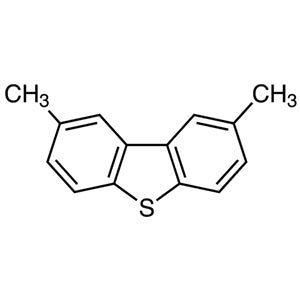
TCI D2223 2,8-Dimethyldibenzothiophene is a sulfur-containing heterocyclic compound built on a dibenzothiophene skeleton carrying two methyl groups at the 2 and 8 positions. The dibenzothiophene framework is widely recognised in laboratory work as the representative aromatic sulfur species that is difficult to remove from petroleum fractions, which is why its derivatives are routinely employed as model compounds and comparison standards. The presence of methyl groups on both sides of the ring system brings this molecule even closer to the profile of the real sulfur compounds found in diesel fuel and crude oil.
The properties that make this compound a preferred choice are its high stability and its clearly defined substitution pattern. The fused aromatic rings make it a stable solid that does not readily decompose during storage or analysis, so it is well suited for use as a long-term reference material. The sulfur atom in the thiophene position is less reactive than that of ordinary thiols or sulfides, and this is precisely the reason the compound is used to test the robustness of desulfurisation catalysts. In addition, its extended conjugated framework gives it luminescence and ultraviolet absorption characteristics that are of interest in organic electronic materials research.
In Indonesian laboratories, this compound is typically used where a well-defined aromatic sulfur reference is needed rather than a general-purpose reagent. It supports petroleum and fuel-related research groups working on desulfurisation, analytical laboratories that need a consistent comparison compound for sulfur determination, and materials chemistry groups exploring heterocyclic building blocks. As a heterocyclic building block, it also serves synthesis work in university and institutional research laboratories where reproducible starting materials matter.
TCI brochures (PDF)
- Thiophenes 2026-06-29 · p. 12
- Building Blocks for Organic Semiconductor 2026-03-24 · p. 28
Related TCI products
- TCI D6087 1207-12-1 4,6-Dimethyldibenzo[b,d]thiophene
- TCI D4153 1016-05-3 Dibenzothiophene 5,5-Dioxide
- TCI D0148 132-65-0 Dibenzothiophene
- TCI T3236 912824-84-1 4-(4,4,5,5-Tetramethyl-1,3,2-dioxaborolan-2-yl)dibenzothiophene
- TCI B5384 530402-77-8 4-(4-Bromophenyl)dibenzothiophene
- TCI D4777 22099-23-6 Dibenzothiophene-2-carboxaldehyde
- Hydrodesulfurisation catalyst evaluation — the hindered, low-reactivity thiophenic sulfur makes it a demanding test substrate that reveals the true performance limits of a desulfurisation catalyst.
- Model compound studies for petroleum fractions — its methyl substitution pattern mimics the refractory sulfur species actually present in diesel fuel and crude oil samples.
- Reference and comparison standard in sulfur analysis — the defined substitution pattern and stable solid form give consistent, reproducible results across repeated analytical runs.
- Organic electronic materials research — the extended conjugated aromatic framework provides luminescence and ultraviolet absorption behaviour useful when screening heterocyclic cores for device applications.
- Heterocyclic synthesis building block — the stable dibenzothiophene skeleton with fixed 2,8-substitution serves as a reliable starting point for constructing more complex sulfur heterocycles.
| Brand | TCI (Tokyo Chemical Industry) |
|---|---|
| CAS number | 1207-15-4 |
| Molecular formula | — |
| Purity | — |
| Category | Chemistry > Building Blocks > Heterocyclic Building Blocks |
| Pack sizes | available in standard TCI catalogue pack sizes; please confirm the required size when ordering |
| Physical form | solid |
| Storage | store in a closed container in a cool, dry, well-ventilated area |
- Chemical name: 2,8-Dimethyldibenzothiophene
Store the material in its original tightly closed container in a cool, dry and well-ventilated place, away from direct sunlight, heat sources and incompatible substances such as strong oxidising agents. Amber glass or the supplier's original packaging is suitable for keeping the solid protected from light and moisture. Handle the compound in a fume hood and use appropriate personal protective equipment, including safety goggles, gloves and a laboratory coat, and avoid generating or inhaling dust when weighing out portions. Keep the container closed when not in use, return it promptly to its designated storage location, and dispose of residues and contaminated materials in accordance with the applicable chemical waste procedures at your institution. Always consult the manufacturer's Safety Data Sheet before first use.
—
Produk Terkait
-
4,6-Dimethyldibenzo[b,d]thiophene TCI D6087
Regular price From Rp 2.466.450,00Regular price -
Dibenzothiophene5,5-Dioxide TCI D4153
Regular price From Rp 1.378.650,00Regular price -
Dibenzothiophene TCI D0148
Regular price From Rp 664.650,00Regular price -
4-(4,4,5,5-Tetramethyl-1,3,2-dioxaborolan-2-yl)dibenzothiophene TCI T3236
Regular price From Rp 1.220.100,00Regular price -
4-(4-Bromophenyl)dibenzothiophene TCI B5384
Regular price From Rp 1.326.150,00Regular price -
Dibenzothiophene-2-carboxaldehyde TCI D4777
Regular price From Rp 4.213.650,00Regular price -
Dibenzothiophene-4-carboxaldehyde TCI D4767
Regular price From Rp 2.889.600,00Regular price -
Dibenzothiophene-4-boronicAcid(containsvaryingamountsofAnhydride) TCI D4057
Regular price From Rp 1.565.550,00Regular price
![4,6-Dimethyldibenzo[b,d]thiophene (CAS 1207-12-1) - TCI D6087 - AMI Scientific](http://amiscientific.com/cdn/shop/files/TCI2510D6087.jpg?v=1767109697&width=533)


