TCI D4057 Dibenzothiophene-4-boronic Acid (CAS 108847-20-7) is an organoboron reagent that carries a boronic acid group at the 4-position of the dibenzothiophene framework. As is common for aromatic boronic acids, this product contains varying amounts of the boroxine anhydride formed by natural intermolecular dehydration. In synthetic laboratories, the compound serves as the nucleophilic partner in Suzuki-Miyaura cross-coupling reactions, the most reliable method for forming carbon-carbon bonds between two aromatic fragments. With this reagent, a dibenzothiophene unit can be attached directly and efficiently onto a target molecular scaffold.
The property that makes this reagent widely chosen is the character of the dibenzothiophene unit itself. Its rigid, electron-rich tricyclic framework provides high thermal stability, a large triplet energy, and good hole-transporting behaviour, which is why it has become a favoured motif in the design of organic light-emitting diode materials. The 4-position, located adjacent to the sulfur atom, gives a distinctive substitution geometry that influences molecular shape and solid-state packing. It should be noted that the presence of the anhydride causes the effective molecular weight to vary, so stoichiometric calculations should account for this.
In Indonesian laboratories, this reagent is typically used in university and institutional research groups working on organic synthesis, functional materials, and optoelectronics, as well as in industrial R&D units developing new molecular scaffolds. It is normally handled in gram or sub-gram quantities on the bench, weighed out for coupling reactions under inert atmosphere, and stored alongside other moisture-sensitive organometallic reagents in a controlled chemical store.
TCI brochures (PDF)
- Thiophenes 2026-06-29 · p. 11
- Suzuki-Miyaura Cross Coupling Reaction 2025-12-01 · p. 13
- Boron Compounds 2025-10-07 · p. 12
- Building Blocks for Organic Semiconductor 2026-03-24 · p. 28
Related TCI products
- TCI B4774 113893-08-6 Benzo[b]thiophene-3-boronic Acid (contains varying amounts of Anhydride)
- TCI B2893 98437-23-1 Benzo[b]thiophene-2-boronic Acid (contains varying amounts of Anhydride)
- TCI T3236 912824-84-1 4-(4,4,5,5-Tetramethyl-1,3,2-dioxaborolan-2-yl)dibenzothiophene
- TCI T2621 160032-40-6 Thieno[3,2-b]thiophene-2-boronic Acid (contains varying amounts of Anhydride)
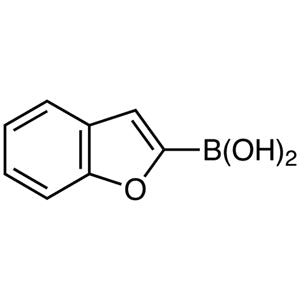
- TCI B2978 98437-24-2 Benzofuran-2-boronic Acid (contains varying amounts of Anhydride)
- TCI P2282 867044-33-5 4-(2-Phenyl-1H-benzimidazol-1-yl)phenylboronic Acid (contains varying amounts of Anhydride)
- Suzuki-Miyaura cross-coupling: acts as the nucleophilic boron partner that transfers the dibenzothiophene fragment to an aryl halide, forming a robust biaryl carbon-carbon bond under palladium catalysis.
- OLED material synthesis: introduces a dibenzothiophene unit whose high triplet energy and thermal stability make it a preferred building block for host and charge-transport materials.
- Hole-transport layer development: the electron-rich tricyclic core imparts good hole-transporting character, so the reagent is useful when constructing molecules intended for hole-transporting functions.
- Functional aromatic scaffold construction: allows direct, efficient attachment of a rigid sulfur-containing tricycle onto larger conjugated frameworks without multi-step protection or functional group manipulation.
- Structure-property studies: substitution at the 4-position adjacent to sulfur gives distinctive geometry, letting researchers examine how substitution pattern affects molecular shape and solid-state packing.
| Brand | TCI |
|---|---|
| CAS number | 108847-20-7 |
| Molecular formula | — |
| Purity | — |
| Category | Chemistry > Organometallic Reagents > Organoboron [Organometallic Reagents] |
| Pack sizes | available in standard TCI catalogue pack sizes; please confirm the required size when ordering |
| Physical form | — |
| Storage | keep tightly closed in a cool, dry place, protected from moisture |
- Composition note: contains varying amounts of the corresponding boroxine anhydride
Store the reagent in its original tightly closed container in a cool, dry, well-ventilated chemical store, away from moisture and sources of ignition. Aromatic boronic acids absorb water and undergo further dehydration to the boroxine on standing, so the container should be closed promptly after each use and, where practicable, kept under an inert atmosphere. Weigh the solid in a fume hood using clean, dry spatulas and glassware. Wear a laboratory coat, safety glasses, and chemically resistant gloves. Because the anhydride content varies, verify stoichiometry before use and consult the manufacturer's safety data sheet for full handling guidance.
—
Produk Terkait
-
Benzo[b]thiophene-3-boronicAcid(containsvaryingamountsofAnhydride) TCI B4774
Regular price From Rp 1.220.100,00Regular price -
Benzo[b]thiophene-2-boronicAcid(containsvaryingamountsofAnhydride) TCI B2893
Regular price From Rp 743.400,00Regular price -
4-(4,4,5,5-Tetramethyl-1,3,2-dioxaborolan-2-yl)dibenzothiophene TCI T3236
Regular price From Rp 1.220.100,00Regular price -
Thieno[3,2-b]thiophene-2-boronicAcid(containsvaryingamountsofAnhydride) TCI T2621
Regular price Rp 5.830.650,00Regular price -
Benzofuran-2-boronicAcid(containsvaryingamountsofAnhydride) TCI B2978
Regular price Rp 1.035.300,00Regular price -
4-(2-Phenyl-1H-benzimidazol-1-yl)phenylboronicAcid(containsvaryingamountsofAnhydride) TCI P2282
Regular price Rp 2.625.000,00Regular price -
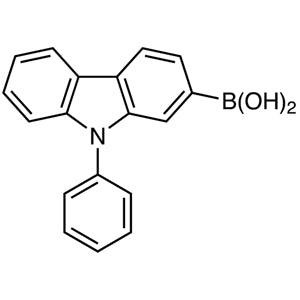
9-Phenylcarbazole-2-boronicAcid(containsvaryingamountsofAnhydride) TCI P2169
Regular price From Rp 477.750,00Regular price -
4-(1-Phenyl-1H-benzimidazol-2-yl)phenylboronicAcid(containsvaryingamountsofAnhydride) TCI P2158
Regular price From Rp 1.298.850,00Regular price
![113893-08-6 Benzo[b]thiophene-3-boronic Acid (contains varying amounts of Anhydride) - AMI Scientific](http://amiscientific.com/cdn/shop/files/TCI2510B4774_65b85fee-ce4d-45b9-ad87-4962d8f3452c.jpg?v=1767853515&width=533)
![98437-23-1 Benzo[b]thiophene-2-boronic Acid (contains varying amounts of Anhydride) - AMI Scientific](http://amiscientific.com/cdn/shop/files/TCI2510B2893_29d53da9-04a5-422a-acac-439fc05f1bb6.jpg?v=1767339122&width=533)

![160032-40-6 Thieno[3,2-b]thiophene-2-boronic Acid (contains varying amounts of Anhydride) - AMI Scientific](http://amiscientific.com/cdn/shop/files/TCI2510T2621.jpg?v=1768206488&width=533)