

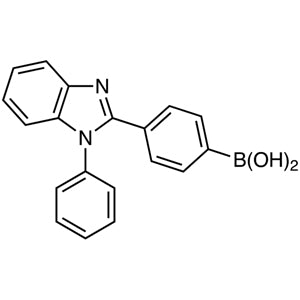
4-(1-Phenyl-1H-benzimidazol-2-yl)phenylboronic Acid is a specialized organic compound widely used in laboratory settings for its unique reactivity and structural versatility. This compound plays a crucial role in various organic reactions, particularly in the synthesis of complex molecules containing boron. Its application is especially prominent in coupling reactions such as the Suzuki-Miyaura reaction, which is essential for the development of heterocyclic compounds and organic materials. Due to its ability to interact with transition metals and ligands, it is a valuable reagent in both organic and organometallic chemistry research.
The compound's reactivity is further enhanced by the presence of varying amounts of anhydride, which influences its behavior in different reaction conditions. This characteristic allows for flexible use in a wide range of synthetic pathways. Its stability under controlled conditions and its ability to participate in catalytic processes make it a preferred choice for researchers aiming for precise and efficient chemical synthesis. The compound's chemical properties ensure its reliability in both academic and industrial laboratory environments.
In Indonesian laboratories, this compound is commonly used in organic chemistry research, particularly in the development of new materials and the synthesis of complex organic compounds. It is frequently employed in academic and research institutions to support advanced chemical studies and innovation in the field of organic synthesis. Its versatility and effectiveness make it a key component in the toolkit of chemists working on complex molecular structures.
- Used in organic synthesis for creating complex heterocyclic compounds due to its reactivity and structural compatibility.
- Applied in Suzuki-Miyaura coupling reactions to form carbon-carbon bonds efficiently in organic material development.
- Utilized in organometallic research for its ability to interact with transition metals and ligands in catalytic processes.
- Employed in the development of new chemical materials due to its versatility in forming stable and reactive intermediates.
- Integrated into research projects requiring precise chemical synthesis for pharmaceutical and industrial applications.
| Brand | TCI |
|---|---|
| CAS number | 952514-79-3 |
| Molecular formula | — |
| Purity | — |
| Category | Chemistry > Organometallic Reagents > Organoboron [Organometallic Reagents] |
| Pack sizes | As per supplier specifications |
| Physical form | Solid or powder (as per product description) |
| Storage | Store in a cool, dry place away from moisture and direct sunlight |
This compound should be stored in a cool, dry environment to maintain its chemical stability and reactivity. It is recommended to use airtight containers to prevent exposure to moisture and air, which may affect its performance in reactions. Due to its potential reactivity, it should be handled with care in a well-ventilated laboratory setting. Proper personal protective equipment, such as gloves and safety goggles, should be worn during handling to ensure safety. The compound should not be stored near incompatible materials or in areas with high humidity. Regular monitoring of storage conditions is advised to ensure optimal performance and safety in laboratory use.
—