

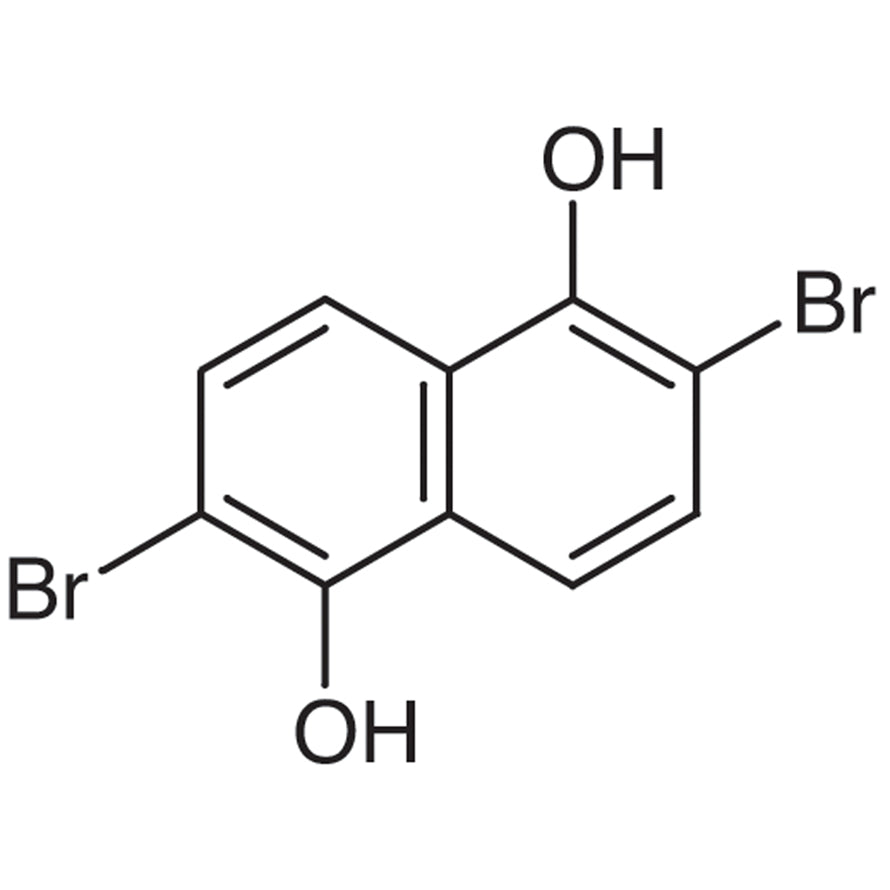
TCI D2593 2,6-Dibromo-1,5-dihydroxynaphthalene is a naphthalene-based building block that carries two hydroxyl groups together with two bromine atoms at defined positions on the fused bicyclic ring system. The naphthalene framework is a rigid, planar and extended aromatic structure that is frequently used as a core for constructing molecules with specialised optical, electronic or structural properties. Because four substituents sit at ordered positions on this core, the compound acts as a branching point in synthesis — a starting material that researchers in organic chemistry and materials science laboratories can develop in several different directions from a single scaffold.
The property that makes this material sought after is the combination of two reactive site types with genuinely different characters. The bromine atoms on the aromatic ring are leaving groups well suited to palladium-catalysed cross-coupling reactions, allowing researchers to install additional aromatic rings, alkenyl groups or alkynyl groups using well-established procedures. The hydroxyl groups, meanwhile, can be alkylated, acylated or converted into triflates, and at the same time act as hydrogen-bond donors. The extended naphthalene aromatic system also contributes light-absorbing behaviour and structural rigidity to whatever architecture is built around it.
In Indonesian laboratories this type of building block is typically held as a starting material for synthetic route development rather than as a routine bulk reagent. It suits university research groups, materials chemistry laboratories and R&D units that prepare functionalised aromatic targets in small to moderate quantities, where a single scaffold offering two distinct handles reduces the number of separate intermediates that must be sourced or prepared in-house before a target molecule can be assembled.
Related TCI products
- TCI D0597 135-53-5 Sodium 6,7-Dihydroxynaphthalene-2-sulfonate
- TCI D4669 96965-79-6 3,6-Dibromo-2,7-dihydroxynaphthalene
- TCI D4668 132178-78-0 1,5-Dibromo-2,6-dihydroxynaphthalene
- TCI D5448 132717-37-4 2,7-Dibromo-9-phenyl-9H-fluoren-9-ol
- TCI D5323 15969-09-2 2,4-Dibromo-6-nitrophenol
- TCI D5093 13979-81-2 3,5-Dibromo-p-cresol
- Palladium-catalysed cross-coupling chemistry — the two aryl bromide positions serve as established leaving groups for installing additional aromatic rings, alkenyl or alkynyl fragments onto the naphthalene core.
- Synthesis of extended aromatic and conjugated systems — the rigid, planar naphthalene framework provides a light-absorbing core suitable for building molecules with tailored optical and electronic behaviour.
- Hydroxyl group derivatisation — the two phenolic positions can be alkylated or acylated, allowing researchers to adjust solubility, protect reactive sites, or introduce further functional chains.
- Triflate intermediate preparation — converting the hydroxyl groups into triflates creates a second family of coupling-ready sites, so all four substituent positions become synthetically addressable.
- Materials chemistry scaffold development — the ordered four-substituent arrangement makes this a branching node for divergent synthetic routes toward structurally defined functional materials and hydrogen-bonding architectures.
| Brand | TCI (Tokyo Chemical Industry) |
|---|---|
| CAS number | 84-59-3 |
| Molecular formula | — |
| Purity | — |
| Category | Chemistry > Building Blocks > Non-Heterocyclic Building Blocks |
| Pack sizes | research and laboratory-scale packs; available sizes follow the manufacturer's current catalogue listing |
| Physical form | — |
| Storage | keep in the tightly closed original container under the conditions stated on the manufacturer's label and safety data sheet |
- Chemical name: 2,6-Dibromo-1,5-dihydroxynaphthalene
Store the material in its tightly closed original container in a cool, dry and well-ventilated area, away from direct sunlight, heat sources and incompatible chemicals. Keep the container sealed between uses to limit exposure to moisture and air, and return it promptly to designated chemical storage. Handle the substance in a fume hood using appropriate personal protective equipment, including safety glasses, gloves and a laboratory coat, and avoid generating or inhaling dust when weighing out portions. Use clean, dry spatulas and glassware to prevent contamination of the remaining stock. Always consult the manufacturer's safety data sheet before use, and follow institutional procedures for labelling, spill response and chemical waste disposal.
—
Produk Terkait
-
Sodium6,7-Dihydroxynaphthalene-2-sulfonate TCI D0597
Regular price From Rp 1.008.000,00Regular price -
3,6-Dibromo-2,7-dihydroxynaphthalene TCI D4669
Regular price From Rp 3.870.300,00Regular price -
1,5-Dibromo-2,6-dihydroxynaphthalene TCI D4668
Regular price From Rp 4.929.750,00Regular price -
2,7-Dibromo-9-phenyl-9H-fluoren-9-ol TCI D5448
Regular price From Rp 1.749.300,00Regular price -
2,4-Dibromo-6-nitrophenol TCI D5323
Regular price Rp 1.881.600,00Regular price -
3,5-Dibromo-p-cresol TCI D5093
Regular price Rp 1.458.450,00Regular price -
1,2-Dibromo-4,5-dimethoxybenzene TCI D5019
Regular price From Rp 1.431.150,00Regular price -
3',5'-Dibromo-2'-hydroxyacetophenone TCI D4637
Regular price Rp 955.500,00Regular price


