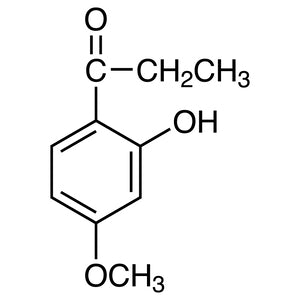
2',4'-Dihydroxypropiophenone (TCI D2694) is an aromatic ketone derived from resorcinol. Its benzene ring has two hydroxyl groups, at the 2' and 4' positions, and a propanoyl group. The compound is classed as a non-heterocyclic building block and is often used as a starting material for more complex phenolic compounds. Hydroxyaryl ketones like this one are a common scaffold in natural product chemistry. For that reason the compound is widely used to synthesize chalcones, chromones, flavonoids and related derivatives of interest to pharmaceutical and cosmetic research.
Chemists choose this compound because its functional groups sit in very useful positions. The hydroxyl group ortho to the carbonyl forms an intramolecular hydrogen bond that stabilizes the molecule. The same position also allows cyclization reactions that build chromone or chromanone frameworks. The hydroxyl group at the 4' position is easier to alkylate or acylate selectively, so researchers can change one side of the molecule without disturbing the other. The ethyl ketone group provides an alpha carbon that can take part in condensation reactions. Together, these features make the compound flexible for stepwise synthesis and for preparing series of analogues.
In Indonesian laboratories, this building block suits university organic chemistry groups, natural product research teams and pharmaceutical development laboratories. They can use it to build phenolic target molecules and to study structure–activity relationships. It also works well in teaching and thesis research on chalcone and flavonoid synthesis, where its well-defined reactive sites help show selective functionalization. Researchers who explore new compounds for pharmaceutical or cosmetic applications can use it as a dependable starting point for analogue libraries.
Related TCI products
- Chalcone synthesis: the alpha carbon of the ethyl ketone group can undergo condensation reactions, so the compound is a practical starting material for hydroxylated chalcone-type structures.
- Chromone and chromanone construction: the hydroxyl group ortho to the carbonyl allows cyclization reactions, giving chemists direct access to these oxygen-containing ring frameworks.
- Flavonoid and natural product analogue research: the hydroxyaryl ketone scaffold is common in natural products, so the compound suits synthetic routes toward flavonoid-like target molecules.
- Selective functionalization studies: the 4' hydroxyl group can be alkylated or acylated selectively, so researchers can modify one side of the molecule while the rest stays unchanged.
- Analogue series for pharmaceutical and cosmetic research: its several distinct reactive sites support stepwise synthesis, which helps when preparing related derivatives for screening and structure–activity work.
| Brand | TCI |
|---|---|
| CAS number | 5792-36-9 |
| Molecular formula | — |
| Purity | — |
| Category | Chemistry > Building Blocks > Non-Heterocyclic Building Blocks |
| Pack sizes | as listed on the product page; see the TCI documentation for available options |
| Physical form | see the TCI product label and Safety Data Sheet |
| Storage | — |
- Product code: D2694
Keep 2',4'-Dihydroxypropiophenone in its original, tightly sealed container in a cool, dry, well-ventilated area, away from direct sunlight, heat sources and incompatible substances such as strong oxidizing agents. Close the container promptly after each use to limit exposure to moisture and air. Follow any specific storage temperature printed on the TCI label. Handle the material in a fume hood or a well-ventilated area, and wear suitable gloves, safety glasses and a laboratory coat. Avoid breathing dust and avoid contact with skin and eyes. Read the Safety Data Sheet before use, and dispose of waste according to institutional and local regulations.
—
Produk Terkait
-
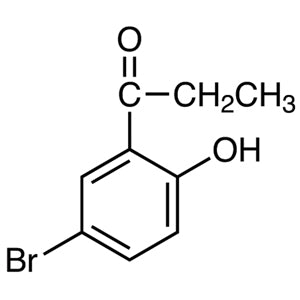
5'-Bromo-2'-hydroxypropiophenone TCI B4769
Regular price From Rp 1.037.000,00Regular priceRp 721.000,00Sale price From Rp 1.037.000,00 -
2',4',6'-Trihydroxypropiophenone TCI T0887
Regular price Rp 3.397.000,00Regular priceRp 2.327.000,00Sale price Rp 3.397.000,00 -
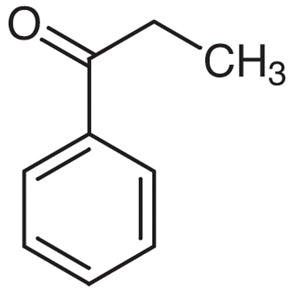
Propiophenone TCI P0519
Regular price From Rp 598.000,00Regular priceRp 406.000,00Sale price From Rp 598.000,00 -
4'-Hydroxypropiophenone TCI H0299
Regular price From Rp 595.000,00Regular priceRp 421.000,00Sale price From Rp 595.000,00 -
2'-Hydroxypropiophenone TCI H0298
Regular price Rp 648.000,00Regular priceRp 456.000,00Sale price Rp 648.000,00 -
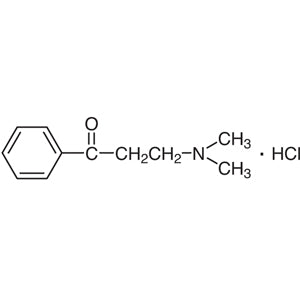
3-(Dimethylamino)propiophenoneHydrochloride TCI D2400
Regular price Rp 1.479.000,00Regular priceRp 1.006.000,00Sale price Rp 1.479.000,00 -
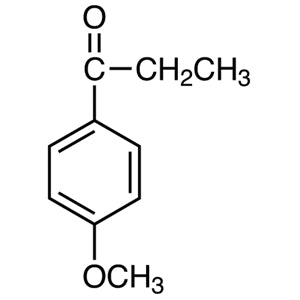
4'-Methoxypropiophenone TCI M1719
Regular price Rp 1.529.000,00Regular priceRp 1.056.000,00Sale price Rp 1.529.000,00 -
2'-Hydroxy-4'-methoxypropiophenone TCI H1207
Regular price Rp 2.230.000,00Regular priceRp 1.533.000,00Sale price Rp 2.230.000,00