

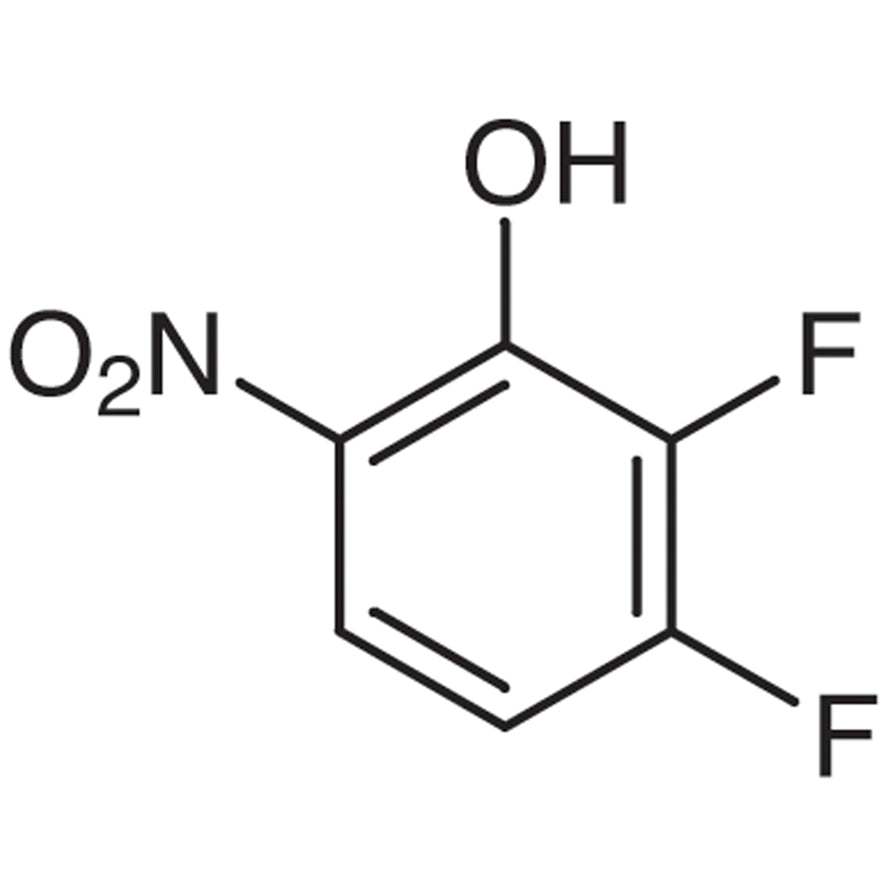
TCI D2705 2,3-Difluoro-6-nitrophenol is a synthesis chemical supplied by TCI and classified as a fluorinated building block. The molecule carries three different types of functional groups on a single benzene ring at the same time: a phenolic hydroxyl group, a nitro group, and two adjacent fluorine atoms. This density of functional groups makes it a highly versatile starting material in synthesis laboratories. Its role is to provide an aromatic scaffold that is ready to be modified step by step toward oxygen- and nitrogen-containing heterocyclic compounds, aminophenol derivatives, and other fluorinated target molecules.
The property that makes this compound a preferred choice is the combination of complementary reactivity between its functional groups. The nitro group withdraws electrons and activates the fluorine atoms toward nucleophilic aromatic substitution, so one of the fluorine positions can be replaced in a directed manner by amines, alkoxides, or thiolates. The phenolic hydroxyl group can be alkylated, acylated, or used as an internal nucleophile to close a heterocyclic ring. Once the scaffold has been formed, the nitro group can be reduced to an amino group, which opens routes toward benzoxazoles, benzimidazoles, and other condensed ring systems.
In Indonesian laboratories, this building block is typically used in university and institutional research groups, as well as in industrial R&D units working on fluorinated organic synthesis. It is normally handled at the milligram-to-gram scale for exploratory route development, multi-step scaffold construction, and the preparation of intermediates that are later carried forward to larger batches. Because it enables several distinct transformations from a single starting material, it suits laboratories that need flexibility from a limited chemical inventory.
TCI brochures (PDF)
- Fluorination Reagents, Fluorinated Building Blocks 2026-03-18 · p. 28
- Nucleophilic aromatic substitution studies: the electron-withdrawing nitro group activates the adjacent fluorine positions, allowing amines, alkoxides, or thiolates to displace fluorine in a controlled and directed manner.
- Synthesis of oxygen- and nitrogen-containing heterocycles: the phenolic hydroxyl group can act as an internal nucleophile to close a ring, giving access to heterocyclic scaffolds from a single precursor.
- Preparation of aminophenol derivatives: reduction of the nitro group to an amino function converts the compound into a difluorinated aminophenol framework for further derivatization work.
- Benzoxazole and benzimidazole construction: the amino group generated after nitro reduction, combined with the neighbouring hydroxyl, supports cyclization into condensed benzofused ring systems.
- Fluorinated target molecule development: the two adjacent fluorine atoms are retained through many transformations, making this a practical entry point for building other fluorinated molecules.
| Brand | TCI (Tokyo Chemical Industry) |
|---|---|
| CAS number | 82419-26-9 |
| Molecular formula | — |
| Purity | — |
| Category | Chemistry > Building Blocks > Fluorinated Building Blocks |
| Pack sizes | available in standard TCI research-scale packaging; please confirm the pack size when ordering |
| Physical form | — |
| Storage | keep in the original tightly closed container as indicated on the manufacturer label |
- Catalogue number: D2705
Store the container tightly closed in a cool, dry, well-ventilated area away from heat, ignition sources, and incompatible materials such as strong bases and strong reducing agents. Keep the material in its original manufacturer container, or in a chemically compatible tightly sealed amber glass container if transfer is required, and keep it clearly labelled. Handle only in a functioning fume hood while wearing safety glasses, chemical-resistant gloves, and a laboratory coat. Nitroaromatic phenols should be treated as skin, eye, and respiratory irritants, so avoid dust formation, avoid direct contact and inhalation, and wash hands thoroughly after use. Collect all residues and contaminated consumables as designated chemical waste, and consult the manufacturer safety data sheet before first use.
—
Produk Terkait
-
3-Fluoro-2-nitrophenol TCI F0947
Regular price From Rp 664.650,00Regular price -
2-Fluoro-6-nitrophenol TCI F0623
Regular price From Rp 584.850,00Regular price -
2-Fluoro-4-nitrophenol TCI F0381
Regular price From Rp 1.458.450,00Regular price -
4-Fluoro-2-nitrophenol TCI F0367
Regular price From Rp 823.200,00Regular price -
3-Fluoro-4-nitrophenol TCI F0348
Regular price Rp 3.843.000,00Regular price -
5-Fluoro-2-nitrophenol TCI F0224
Regular price Rp 1.485.750,00Regular price -
2-Chloro-4-fluoro-5-nitrophenol TCI C2616
Regular price From Rp 6.253.800,00Regular price -
5-Bromo-1,3-difluoro-2-(trifluoromethoxy)benzene TCI B5057
Regular price From Rp 1.087.800,00Regular price


