

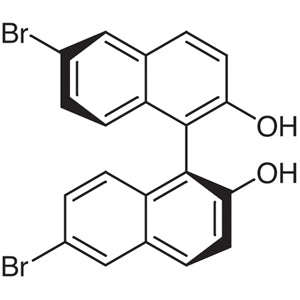
TCI D2730 (S)-(+)-6,6'-Dibromo-1,1'-bi-2-naphthol is the enantiomeric counterpart of the brominated BINOL series and a key reagent in asymmetric synthesis. The molecule consists of two naphthol units joined at the 1,1' positions, so rotation between the rings is hindered and a stable axial chirality is maintained at ordinary laboratory working temperatures. The two opposing hydroxyl groups form a chiral pocket capable of binding metals or acting as an organocatalyst scaffold, while the two bromine atoms at the 6 and 6' positions open the way to further structural elaboration.
The characteristic that leads researchers to select this material is its availability as a single enantiomer of (S) configuration, which allows the direction of chiral induction in a reaction to be reversed without altering any other condition. Comparing results obtained with the (R) and (S) series is the most direct way to demonstrate that the selectivity of a reaction is genuinely controlled by the catalyst. The bromine substituents lower the electron density of the aromatic framework, influencing the acidity of phosphate derivatives while also providing reactive sites for cross-coupling. The rigid binaphthyl backbone keeps the geometry of the chiral pocket consistent.
In Indonesian laboratories, this reagent is typically used in university and institutional research groups working on asymmetric catalysis, where the (S) enantiomer is ordered alongside the (R) form so that both directions of chiral induction can be examined in the same study. It is handled in synthetic organic chemistry laboratories as a starting scaffold for preparing chiral ligands and organocatalysts, and it serves method-development work where enantioselectivity must be established with confidence rather than assumed.
TCI brochures (PDF)
- Asymmetric Organocatalysts 2025-06-12 · p. 9
- Asymmetric Synthesis 2026-03-18 · p. 3
Related TCI products
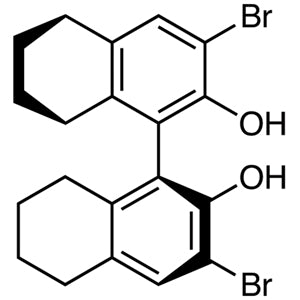
- TCI D5107 765278-73-7 (S)-(-)-3,3'-Dibromo-5,5',6,6',7,7',8,8'-octahydro-1,1'-bi-2-naphthol
- TCI D4418 65355-08-0 (R)-(+)-3,3'-Dibromo-5,5',6,6',7,7',8,8'-octahydro-1,1'-bi-2-naphthol
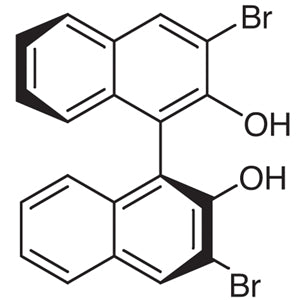
- TCI D2811 119707-74-3 (S)-3,3'-Dibromo-1,1'-bi-2-naphthol
- TCI D2810 111795-43-8 (R)-3,3'-Dibromo-1,1'-bi-2-naphthol
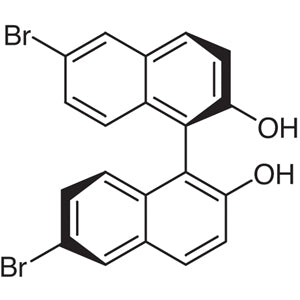
- TCI D2729 65283-60-5 (R)-(-)-6,6'-Dibromo-1,1'-bi-2-naphthol
- TCI B2048 93379-49-8 (+)-4,5-Bis[hydroxy(diphenyl)methyl]-2,2-dimethyl-1,3-dioxolane
- Chiral ligand synthesis: the two hydroxyl groups form a defined chiral pocket that binds metal centres, making this compound a direct precursor for ligands used in enantioselective transformations.
- Organocatalyst preparation: the rigid binaphthyl backbone serves as a scaffold for chiral phosphate and related organocatalysts, with the bromine substituents tuning the acidity of the derived catalyst.
- Cross-coupling elaboration: bromine atoms at the 6 and 6' positions provide reactive handles for cross-coupling chemistry, allowing systematic extension of the binaphthol core into larger structures.
- Control experiments in asymmetric catalysis: as the single (S) enantiomer, it reverses the direction of chiral induction while every other reaction condition is held unchanged.
- Selectivity verification studies: comparing outcomes between the (R) and (S) series is the most direct demonstration that observed selectivity is genuinely controlled by the catalyst rather than the substrate.
| Brand | TCI |
|---|---|
| CAS number | 80655-81-8 |
| Molecular formula | — |
| Purity | — |
| Category | Chemistry > Asymmetric Synthesis > Chiral Catalysts, Chiral Ligands, Chiral Reagents |
| Pack sizes | available in TCI standard research-scale packaging; please confirm the required pack size when ordering |
| Physical form | — |
| Storage | store in a cool, dry place in a tightly closed original container, protected from light |
- Chemical name: (S)-(+)-6,6'-Dibromo-1,1'-bi-2-naphthol
Keep the material in its original tightly closed container in a cool, dry place away from direct light and moisture, since prolonged exposure to air and light is undesirable for phenolic aromatic compounds. Amber glass or the supplier's original packaging is suitable, and containers should be resealed promptly after each use to preserve enantiomeric integrity. Handle inside a fume hood using gloves, safety glasses, and a laboratory coat, and avoid generating or inhaling dust when weighing. Use clean, dry spatulas to prevent cross-contamination between the (S) and (R) series, label all secondary containers clearly with configuration and CAS number, and consult the manufacturer's safety data sheet before use and disposal.
—
Produk Terkait
-
(S)-(-)-3,3'-Dibromo-5,5',6,6',7,7',8,8'-octahydro-1,1'-bi-2-naphthol TCI D5107
Regular price Rp 2.466.450,00Regular price -
(R)-(+)-3,3'-Dibromo-5,5',6,6',7,7',8,8'-octahydro-1,1'-bi-2-naphthol TCI D4418
Regular price From Rp 3.260.250,00Regular price -
(S)-3,3'-Dibromo-1,1'-bi-2-naphthol TCI D2811
Regular price From Rp 4.213.650,00Regular price -
(R)-3,3'-Dibromo-1,1'-bi-2-naphthol TCI D2810
Regular price From Rp 4.849.950,00Regular price -
(R)-(-)-6,6'-Dibromo-1,1'-bi-2-naphthol TCI D2729
Regular price Rp 4.452.000,00Regular price -
(+)-4,5-Bis[hydroxy(diphenyl)methyl]-2,2-dimethyl-1,3-dioxolane TCI B2048
Regular price From Rp 1.829.100,00Regular price -
N-BenzylcinchonidiniumChloride[ChiralPhase-TransferCatalyst] TCI B1683
Regular price Rp 3.922.800,00Regular price -
(-)-4,5-Bis[hydroxy(diphenyl)methyl]-2,2-dimethyl-1,3-dioxolane TCI B1614
Regular price From Rp 1.087.800,00Regular price


![93379-49-8 (+)-4,5-Bis[hydroxy(diphenyl)methyl]-2,2-dimethyl-1,3-dioxolane - AMI Scientific](http://amiscientific.com/cdn/shop/files/TCI2510B2048_ca66ec29-76e5-43e7-9f7b-9d16d3c27d2d.jpg?v=1767330617&width=533)
![69257-04-1 N-Benzylcinchonidinium Chloride [Chiral Phase-Transfer Catalyst] - AMI Scientific](http://amiscientific.com/cdn/shop/files/TCI2510B1683.jpg?v=1767087605&width=533)
![93379-48-7 (-)-4,5-Bis[hydroxy(diphenyl)methyl]-2,2-dimethyl-1,3-dioxolane - AMI Scientific](http://amiscientific.com/cdn/shop/files/TCI2510B1614_834fd19e-0321-4868-b028-1261dabc7fec.jpg?v=1767327573&width=533)