

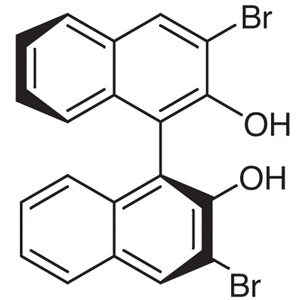
(S)-3,3'-Dibromo-1,1'-bi-2-naphthol is a chiral compound widely used in asymmetric synthesis to produce molecules with defined stereochemistry. This material plays a crucial role in organic chemistry laboratories, particularly in the development of pharmaceuticals, industrial chemicals, and bioactive compounds. Its unique structure allows it to act as a chiral reagent or catalyst, enabling precise control over the stereochemical outcome of chemical reactions. In research settings, it is essential for creating enantiomerically pure products, which are vital in drug development and advanced chemical synthesis. The compound's ability to influence reaction pathways makes it a valuable tool for scientists aiming to achieve high selectivity and yield in complex synthetic processes.
The compound's chiral nature and structural complexity are key factors that make it a preferred choice in asymmetric synthesis. Its ability to interact selectively with other reactants ensures that only the desired stereoisomer is formed, reducing the need for additional purification steps. This characteristic is especially important in the production of pharmaceuticals, where the stereochemistry of a molecule can significantly affect its biological activity. Additionally, its stability under various reaction conditions enhances its utility in a wide range of chemical processes. These properties make it a reliable and effective component in both academic and industrial research environments.
In Indonesian laboratories, (S)-3,3'-Dibromo-1,1'-bi-2-naphthol is commonly used in research related to organic chemistry, drug discovery, and materials science. It is frequently employed in academic institutions and research centers to support the development of new compounds and to meet the growing demand for chiral pharmaceuticals. Its application is also seen in the production of specialty chemicals and in studies focused on improving synthetic efficiency and product purity.
TCI brochures (PDF)
- Asymmetric Organocatalysts 2025-06-12 · p. 9
- Asymmetric Synthesis 2026-03-18 · p. 3
Related TCI products
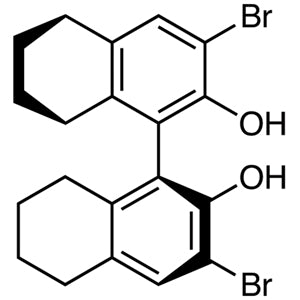
- TCI D5107 765278-73-7 (S)-(-)-3,3'-Dibromo-5,5',6,6',7,7',8,8'-octahydro-1,1'-bi-2-naphthol
- TCI D4418 65355-08-0 (R)-(+)-3,3'-Dibromo-5,5',6,6',7,7',8,8'-octahydro-1,1'-bi-2-naphthol
- TCI D2810 111795-43-8 (R)-3,3'-Dibromo-1,1'-bi-2-naphthol
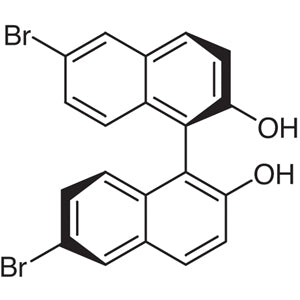
- TCI D2730 80655-81-8 (S)-(+)-6,6'-Dibromo-1,1'-bi-2-naphthol
- TCI D2729 65283-60-5 (R)-(-)-6,6'-Dibromo-1,1'-bi-2-naphthol
- TCI B2048 93379-49-8 (+)-4,5-Bis[hydroxy(diphenyl)methyl]-2,2-dimethyl-1,3-dioxolane
- Asymmetric synthesis is a key application where this compound is used to produce enantiomerically pure compounds, which are essential in pharmaceutical development.
- Chiral catalyst development benefits from this material's ability to influence reaction stereochemistry, making it ideal for creating new catalytic systems.
- Organic chemistry research utilizes this compound to explore stereochemical control in complex synthetic pathways, enhancing the efficiency of chemical processes.
- Drug discovery projects rely on this reagent to synthesize bioactive molecules with specific stereochemical configurations, improving the effectiveness of potential therapeutic agents.
- Industrial chemical production uses this compound to create specialty chemicals with defined chiral properties, meeting the needs of various manufacturing sectors.
| Brand | TCI |
|---|---|
| CAS number | 119707-74-3 |
| Molecular formula | — |
| Purity | — |
| Category | Chemistry > Asymmetric Synthesis > Chiral Catalysts, Chiral Ligands, Chiral Reagents |
| Pack sizes | Available in various quantities as per supplier specifications |
| Physical form | Solid (as per standard product description) |
| Storage | Store in a cool, dry place away from light and moisture |
This compound should be stored in a cool, dry environment, away from direct light and moisture to maintain its stability and effectiveness. It is recommended to use airtight containers to prevent exposure to air and humidity, which could affect its chemical integrity. In laboratory settings, proper personal protective equipment, such as gloves and safety goggles, should be worn when handling the material to ensure safety. The compound is not flammable, but it should be handled with care to avoid contamination. It is important to store it in a well-ventilated area and keep it away from incompatible substances to prevent any adverse reactions. Regular monitoring of storage conditions ensures the compound remains in optimal condition for use in research applications.
—
Produk Terkait
-
(S)-(-)-3,3'-Dibromo-5,5',6,6',7,7',8,8'-octahydro-1,1'-bi-2-naphthol TCI D5107
Regular price Rp 2.466.450,00Regular price -
(R)-(+)-3,3'-Dibromo-5,5',6,6',7,7',8,8'-octahydro-1,1'-bi-2-naphthol TCI D4418
Regular price From Rp 3.260.250,00Regular price -
(R)-3,3'-Dibromo-1,1'-bi-2-naphthol TCI D2810
Regular price From Rp 4.849.950,00Regular price -
(S)-(+)-6,6'-Dibromo-1,1'-bi-2-naphthol TCI D2730
Regular price From Rp 3.630.900,00Regular price -
(R)-(-)-6,6'-Dibromo-1,1'-bi-2-naphthol TCI D2729
Regular price Rp 4.452.000,00Regular price -
(+)-4,5-Bis[hydroxy(diphenyl)methyl]-2,2-dimethyl-1,3-dioxolane TCI B2048
Regular price From Rp 1.829.100,00Regular price -
N-BenzylcinchonidiniumChloride[ChiralPhase-TransferCatalyst] TCI B1683
Regular price Rp 3.922.800,00Regular price -
(-)-4,5-Bis[hydroxy(diphenyl)methyl]-2,2-dimethyl-1,3-dioxolane TCI B1614
Regular price From Rp 1.087.800,00Regular price


![93379-49-8 (+)-4,5-Bis[hydroxy(diphenyl)methyl]-2,2-dimethyl-1,3-dioxolane - AMI Scientific](http://amiscientific.com/cdn/shop/files/TCI2510B2048_ca66ec29-76e5-43e7-9f7b-9d16d3c27d2d.jpg?v=1767330617&width=533)
![69257-04-1 N-Benzylcinchonidinium Chloride [Chiral Phase-Transfer Catalyst] - AMI Scientific](http://amiscientific.com/cdn/shop/files/TCI2510B1683.jpg?v=1767087605&width=533)
![93379-48-7 (-)-4,5-Bis[hydroxy(diphenyl)methyl]-2,2-dimethyl-1,3-dioxolane - AMI Scientific](http://amiscientific.com/cdn/shop/files/TCI2510B1614_834fd19e-0321-4868-b028-1261dabc7fec.jpg?v=1767327573&width=533)