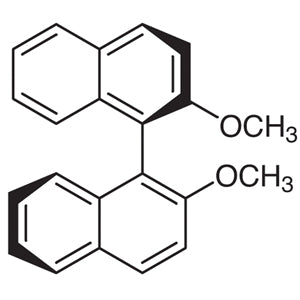
TCI D2747 (R)-2,2'-Dimethoxy-1,1'-binaphthyl, CAS 35294-28-1, is the dimethyl ether of (R)-BINOL, an axially chiral compound that forms one of the most important scaffolds in asymmetric chemistry. With both hydroxyl groups of the BINOL framework protected as methyl ethers, the compound becomes far more resistant to oxidation and to strongly basic conditions, while still retaining the stable binaphthyl chiral axis. In the laboratory, this material is most often used as a starting material for installing substituents at the 3 and 3' positions of the binaphthyl skeleton, because the methoxy groups act as highly effective directed metalation groups.
The characteristic that makes this compound the preferred choice is its role as a gateway to advanced-generation chiral ligands. Directed lithiation with an organolithium base, followed by reaction with an electrophile, allows formyl, boronate, silyl, phosphine, or halogen groups to be installed at the 3,3' positions — the positions widely recognized as the most decisive in defining the steric environment of a chiral catalyst. Once the modification is complete, the methyl ether groups can be cleaved back to the diol using common demethylation reagents, so that the protection–functionalization–deprotection sequence proceeds smoothly. The rigidity of the biaryl framework also keeps the rotational barrier high, so the chiral information of the axis is preserved throughout the synthetic sequence.
In Indonesian laboratories, this material is typically found in university and institutional research groups working on asymmetric synthesis, ligand design, and organocatalysis, as well as in pharmaceutical and fine-chemical development work where single-enantiomer products are required. It is generally handled at the bench scale on a Schlenk line or in a glovebox, under an inert atmosphere with dry solvents, as part of multi-step routes toward custom chiral ligands rather than being used directly as a catalyst.
TCI brochures (PDF)
- Asymmetric Synthesis 2026-03-18 · p. 2
Related TCI products
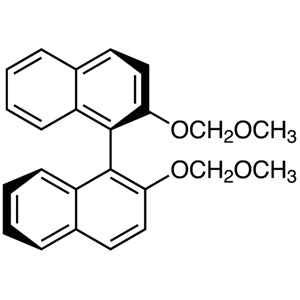
- TCI B3202 173831-50-0 (R)-2,2'-Bis(methoxymethoxy)-1,1'-binaphthyl
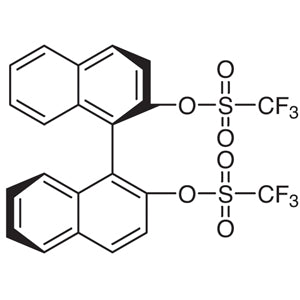
- TCI B2231 128544-05-8 (S)-(+)-1,1'-Binaphthyl-2,2'-diyl Bis(trifluoromethanesulfonate)
- TCI B2230 126613-06-7 (R)-(-)-1,1'-Binaphthyl-2,2'-diyl Bis(trifluoromethanesulfonate)
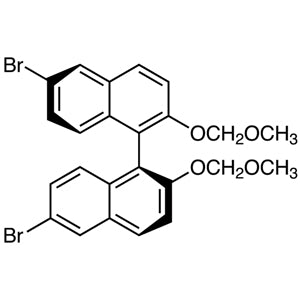
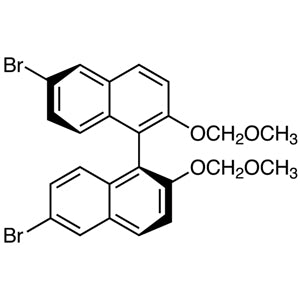
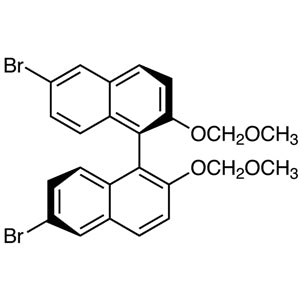
- TCI D4883 211560-97-3 (S)-6,6'-Dibromo-2,2'-bis(methoxymethoxy)-1,1'-binaphthyl
- TCI D4882 179866-74-1 (R)-6,6'-Dibromo-2,2'-bis(methoxymethoxy)-1,1'-binaphthyl
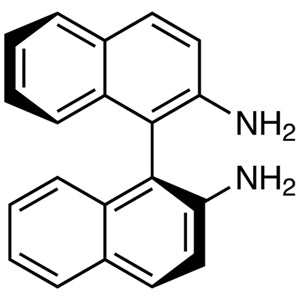
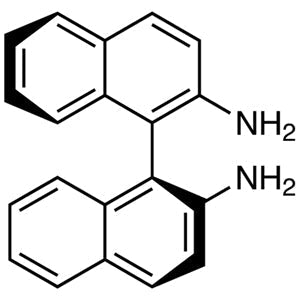
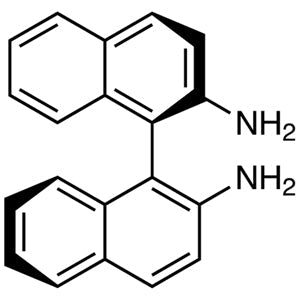
- TCI D3208 18531-95-8 (S)-(-)-1,1'-Binaphthyl-2,2'-diamine
- Chiral ligand synthesis — serves as the protected BINOL platform from which 3,3'-substituted ligands are constructed, giving researchers direct control over the steric pocket of the final catalyst.
- Directed ortho-metalation chemistry — the two methoxy groups coordinate organolithium reagents and direct deprotonation cleanly to the 3,3' positions, making regioselective functionalization reliable and reproducible.
- Preparation of chiral phosphoric acids and organocatalysts — after 3,3' functionalization and demethylation, the recovered diol becomes the backbone for widely used binaphthyl-derived organocatalyst families.
- Asymmetric synthesis method development — the stable, configurationally rigid chiral axis lets researchers study how substituent changes at 3,3' translate into enantioselectivity in a model reaction.
- Protecting-group strategy studies — demonstrates a complete protection, functionalization, and deprotection sequence on a chiral biaryl, useful for teaching and for validating new demethylation conditions.
| Brand | TCI (Tokyo Chemical Industry) |
|---|---|
| CAS number | 35294-28-1 |
| Molecular formula | — |
| Purity | — |
| Category | Chemistry > Asymmetric Synthesis > Chiral Catalysts, Chiral Ligands, Chiral Reagents |
| Pack sizes | available in standard TCI research-scale packaging; please confirm the required size when ordering |
| Physical form | — |
| Storage | store in a cool, dry place in a tightly closed container |
- Catalog number: D2747
Store the container tightly closed in a cool, dry, well-ventilated area away from strong oxidizing agents and sources of ignition, and keep it in the original supplier packaging or in an equivalent tightly sealed amber glass bottle to limit exposure to moisture and light. Because this material is normally used in organolithium chemistry, transfer it under an inert atmosphere and use dry solvents and oven-dried glassware to protect the downstream reaction. Handle in a fume hood with gloves, safety glasses, and a laboratory coat, avoid generating dust, and consult the manufacturer's safety data sheet before use and before disposal of any residues.
—
Produk Terkait
-
(R)-2,2'-Bis(methoxymethoxy)-1,1'-binaphthyl TCI B3202
Regular price From Rp 1.829.100,00Regular price -
(S)-(+)-1,1'-Binaphthyl-2,2'-diylBis(trifluoromethanesulfonate) TCI B2231
Regular price Rp 1.565.550,00Regular price -
(R)-(-)-1,1'-Binaphthyl-2,2'-diylBis(trifluoromethanesulfonate) TCI B2230
Regular price Rp 1.829.100,00Regular price -
(S)-6,6'-Dibromo-2,2'-bis(methoxymethoxy)-1,1'-binaphthyl TCI D4883
Regular price From Rp 2.625.000,00Regular price -
(R)-6,6'-Dibromo-2,2'-bis(methoxymethoxy)-1,1'-binaphthyl TCI D4882
Regular price From Rp 3.551.100,00Regular price -
(S)-(-)-1,1'-Binaphthyl-2,2'-diamine TCI D3208
Regular price Rp 1.724.100,00Regular price -
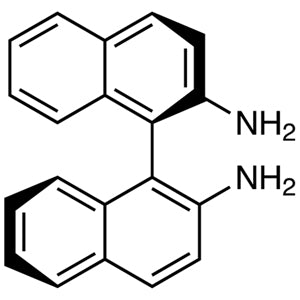
(R)-(+)-1,1'-Binaphthyl-2,2'-diamine TCI D3207
Regular price Rp 1.538.250,00Regular price -
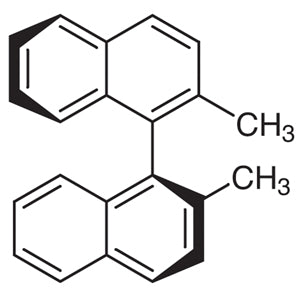
(S)-2,2'-Dimethyl-1,1'-binaphthyl TCI D2838
Regular price From Rp 6.863.850,00Regular price