


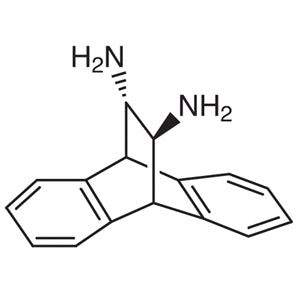
TCI D3445 (11S,12S)-9,10-Dihydro-9,10-ethanoanthracene-11,12-diamine is the enantiomeric counterpart of the bridged anthracene-framework vicinal diamine, carrying the (11S,12S) absolute configuration. As a chiral reagent, its role in the laboratory is to supply a source of stereochemical information that can be transferred onward to a catalyst, a ligand, or a reaction product. Having both enantiomers available separately matters a great deal in asymmetric synthesis research, because investigators need to be able to access both directions of chiral induction in order to produce the opposite enantiomeric product whenever the target compound calls for it.
The most notable property of this material is its tricyclic framework, which possesses essentially no rotational freedom, so the angle and the distance between the two primary amine groups remain fixed. That rigidity reduces the number of catalytic conformations that can form, and in practice it often delivers higher enantiomeric selectivity as well as greater consistency between experimental batches. The two primary amine groups are reactive toward aldehydes, isothiocyanates, acid chlorides, and sulfonyl chlorides, which means a single starting material can be elaborated into a diverse family of catalysts. The aromatic anthracene walls contribute further to the steric environment surrounding the reactive center.
In Indonesian laboratories, this reagent is typically encountered in university and institutional research groups working on asymmetric synthesis, organocatalysis, and ligand design, where the ability to prepare a chiral catalyst in-house from a defined building block is more practical than sourcing each finished catalyst separately. It is generally purchased in small research quantities, handled on the bench scale, and paired with the opposite enantiomer so that both directions of stereochemical induction can be compared within a single study.
TCI brochures (PDF)
- Asymmetric Synthesis 2026-03-18 · p. 6
Related TCI products
- TCI D3444 181139-49-1 (11R,12R)-9,10-Dihydro-9,10-ethanoanthracene-11,12-diamine
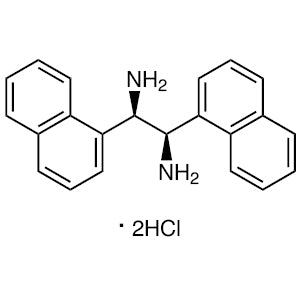
- TCI D5937 1055301-17-1 (1R,2R)-1,2-Di(naphthalen-1-yl)ethane-1,2-diamine Dihydrochloride
- TCI D3809 767291-67-8 (1S,2S)-N,N'-Dimethyl-N,N'-bis(3,3-dimethylbutyl)cyclohexane-1,2-diamine
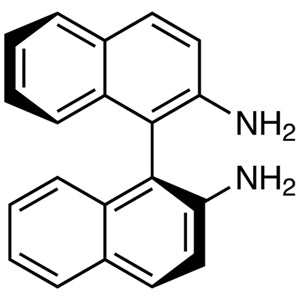
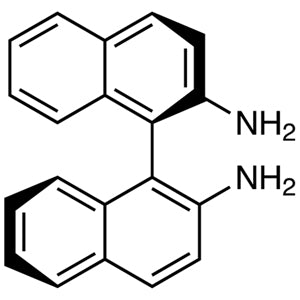
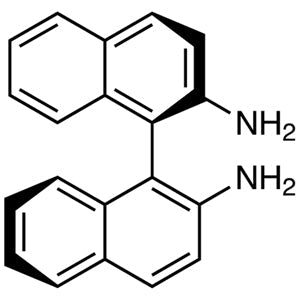
- TCI D3208 18531-95-8 (S)-(-)-1,1'-Binaphthyl-2,2'-diamine
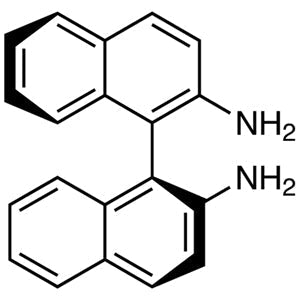
- TCI D3207 18741-85-0 (R)-(+)-1,1'-Binaphthyl-2,2'-diamine
- TCI M1402 175166-49-1 (-)-2,2'-Methylenebis[(3aS,8aR)-3a,8a-dihydro-8H-indeno[1,2-d]oxazole]
- Chiral ligand synthesis: the two primary amine groups condense readily with aldehydes to form diimine and salen-type ligands whose fixed backbone geometry supports reproducible metal coordination.
- Organocatalyst preparation: reaction with isothiocyanates gives thiourea-based organocatalysts, letting one laboratory build a full catalyst series from a single well-defined chiral starting material.
- Asymmetric induction studies: because it is the (11S,12S) enantiomer, it allows researchers to reverse the sense of chiral induction and obtain the opposite enantiomeric product of a target compound.
- Chiral auxiliary and amide derivative work: acylation with acid chlorides installs the rigid anthracene framework directly onto a substrate to control the stereochemical outcome of subsequent steps.
- Sulfonamide-based catalyst development: treatment with sulfonyl chlorides converts the diamine into chiral sulfonamides, exploiting the aromatic anthracene walls that shape the steric environment near the reactive center.
| Brand | TCI |
|---|---|
| CAS number | 138517-66-5 |
| Molecular formula | — |
| Purity | — |
| Category | Chemistry > Asymmetric Synthesis > Chiral Catalysts, Chiral Ligands, Chiral Reagents |
| Pack sizes | available in TCI research-scale packaging; please confirm the currently offered sizes when ordering |
| Physical form | — |
| Storage | store according to the manufacturer's stated conditions on the product label and certificate of analysis |
- Chemical name: (11S,12S)-9,10-Dihydro-9,10-ethanoanthracene-11,12-diamine
Store the container tightly closed in a cool, dry, well-ventilated place away from direct sunlight, moisture, and heat sources, and follow any storage temperature stated by the manufacturer on the label. Primary amines are basic and reactive, so keep the material away from acids, acid chlorides, isothiocyanates, and other reactive electrophiles unless deliberately reacting them, and keep the original amber or opaque supplier container rather than transferring the material unnecessarily. Handle in a fume hood using gloves, safety glasses, and a laboratory coat, weigh out quantities promptly to limit exposure to atmospheric moisture and carbon dioxide, and consult the manufacturer's safety data sheet before first use. Dispose of residues and contaminated consumables through the laboratory's chemical waste stream.
—
Produk Terkait
-
(11R,12R)-9,10-Dihydro-9,10-ethanoanthracene-11,12-diamine TCI D3444
Regular price From Rp 2.995.650,00Regular price -
(1R,2R)-1,2-Di(naphthalen-1-yl)ethane-1,2-diamineDihydrochloride TCI D5937
Regular price Rp 2.491.650,00Regular price -
(1S,2S)-N,N'-Dimethyl-N,N'-bis(3,3-dimethylbutyl)cyclohexane-1,2-diamine TCI D3809
Regular price Rp 4.028.850,00Regular price -
(S)-(-)-1,1'-Binaphthyl-2,2'-diamine TCI D3208
Regular price Rp 1.724.100,00Regular price -
(R)-(+)-1,1'-Binaphthyl-2,2'-diamine TCI D3207
Regular price Rp 1.538.250,00Regular price -
(-)-2,2'-Methylenebis[(3aS,8aR)-3a,8a-dihydro-8H-indeno[1,2-d]oxazole] TCI M1402
Regular price From Rp 955.500,00Regular price -
(+)-2,2'-Methylenebis[(3aR,8aS)-3a,8a-dihydro-8H-indeno[1,2-d]oxazole] TCI M1401
Regular price From Rp 1.008.000,00Regular price -
Triptycene-1,4-diamine TCI T4164
Regular price From Rp 2.174.550,00Regular price


![175166-49-1 (-)-2,2'-Methylenebis[(3aS,8aR)-3a,8a-dihydro-8H-indeno[1,2-d]oxazole] - AMI Scientific](http://amiscientific.com/cdn/shop/files/TCI2510M1402.jpg?v=1767124910&width=533)
![180186-94-1 (+)-2,2'-Methylenebis[(3aR,8aS)-3a,8a-dihydro-8H-indeno[1,2-d]oxazole] - AMI Scientific](http://amiscientific.com/cdn/shop/files/TCI2510M1401.jpg?v=1767124905&width=533)
