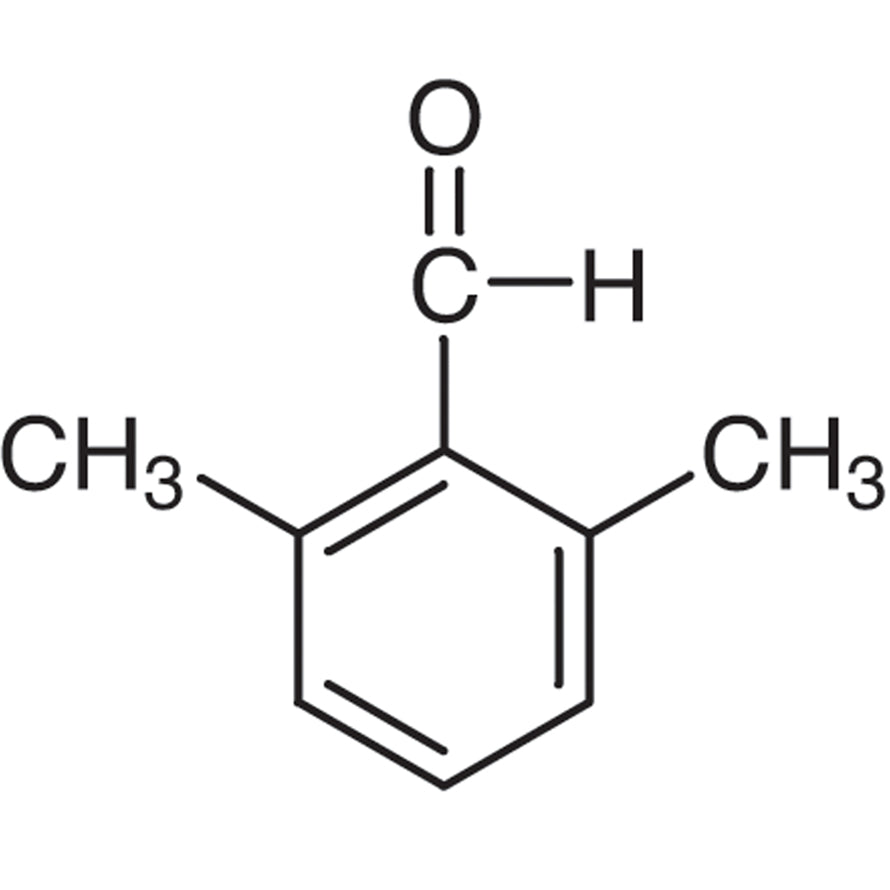
TCI D3681 2,6-Dimethylbenzaldehyde is a non-heterocyclic building block, specifically an aromatic aldehyde carrying two methyl groups that flank the formyl group at both ortho positions. Aromatic aldehydes are among the most versatile reagents in organic synthesis because their carbonyl group readily undergoes nucleophilic addition, condensation, reduction, oxidation, and reductive amination. The role of this compound in the laboratory is to supply a 2,6-dimethylphenyl fragment together with a ready-to-elaborate aldehyde reaction site, which is why it is widely used to construct amines, benzylic alcohols, imines, ligands, and a broad range of target molecular frameworks in organic and medicinal chemistry research.
The distinguishing property that leads chemists to select this reagent is the steric hindrance created by the two methyl groups positioned on either side of the formyl group. This hindrance forces the carbonyl group out of perfect coplanarity with the benzene ring, reduces conjugation, and alters its reactivity pattern compared with ordinary benzaldehyde. As a result, the compound is useful for controlling reaction selectivity, slowing certain side pathways, and building molecules with twisted conformations that are valued in ligand design and materials work. The methyl groups themselves also remain available as part of the final scaffold.
In Indonesian laboratories, this building block is typically stocked by university research groups, medicinal chemistry teams, and industrial R&D units that carry out multi-step organic synthesis. It is normally purchased in research-scale quantities for method development, reaction screening, and the preparation of intermediates rather than for bulk production. Because it is supplied as a catalogue reagent from TCI, it fits well into laboratories that require consistent, well-documented building blocks for reproducible synthetic routes and for teaching advanced organic synthesis practicals.
- Reductive amination and amine synthesis — the aldehyde group condenses with primary or secondary amines and is then reduced, delivering sterically shielded 2,6-dimethylbenzyl amines for library and lead work.
- Imine and Schiff base formation — condensation with amines gives bulky imines whose hindered geometry is often exploited in ligand frameworks and in coordination chemistry studies.
- Benzylic alcohol preparation — controlled reduction of the formyl group provides 2,6-dimethylbenzyl alcohol derivatives useful as intermediates or as protected fragments in longer synthetic sequences.
- Condensation and olefination chemistry — the carbonyl serves as an electrophilic partner in aldol-type, Wittig-type, and related condensations where the ortho methyl groups modulate the reaction outcome.
- Ligand and materials scaffold construction — the twisted, non-coplanar arrangement forced by the flanking methyl groups is deliberately used to build conformationally restricted architectures for design studies.
| Brand | TCI (Tokyo Chemical Industry) |
|---|---|
| CAS number | 1123-56-4 |
| Molecular formula | — |
| Purity | — |
| Category | Chemistry > Building Blocks > Non-Heterocyclic Building Blocks |
| Pack sizes | available in standard TCI research-scale catalogue pack sizes; please confirm the currently offered packaging when ordering |
| Physical form | — |
| Storage | keep in the closed original container under the conditions stated on the manufacturer label and safety data sheet |
- Catalogue number: D3681
Store the reagent in a cool, dry, well-ventilated chemical store away from heat, direct sunlight, ignition sources, and strong oxidising agents, following the specific conditions printed on the manufacturer label and safety data sheet. Keep the material in its tightly closed original container, or in a compatible tightly sealed glass container that is clearly labelled if decanted, and reseal promptly after each use to limit exposure to air and moisture. Handle inside a fume hood using safety glasses, gloves, and a laboratory coat, avoid inhalation of vapour and contact with skin and eyes, and use clean, dry glassware and spatulas when weighing. Segregate incompatible chemicals during storage, keep spill absorbent and eyewash facilities accessible, and dispose of residues and contaminated materials as chemical waste in accordance with institutional procedures. Always read the full safety data sheet before first use.
—
Produk Terkait
-
4-Hydroxy-3,5-dimethylbenzaldehyde TCI H1023
Regular price From Rp 637.350,00Regular price -
3,5-Dimethylbenzaldehyde TCI D3498
Regular price From Rp 1.618.050,00Regular price -
2,3-Dimethylbenzaldehyde TCI D3463
Regular price From Rp 530.250,00Regular price -
3,4-Dimethylbenzaldehyde TCI D3334
Regular price From Rp 928.200,00Regular price -
2,4-Dimethylbenzaldehyde TCI D2392
Regular price From Rp 743.400,00Regular price -
2,4,5-Trimethylbenzaldehyde TCI T1411
Regular price Rp 1.961.400,00Regular price -
2,4,6-Trimethylbenzaldehyde TCI T1368
Regular price Rp 2.147.250,00Regular price -
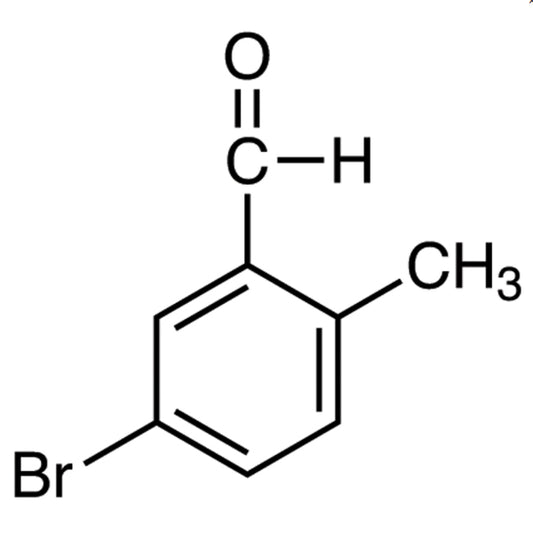
5-Bromo-2-methylbenzaldehyde TCI B5036
Regular price From Rp 2.677.500,00Regular price