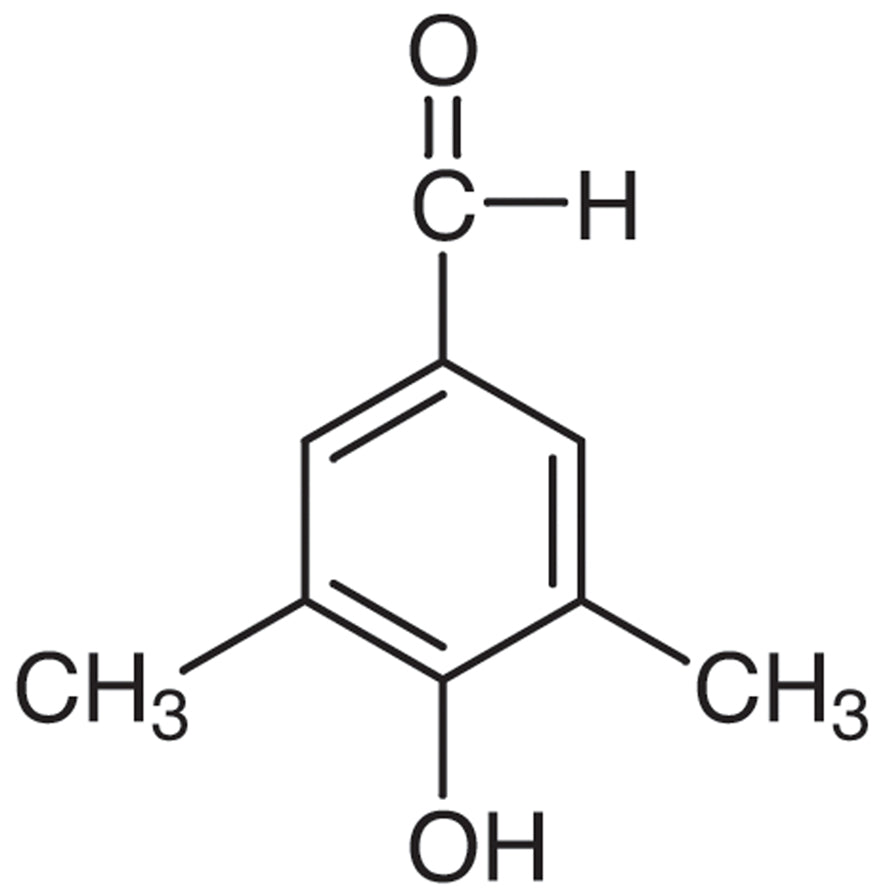
4-Hydroxy-3,5-dimethylbenzaldehyde is a versatile organic compound widely used in laboratory settings for its reactivity and structural versatility. As a building block in synthetic chemistry, it plays a crucial role in the development of complex molecules across various fields. Its aromatic structure, combined with functional groups such as the aldehyde and hydroxyl, allows it to participate in a range of chemical reactions. This makes it an essential tool for researchers working on both academic and industrial projects. Its ability to form stable intermediates under controlled conditions enhances its utility in synthetic pathways.
The compound’s reactivity stems from its functional groups, which enable it to engage in condensation, substitution, and reduction reactions. Its stability under specific conditions, along with its sensitivity to high temperatures and oxidation, makes it a material that requires careful handling. The presence of multiple reactive sites allows for the formation of diverse derivatives, which can be tailored for specific applications. These characteristics make it a preferred choice for chemists seeking to explore new synthetic routes and functional group transformations.
In Indonesian laboratories, 4-Hydroxy-3,5-dimethylbenzaldehyde is commonly used in organic chemistry research, chemical development, and studies on aromatic reactivity. Its availability in solid form and ease of use make it a practical option for both academic and industrial applications. Researchers in Indonesia rely on this compound for its reliability and effectiveness in a variety of experimental setups, contributing to advancements in chemical synthesis and material science.
- Organic synthesis applications benefit from this compound’s reactivity and structural versatility, allowing for the creation of complex molecules.
- Pharmaceutical research utilizes its functional groups to develop new drug compounds through targeted chemical modifications.
- Dye and pigment development leverages its aromatic structure and functional groups to create colorants with specific properties.
- Industrial chemical production incorporates it as a building block for the synthesis of various chemical intermediates.
- Aromatic reactivity studies rely on its ability to participate in a range of chemical reactions, providing insights into molecular behavior.
| Brand | TCI |
|---|---|
| CAS number | 2233-18-3 |
| Molecular formula | — |
| Purity | — |
| Category | Chemistry > Building Blocks > Non-Heterocyclic Building Blocks |
| Pack sizes | Available in various quantities as per standard laboratory supply |
| Physical form | Solid |
| Storage | Store in a cool, dry place away from direct sunlight and oxidizing agents |
This compound should be stored in a cool, dry environment to maintain its stability and prevent degradation. It is recommended to use airtight containers to minimize exposure to moisture and air, which can affect its reactivity. Due to its sensitivity to high temperatures and oxidation, it should be kept away from heat sources and strong oxidizing agents. Laboratory personnel should wear appropriate personal protective equipment when handling the material to ensure safety. Proper labeling and storage conditions are essential to maintain the integrity of the compound and ensure safe usage in experimental settings.
—
Produk Terkait
-
2,6-Dimethylbenzaldehyde TCI D3681
Regular price From Rp 1.696.800,00Regular price -
3,5-Dimethylbenzaldehyde TCI D3498
Regular price From Rp 1.618.050,00Regular price -
2,3-Dimethylbenzaldehyde TCI D3463
Regular price From Rp 530.250,00Regular price -
3,4-Dimethylbenzaldehyde TCI D3334
Regular price From Rp 928.200,00Regular price -
2,4-Dimethylbenzaldehyde TCI D2392
Regular price From Rp 743.400,00Regular price -
2,4,5-Trimethylbenzaldehyde TCI T1411
Regular price Rp 1.961.400,00Regular price -
2,4,6-Trimethylbenzaldehyde TCI T1368
Regular price Rp 2.147.250,00Regular price -
5-Bromo-2-methylbenzaldehyde TCI B5036
Regular price From Rp 2.677.500,00Regular price