

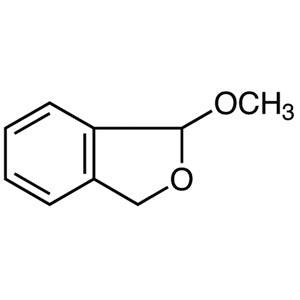
1,3-Dihydro-1-methoxyisobenzofuran from TCI, catalogue number D3828, CAS 67536-29-2, is a heterocyclic compound consisting of a five-membered oxygen-containing ring fused to a benzene ring, with a methoxy group attached at the acetal carbon position. Structurally, the molecule is a cyclic acetal, which means that in the laboratory it serves two purposes at once: it acts as a protected form of an aromatic carbonyl group, and it supplies a ready-made hydrogenated benzofuran framework. Its role is that of a heterocyclic building block — a starting material carrying a core skeleton that is prepared for further modification, so that researchers do not need to construct the ring system from scratch in every synthetic route.
The property that makes this compound a preferred choice is the characteristic reactivity of a cyclic acetal, which can be opened in a controlled manner under acidic conditions to generate a stabilised electrophile ready to react with a wide range of nucleophiles. In this way the user gains good chemoselectivity control, because the reactive centre remains effectively "hidden" until the desired reaction conditions are deliberately applied. The fused benzo framework also contributes conformational rigidity and allows further functionalisation on the aromatic ring, giving synthetic chemists an additional dimension of structural elaboration from a single, well-defined starting material.
This combination makes the product a practical choice for laboratories in Indonesia working on organic synthesis and heterocyclic chemistry. It is typically used in university research groups, graduate and postgraduate synthesis projects, and in research and development laboratories preparing intermediates for more complex target molecules. Supplied under the TCI brand within the Chemistry > Building Blocks > Heterocyclic Building Blocks category, it fits routine bench-scale synthetic work where a reliable, ready-to-modify heterocyclic core shortens the overall route.
Related TCI products
- TCI B1512 7426-75-7 1,4-Bis(4,5-dihydro-2-oxazolyl)benzene
- TCI B1511 34052-90-9 1,3-Bis(4,5-dihydro-2-oxazolyl)benzene
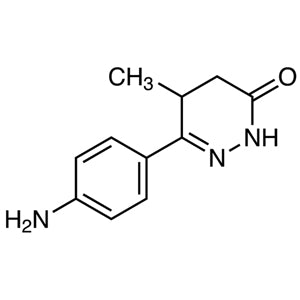
- TCI A2919 36725-28-7 6-(4-Aminophenyl)-4,5-dihydro-5-methyl-3(2H)-pyridazinone
- TCI A2618 137281-39-1 4-[2-(2-Amino-4,7-dihydro-4-oxo-3H-pyrrolo[2,3-d]pyrimidin-5-yl)ethyl]benzoic Acid
- TCI M3833 3414-94-6 5-Phenyl-2,4-dihydro-3H-1,2,4-triazole-3-thione
- TCI M2710 119-17-5 3-(3-Methyl-5-oxo-4,5-dihydro-1H-pyrazol-1-yl)benzenesulfonic Acid
- Heterocyclic synthesis — provides a pre-formed benzofuran-type ring system, allowing researchers to begin a synthetic route from an assembled core rather than building the fused heterocycle step by step.
- Protected carbonyl chemistry — the cyclic acetal functions as a masked aromatic carbonyl group, letting chemists carry the latent reactive centre through steps that would otherwise attack a free carbonyl.
- Acid-mediated electrophilic reactions — controlled ring opening under acidic conditions generates a stabilised electrophile, making the compound suitable for coupling with diverse nucleophiles in targeted bond-forming steps.
- Chemoselective multi-step routes — because the reactive group stays hidden until intended conditions are applied, the material supports sequences where selectivity between competing functional groups must be maintained.
- Aromatic functionalisation studies — the fused benzo ring offers positions for further substitution, so the compound serves as a scaffold for preparing analogue series with varied aromatic substituents.
| Brand | TCI (catalogue number D3828) |
|---|---|
| CAS number | 67536-29-2 |
| Molecular formula | — |
| Purity | — |
| Category | Chemistry > Building Blocks > Heterocyclic Building Blocks |
| Pack sizes | available in standard TCI research-scale packaging; please confirm the currently offered sizes when ordering |
| Physical form | — |
| Storage | keep in a tightly closed original container as indicated on the manufacturer's label and safety data sheet |
- Chemical name: 1,3-Dihydro-1-methoxyisobenzofuran
Store the container tightly closed in a cool, dry, well-ventilated area, away from heat, ignition sources, and direct sunlight, and keep it separated from strong acids, since acidic conditions can open the acetal ring. Retain the material in its original manufacturer's container whenever possible, or transfer only to a chemically compatible, clearly labelled vessel that is kept sealed to limit exposure to moisture and air. Handle in a fume hood using standard laboratory personal protective equipment, including safety glasses, gloves, and a lab coat. Always consult the manufacturer's safety data sheet for the authoritative handling, first-aid, and disposal information before use, and dispose of residues and contaminated materials through the laboratory's approved chemical waste procedures.
—
Produk Terkait
-
1,4-Bis(4,5-dihydro-2-oxazolyl)benzene TCI B1512
Regular price Rp 2.518.950,00Regular price -
1,3-Bis(4,5-dihydro-2-oxazolyl)benzene TCI B1511
Regular price From Rp 903.000,00Regular price -
6-(4-Aminophenyl)-4,5-dihydro-5-methyl-3(2H)-pyridazinone TCI A2919
Regular price Rp 1.670.550,00Regular price -
4-[2-(2-Amino-4,7-dihydro-4-oxo-3H-pyrrolo[2,3-d]pyrimidin-5-yl)ethyl]benzoicAcid TCI A2618
Regular price From Rp 928.200,00Regular price -
5-Phenyl-2,4-dihydro-3H-1,2,4-triazole-3-thione TCI M3833
Regular price From Rp 1.167.600,00Regular price -
3-(3-Methyl-5-oxo-4,5-dihydro-1H-pyrazol-1-yl)benzenesulfonicAcid TCI M2710
Regular price From Rp 477.750,00Regular price -
9-Methyl-3,4-dihydro-2H-pyrido[1,2-a]pyrimidin-2-one TCI M0670
Regular price Rp 2.386.650,00Regular price -
3,4-Dihydro-4-oxo-1,2,3-benzotriazine TCI K0003
Regular price From Rp 928.200,00Regular price


![137281-39-1 4-[2-(2-Amino-4,7-dihydro-4-oxo-3H-pyrrolo[2,3-d]pyrimidin-5-yl)ethyl]benzoic Acid - AMI Scientific](http://amiscientific.com/cdn/shop/files/TCI2510A2618.jpg?v=1767083121&width=533)


![61751-44-8 9-Methyl-3,4-dihydro-2H-pyrido[1,2-a]pyrimidin-2-one - AMI Scientific](http://amiscientific.com/cdn/shop/files/TCI2510M0670.jpg?v=1767123458&width=533)
