

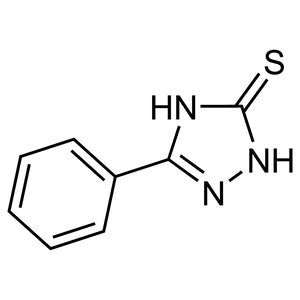
TCI M3833 is 5-Phenyl-2,4-dihydro-3H-1,2,4-triazole-3-thione, a heterocyclic compound that combines a 1,2,4-triazole ring with a thione group at position three and a phenyl substituent at position five. The compound is a classic building block in medicinal chemistry and coordination chemistry, because the triazole-thione ring can exist in a thiol–thione tautomeric equilibrium and therefore offers two reactive points at once: a nucleophilic sulfur atom and ring nitrogen atoms capable of coordination. This flexibility is what makes it a popular starting material for constructing libraries of bioactive compounds in synthesis laboratories.
The properties that make it a frequently chosen reagent include its readiness to undergo S-alkylation with alkyl halides to give triazole thioethers, as well as its ability to form fused ring systems such as triazolothiadiazoles and triazolothiadiazines through reaction with bifunctional reagents. The triazole scaffold itself is known to be metabolically stable, able to form hydrogen bonds as both donor and acceptor, and is frequently used as a bioisostere of the amide group in drug design. The phenyl substituent adds lipophilic character and provides an aromatic surface for interaction.
In Indonesian laboratories, this building block is typically used in university and institutional research groups working on organic synthesis, medicinal chemistry, and coordination chemistry. It is normally handled at the bench scale for exploratory reaction work, derivative preparation, and the assembly of small compound collections. Users generally weigh out the solid under standard laboratory conditions, carry the reaction through routine heterocyclic chemistry procedures, and characterise the products with the analytical instrumentation available in the department.
Related TCI products
- TCI B2228 132765-35-6 4,5-Bis(2-cyanoethylthio)-1,3-dithiole-2-thione
- TCI B1778 49638-64-4 4,5-Bis(methylthio)-1,3-dithiole-2-thione
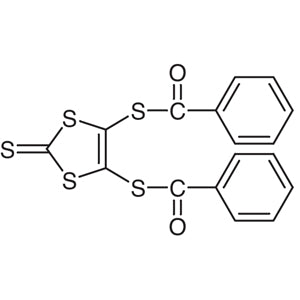
- TCI B1199 68494-08-6 4,5-Bis(benzoylthio)-1,3-dithiole-2-thione
- TCI P3198 15264-63-8 5-(Pyridin-4-yl)-1,3,4-oxadiazole-2(3H)-thione
- TCI P1635 202126-48-5 5-Propyl-1,3-dithiolo[4,5-d][1,3]dithiole-2-thione
- TCI M3790 2103-88-0 4-Phenylthiazole-2(3H)-thione
- S-alkylation chemistry: the nucleophilic sulfur atom reacts readily with alkyl halides, letting researchers prepare triazole thioether derivatives quickly and reliably from a single, well-defined starting material.
- Fused heterocycle construction: reaction with bifunctional reagents builds triazolothiadiazole and triazolothiadiazine ring systems, giving synthetic chemists direct access to more elaborate polycyclic scaffolds.
- Medicinal chemistry library synthesis: the dual reactive points on the ring allow systematic derivatisation, which supports the assembly of structurally varied compound collections for biological evaluation.
- Coordination chemistry studies: the ring nitrogen atoms and the sulfur centre can coordinate to metals, making the compound useful for preparing and studying metal complexes in the laboratory.
- Bioisostere-based drug design work: the metabolically stable triazole scaffold acts as an amide bioisostere and hydrogen bond donor and acceptor, supporting structure–activity exploration in design projects.
| Brand | TCI |
|---|---|
| CAS number | 3414-94-6 |
| Molecular formula | — |
| Purity | — |
| Category | Chemistry > Building Blocks > Heterocyclic Building Blocks |
| Pack sizes | available in standard TCI research pack sizes; please confirm the pack size when ordering |
| Physical form | — |
| Storage | store in a cool, dry place in a tightly closed original container |
- Chemical name: 5-Phenyl-2,4-dihydro-3H-1,2,4-triazole-3-thione
Store the compound in its original tightly closed container in a cool, dry and well ventilated place, away from direct sunlight, moisture and incompatible materials. Glass or other chemically resistant containers with secure closures are suitable for storage and for any subdivided portions, which should be clearly labelled with the compound name and CAS number. Handle the material in a fume hood using standard personal protective equipment, including safety glasses, gloves and a laboratory coat, and avoid generating dust when weighing the solid. Keep the container closed when not in use, return it promptly to its designated storage location, and consult the manufacturer safety data sheet before first use and before disposal of any residues.
—
Produk Terkait
-
4,5-Bis(2-cyanoethylthio)-1,3-dithiole-2-thione TCI B2228
Regular price Rp 4.426.800,00Regular price -
4,5-Bis(methylthio)-1,3-dithiole-2-thione TCI B1778
Regular price Rp 3.605.700,00Regular price -
4,5-Bis(benzoylthio)-1,3-dithiole-2-thione TCI B1199
Regular price From Rp 2.730.000,00Regular price -
5-(Pyridin-4-yl)-1,3,4-oxadiazole-2(3H)-thione TCI P3198
Regular price From Rp 848.400,00Regular price -
5-Propyl-1,3-dithiolo[4,5-d][1,3]dithiole-2-thione TCI P1635
Regular price From Rp 2.199.750,00Regular price -
4-Phenylthiazole-2(3H)-thione TCI M3790
Regular price From Rp 875.700,00Regular price -
6-Methyl-1,3-benzoxazole-2(3H)-thione TCI M3063
Regular price From Rp 1.856.400,00Regular price -
1-Methylpyrrolidine-2-thione TCI M1748
Regular price Rp 2.916.900,00Regular price



![202126-48-5 5-Propyl-1,3-dithiolo[4,5-d][1,3]dithiole-2-thione - AMI Scientific](http://amiscientific.com/cdn/shop/files/TCI2510P1635.jpg?v=1767135018&width=533)


