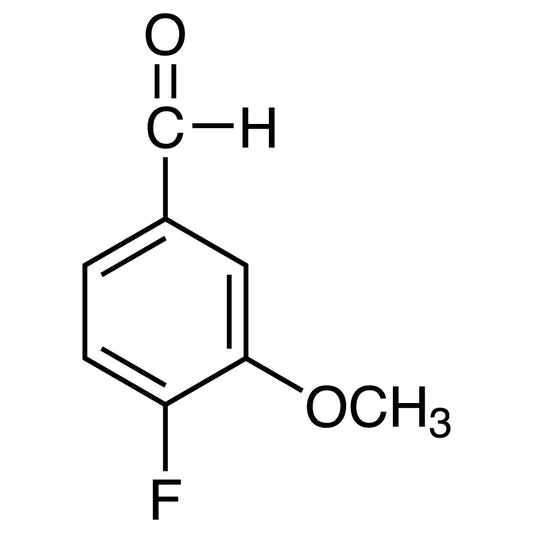
TCI D3885 5,6-Difluoro-o-anisaldehyde is a fluorinated aromatic compound that combines three functional groups within a single benzene framework: a highly reactive aldehyde group, an electron-donating methoxy group, and two electron-withdrawing fluorine atoms. This combination makes it a high-value starting material, or building block, in organic synthesis laboratories, particularly for researchers designing target molecules based on fluorinated aromatic rings. At the bench, the compound generally serves as an entry point for condensation reactions, reductive amination, olefination, and the construction of heterocyclic rings that require specific substitution patterns which are difficult to obtain through direct fluorination.
The characteristic that makes this compound a preferred choice is its highly directed substitution pattern. The fluorine atoms at positions 5 and 6 govern the distribution of electron density around the ring, so that nucleophilic aromatic substitution reactions can be steered selectively, while the methoxy group positioned ortho to the aldehyde contributes a distinctive steric and electronic effect. The aldehyde group itself is one of the most versatile handles in organic chemistry because it can be converted into a wide range of other functionalities, giving synthetic chemists multiple downstream routes from a single, well-defined intermediate rather than a longer sequence of preparatory steps.
In Indonesian laboratories, this compound is typically used in university and institutional research groups working on organic synthesis, medicinal chemistry, and materials chemistry, where fluorinated aromatic scaffolds are required as intermediates. It is normally ordered in research-scale quantities for method development, route-scouting experiments, and the preparation of small libraries of target compounds. Because the specific substitution pattern is not readily prepared in-house, purchasing it as a defined building block saves considerable synthetic effort and keeps project timelines realistic.
TCI brochures (PDF)
- Fluorination Reagents, Fluorinated Building Blocks 2026-03-18 · p. 28
- Fluorinated building block synthesis — provides a preformed difluorinated aromatic ring, removing the need for hazardous and poorly selective direct fluorination steps in the laboratory.
- Condensation reactions — the reactive aldehyde group readily forms imines, hydrazones, and related products, making it a convenient entry point for many synthetic sequences.
- Reductive amination — the aldehyde can be coupled with primary or secondary amines and reduced, giving direct access to fluorinated benzylamine-type structures for further study.
- Heterocyclic ring construction — the aldehyde combined with the fixed fluorine and methoxy positions supports assembly of heterocycles bearing a specifically substituted aromatic ring.
- Nucleophilic aromatic substitution studies — electron-withdrawing fluorine atoms activate the ring so nucleophilic displacement can be directed selectively at chosen positions during route development.
| Brand | TCI (Tokyo Chemical Industry) |
|---|---|
| CAS number | 187543-87-9 |
| Molecular formula | — |
| Purity | — |
| Category | Chemistry > Building Blocks > Fluorinated Building Blocks |
| Pack sizes | available in research-scale laboratory pack sizes; please confirm the currently listed options when ordering |
| Physical form | — |
| Storage | store in the original tightly closed container as indicated on the manufacturer's label |
- Catalogue code: D3885
Store this material in its original tightly closed container in a cool, dry, and well-ventilated area, away from heat, direct sunlight, and incompatible substances such as strong oxidizing agents. Follow the storage temperature and handling conditions stated on the manufacturer's label and safety data sheet, since aldehydes can be sensitive to air and moisture over time. Handle only inside a functioning fume hood, using safety glasses, chemical-resistant gloves, and a laboratory coat. Use clean, dry glassware or the supplier's original packaging for transfer and short-term storage, keep containers clearly labelled, and dispose of residues and contaminated materials through your institution's chemical waste procedures.
—
Produk Terkait
-
6-Fluoro-o-anisaldehyde TCI F1175
Regular price From Rp 903.000,00Regular price -
4-Fluoro-o-anisaldehyde TCI F0827
Regular price From Rp 1.378.650,00Regular price -
3-Fluoro-p-anisaldehyde TCI F0480
Regular price From Rp 505.050,00Regular price -
5-Fluoro-o-anisaldehyde TCI F0428
Regular price From Rp 505.050,00Regular price -
4-Fluoro-m-anisaldehyde TCI F0401
Regular price From Rp 477.750,00Regular price -
2-Fluoro-p-anisaldehyde TCI F0386
Regular price From Rp 1.696.800,00Regular price -
6-Fluoro-m-anisaldehyde TCI F0383
Regular price Rp 3.949.050,00Regular price -
5-Bromo-1,3-difluoro-2-(trifluoromethoxy)benzene TCI B5057
Regular price From Rp 1.087.800,00Regular price