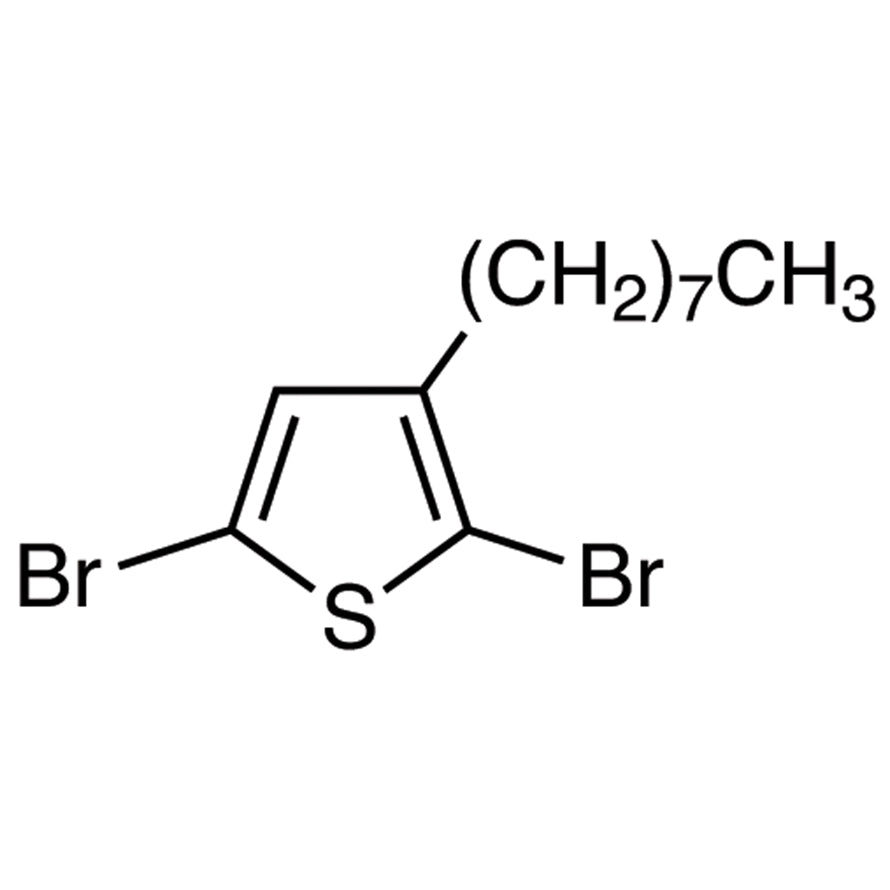
TCI D4053 2,5-Dibromo-3-n-octylthiophene is an octyl-chain-substituted thiophene monomer carrying two bromine atoms at the 2 and 5 positions of the ring. This compound is the classic starting material for preparing poly(3-octylthiophene), one of the most extensively studied semiconducting polymers in the world. In materials science and organic electronics laboratories, its role is to supply a complete repeating unit in a single molecule: the thiophene ring acts as the charge carrier, the alkyl chain provides solubility, and the two bromine atoms serve as connection points for polymerization as well as for directed coupling reactions.
The property that makes researchers choose this compound is the n-octyl chain at the 3 position. That long alkyl chain renders the resulting polymer soluble in common organic solvents, so thin films can be formed using solution techniques such as spin coating, drop casting, or printing. Without this side chain, unsubstituted polythiophene is practically unprocessable. The symmetrical placement of the bromine atoms at both ends of the ring also allows polymerization to grow in an orderly fashion, and when combined with certain nickel-catalyzed methods, researchers can control the regioregularity of the chain, which strongly determines the optoelectronic properties of the material.
In Indonesian laboratories, this monomer is typically used by university materials science and organic electronics research groups, chemistry and physics departments, and institutional research centres working on conjugated polymers. It is commonly handled in synthesis laboratories equipped for inert-atmosphere work and coupling chemistry, where the resulting polymer is subsequently processed into thin films for characterization. It also serves teaching and postgraduate research programmes that introduce students to solution-processable semiconducting polymer preparation.
TCI brochures (PDF)
- Thiophenes 2026-06-29 · p. 3
- Building Blocks for Organic Semiconductor 2026-03-24 · p. 37
Related TCI products
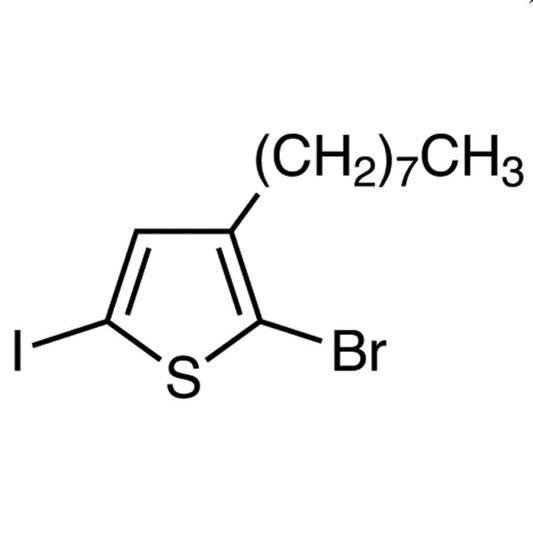
- TCI B4584 1085181-82-3 2-Bromo-5-iodo-3-n-octylthiophene (stabilized with Copper chip)
- TCI B5462 1384281-49-5 9-Benzyl-2,7-dibromo-9H-carbazole
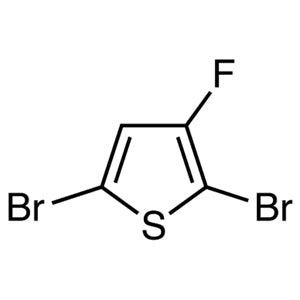
- TCI D5729 32431-85-9 2,5-Dibromo-3-fluorothiophene
- TCI D5448 132717-37-4 2,7-Dibromo-9-phenyl-9H-fluoren-9-ol
- TCI D5424 890653-54-0 3,6-Dibromo-9-(m-tolyl)-9H-carbazole
- TCI D5421 1873364-08-9 3,6-Dibromo-9-(3,5-dimethylphenyl)-9H-carbazole
- Poly(3-octylthiophene) synthesis: the dibrominated ring supplies both linkage points needed for chain growth, making it the standard direct precursor to this widely studied semiconducting polymer.
- Regioregular polymer preparation: symmetrical 2,5-bromination combined with nickel-catalyzed polymerization methods lets researchers control chain regioregularity, which governs the optoelectronic behaviour of the final material.
- Solution-processed thin film fabrication: the n-octyl side chain gives the resulting polymer solubility in common organic solvents, enabling spin coating, drop casting, and printing of films.
- Cross-coupling and directed reactions: the two bromine atoms act as reactive handles for coupling chemistry, allowing the thiophene unit to be built into larger conjugated architectures.
- Organic electronics research and teaching: it provides a complete conjugated repeating unit in one molecule, so laboratories can study charge transport and polymer processing without multi-step precursor preparation.
| Brand | TCI |
|---|---|
| CAS number | 149703-84-4 |
| Molecular formula | — |
| Purity | — |
| Category | Materials Science > Material Building Blocks > Polymer/Macromolecule Semiconductor Building Blocks |
| Pack sizes | available in the pack sizes listed by TCI for this catalogue item; storage according to the manufacturer's stated conditions on the product label and Safety Data Sheet. |
| Physical form | — |
| Storage | — |
- Product code: D4053
- Chemical name: 2,5-Dibromo-3-n-octylthiophene
Store this monomer in its original tightly closed container, in a cool, dry, well-ventilated place away from direct sunlight, heat sources, and incompatible chemicals, following the storage conditions stated by the manufacturer on the label and Safety Data Sheet. Amber or otherwise light-protected glass containers with chemically resistant closures are suitable, and containers should be kept sealed to limit exposure to moisture and air. Handle inside a functioning fume hood using standard laboratory personal protective equipment, including safety goggles, a laboratory coat, and chemically resistant gloves. Avoid inhalation of vapours and contact with skin and eyes, keep transfers away from ignition sources, and dispose of residues and contaminated materials as chemical waste in accordance with institutional and local regulations. Review the Safety Data Sheet before first use.
—
Produk Terkait
-
2-Bromo-5-iodo-3-n-octylthiophene(stabilizedwithCopperchip) TCI B4584
Regular price Rp 2.386.650,00Regular price -
9-Benzyl-2,7-dibromo-9H-carbazole TCI B5462
Regular price From Rp 2.862.300,00Regular price -
2,5-Dibromo-3-fluorothiophene TCI D5729
Regular price From Rp 3.896.550,00Regular price -
2,7-Dibromo-9-phenyl-9H-fluoren-9-ol TCI D5448
Regular price From Rp 1.749.300,00Regular price -
3,6-Dibromo-9-(m-tolyl)-9H-carbazole TCI D5424
Regular price Rp 2.466.450,00Regular price -
3,6-Dibromo-9-(3,5-dimethylphenyl)-9H-carbazole TCI D5421
Regular price From Rp 1.060.500,00Regular price -
3,6-Dibromo-9-(3,4-dimethylphenyl)-9H-carbazole TCI D5420
Regular price Rp 3.525.900,00Regular price -
3,6-Dibromo-9-(2,4-dimethylphenyl)-9H-carbazole TCI D5419
Regular price Rp 4.056.150,00Regular price