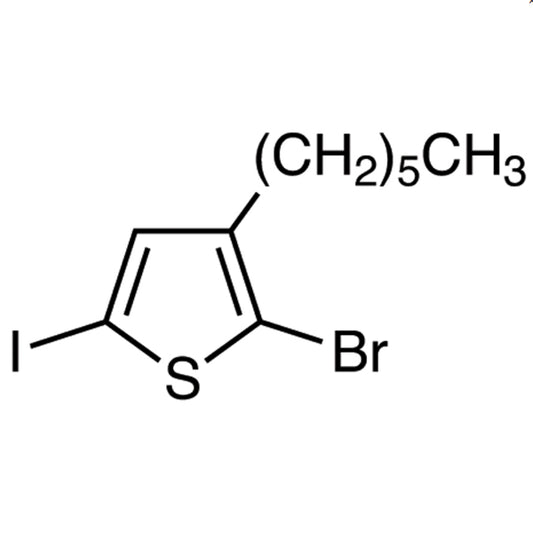
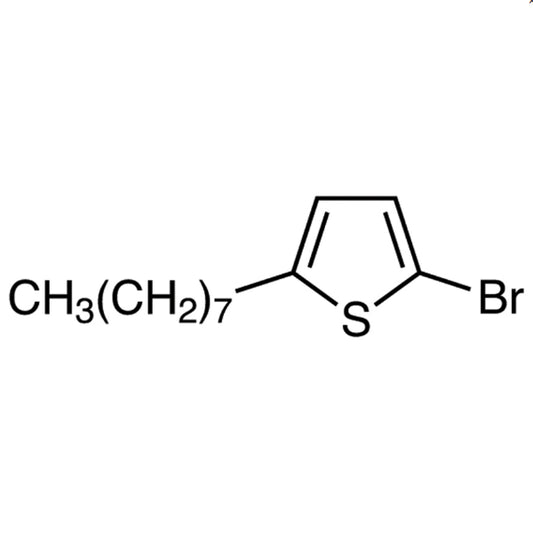
2-Bromo-5-iodo-3-n-octylthiophene is a complex chemical compound widely used in scientific material research, particularly in the development of polymers and semiconductors. This material plays a crucial role in laboratory settings where researchers are exploring molecular structures and electronic properties of organic compounds. Its unique chemical composition makes it an essential component in the synthesis of advanced materials with specialized electronic and optical characteristics. As a building block for organic semiconductors, it contributes to the innovation of next-generation electronic devices and photovoltaic technologies.
The compound’s molecular structure, featuring bromo, iodo, and n-octylthiophene groups, provides specific electronic and reactive properties that are highly desirable in material science. The inclusion of a copper chip as a stabilizer ensures the compound remains chemically stable during storage and use, reducing the risk of degradation. This stability is critical for maintaining the integrity of the material in long-term research projects. Its predictable behavior and compatibility with various synthetic processes make it a preferred choice for researchers working on complex chemical syntheses.
In Indonesian laboratories, this compound is utilized by researchers in higher education institutions and research organizations to develop new materials and technologies. Its relevance in the field of material science and technology has grown significantly, supporting advancements in organic electronics and photovoltaic systems. The compound is a key resource for scientists aiming to push the boundaries of material innovation in the region.
TCI brochures (PDF)
- Thiophenes 2026-06-29 · p. 3
- Building Blocks for Organic Semiconductor 2026-03-24 · p. 37
Related TCI products
- TCI B4586 306769-48-2 2-Bromo-3-dodecyl-5-iodothiophene (stabilized with Copper chip)
- TCI B4585 1034352-30-1 2-Bromo-3-(2-ethylhexyl)-5-iodothiophene (stabilized with Copper chip)
- TCI B3865 160096-76-4 2-Bromo-3-hexyl-5-iodothiophene (stabilized with Copper chip)
- TCI D4053 149703-84-4 2,5-Dibromo-3-n-octylthiophene
- TCI B3738 172514-63-5 2-Bromo-5-n-octylthiophene
- TCI B3733 145543-83-5 2-Bromo-3-n-octylthiophene
- Conducting polymer synthesis for organic semiconductor development due to its reactive functional groups and structural versatility.
- Fabricating organic photovoltaic materials by leveraging its electronic properties and molecular structure for enhanced charge transport.
- Performing molecular electronics research to explore charge mobility and conductivity in organic thin films.
- Developing advanced optoelectronic devices by utilizing its unique optical and electronic characteristics in material design.
- Supporting thin-film transistor research through its compatibility with solution-based processing techniques for semiconductor layers.
| Brand | TCI |
|---|---|
| CAS number | 1085181-82-3 |
| Molecular formula | — |
| Purity | — |
| Category | Materials Science > Material Building Blocks > Polymer/Macromolecule Semiconductor Building Blocks |
| Pack sizes | As specified by supplier |
| Physical form | Solid (exact form may vary based on supplier) |
| Storage | Store in a cool, dry place away from light and moisture |
This compound should be stored in a cool, dry environment, away from direct light and moisture to maintain its stability. It is recommended to use airtight containers made of inert materials such as glass or polyethylene to prevent contamination and degradation. Due to its chemical reactivity, it should be handled in a well-ventilated laboratory setting, preferably with appropriate personal protective equipment. Avoid exposure to incompatible substances such as strong oxidizers or acids. Regular monitoring of storage conditions is advised to ensure the material remains in optimal condition for research applications. Proper labeling and secure storage are essential to prevent accidental exposure or misuse.
—
Produk Terkait
-
2-Bromo-3-dodecyl-5-iodothiophene(stabilizedwithCopperchip) TCI B4586
Regular price Rp 2.782.500,00Regular priceRp 1.961.400,00Sale price Rp 2.782.500,00 -
2-Bromo-3-(2-ethylhexyl)-5-iodothiophene(stabilizedwithCopperchip) TCI B4585
Regular price From Rp 2.332.050,00Regular priceRp 1.646.400,00Sale price From Rp 2.332.050,00 -
2-Bromo-3-hexyl-5-iodothiophene(stabilizedwithCopperchip) TCI B3865
Regular price From Rp 2.464.350,00Regular priceRp 1.738.800,00Sale price From Rp 2.464.350,00 -
2,5-Dibromo-3-n-octylthiophene TCI D4053
Regular price Rp 4.266.150,00Regular priceRp 2.998.800,00Sale price Rp 4.266.150,00 -
2-Bromo-5-n-octylthiophene TCI B3738
Regular price From Rp 6.386.100,00Regular priceRp 4.481.400,00Sale price From Rp 6.386.100,00 -
2-Bromo-3-n-octylthiophene TCI B3733
Regular price Rp 2.571.450,00Regular priceRp 1.813.350,00Sale price Rp 2.571.450,00 -
1-Bromo-2-ethylbutane(stabilizedwithCopperchip) TCI B1905
Regular price From Rp 1.035.300,00Regular priceRp 723.450,00Sale price From Rp 1.035.300,00 -
2-Bromo-5-methylthiophene(stabilizedwithCopperchip+NaHCO3) TCI B1540
Regular price From Rp 1.590.750,00Regular priceRp 1.127.700,00Sale price From Rp 1.590.750,00