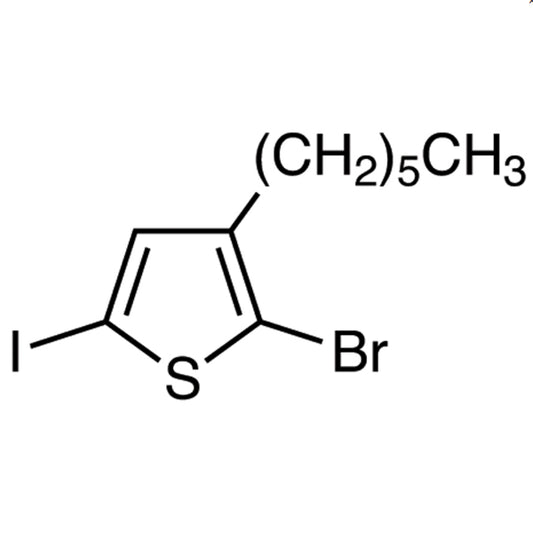
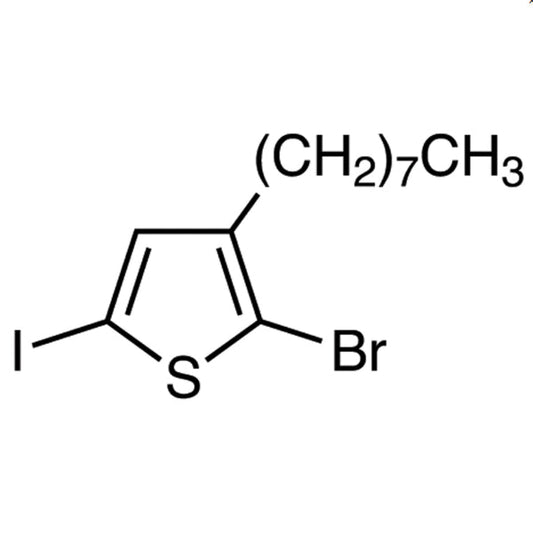
2-Bromo-3-dodecyl-5-iodothiophene is an organic compound widely used in semiconductor and polymer research within laboratory settings. This material plays a crucial role in the development of advanced materials with unique conductive or optical properties. It is particularly relevant in the fields of material science and technology, where its chemical structure allows for tailored modifications to achieve specific functional characteristics. As a building block for complex compound synthesis, it supports the creation of materials used in organic electronics and photovoltaic devices.
The compound’s complex molecular structure makes it a preferred choice for researchers seeking to design materials with precise properties. The inclusion of a copper chip in this product enhances its stability during storage and use, ensuring consistent performance over time. This feature is especially valuable in laboratory environments where long-term reliability and reproducibility are essential. Its chemical versatility and stability make it an ideal candidate for various synthetic applications in both academic and industrial research.
In Indonesian laboratories, this compound is highly relevant to material and energy research initiatives. Many research institutions in Indonesia are focused on developing semiconductor materials for local applications, such as electronic devices and renewable energy systems. The availability of such compounds supports innovative research efforts aimed at advancing technology and sustainability in the region.
TCI brochures (PDF)
- Thiophenes 2026-06-29 · p. 3
- Building Blocks for Organic Semiconductor 2026-03-24 · p. 37
Related TCI products
- TCI B4585 1034352-30-1 2-Bromo-3-(2-ethylhexyl)-5-iodothiophene (stabilized with Copper chip)
- TCI B3865 160096-76-4 2-Bromo-3-hexyl-5-iodothiophene (stabilized with Copper chip)
- TCI B4584 1085181-82-3 2-Bromo-5-iodo-3-n-octylthiophene (stabilized with Copper chip)
- TCI B1905 3814-34-4 1-Bromo-2-ethylbutane (stabilized with Copper chip)
- TCI B1540 765-58-2 2-Bromo-5-methylthiophene (stabilized with Copper chip + NaHCO3)
- TCI B1412 13294-71-8 2-Bromo-2-butene (stabilized with Copper chip)
- Organic electronics development: This compound is ideal for creating conductive polymers used in flexible and printable electronic devices.
- Photovoltaic material synthesis: Its unique optical properties make it suitable for the production of solar cell materials with enhanced light absorption.
- Semiconductor material research: It serves as a key building block in the development of novel semiconductor compounds with tailored electronic properties.
- Polymer chemistry experiments: Its chemical versatility allows it to be used in the synthesis of various polymer-based materials with specific functional groups.
- Energy storage innovation: It contributes to the creation of advanced materials for next-generation energy storage solutions.
| Brand | TCI |
|---|---|
| CAS number | 306769-48-2 |
| Molecular formula | — |
| Purity | — |
| Category | Materials Science > Material Building Blocks > Polymer/Macromolecule Semiconductor Building Blocks |
| Pack sizes | — |
| Physical form | — |
| Storage | Store in a cool, dry place away from light and moisture |
This compound should be stored in a cool, dry environment, away from direct light and moisture to maintain its stability. It is recommended to use airtight containers to prevent exposure to air and humidity. Due to its chemical nature, it should be handled with appropriate personal protective equipment, including gloves and safety goggles. Avoid contact with incompatible materials such as strong oxidizers. Ensure proper ventilation in the workspace to minimize inhalation risks. Regular monitoring of storage conditions is advised to ensure the material remains in optimal condition for use in laboratory applications.
—
Produk Terkait
-
2-Bromo-3-(2-ethylhexyl)-5-iodothiophene(stabilizedwithCopperchip) TCI B4585
Regular price From Rp 2.332.050,00Regular priceRp 1.646.400,00Sale price From Rp 2.332.050,00 -
2-Bromo-3-hexyl-5-iodothiophene(stabilizedwithCopperchip) TCI B3865
Regular price From Rp 2.464.350,00Regular priceRp 1.738.800,00Sale price From Rp 2.464.350,00 -
2-Bromo-5-iodo-3-n-octylthiophene(stabilizedwithCopperchip) TCI B4584
Regular price Rp 2.439.150,00Regular priceRp 1.720.950,00Sale price Rp 2.439.150,00 -
1-Bromo-2-ethylbutane(stabilizedwithCopperchip) TCI B1905
Regular price From Rp 1.035.300,00Regular priceRp 723.450,00Sale price From Rp 1.035.300,00 -
2-Bromo-5-methylthiophene(stabilizedwithCopperchip+NaHCO3) TCI B1540
Regular price From Rp 1.590.750,00Regular priceRp 1.127.700,00Sale price From Rp 1.590.750,00 -
2-Bromo-2-butene(stabilizedwithCopperchip) TCI B1412
Regular price From Rp 1.724.100,00Regular priceRp 1.205.400,00Sale price From Rp 1.724.100,00 -
2-Bromo-3-octadecylthiophene TCI B5410
Regular price Rp 2.306.850,00Regular priceRp 1.628.550,00Sale price Rp 2.306.850,00 -
2-Bromo-3-hexadecylthiophene TCI B5409
Regular price Rp 2.439.150,00Regular priceRp 1.720.950,00Sale price Rp 2.439.150,00