

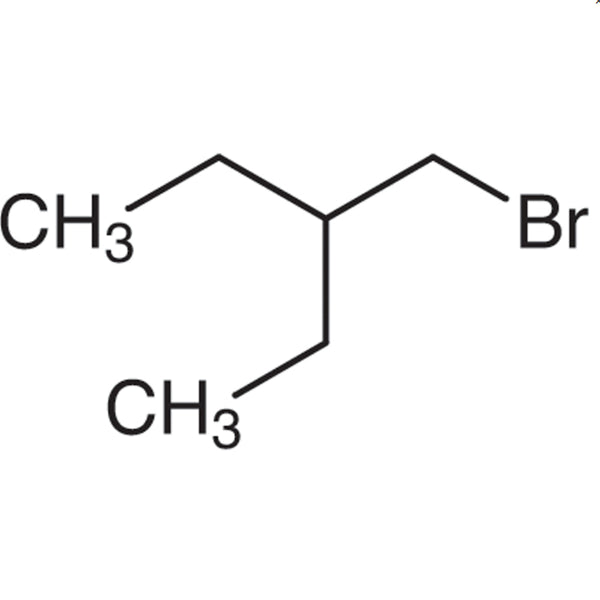
1-Bromo-2-ethylbutane is an essential organic compound widely used in laboratory settings for the synthesis of complex molecules. As a building block in organic chemistry, it plays a crucial role in various reactions, including nucleophilic substitution and elimination mechanisms. Its versatility makes it a valuable tool for researchers aiming to develop new compounds in pharmaceutical and industrial applications. This compound is particularly useful for creating intermediates that serve as precursors in the production of pharmaceuticals and specialty chemicals.
The compound's reactivity and stability make it a preferred choice for chemical synthesis. It is stabilized with a copper chip to prevent degradation and unwanted reactions during storage and use. This stabilization ensures that the compound remains effective and safe for extended periods. Its non-heterocyclic nature also makes it suitable for a wide range of synthetic pathways, allowing chemists to explore diverse reaction conditions and outcomes.
In Indonesian laboratories, 1-Bromo-2-ethylbutane is commonly used in organic chemistry research, especially in academic and industrial settings. Its role in developing new compounds and intermediates is critical for advancing chemical research. The compound's stability and reactivity make it an ideal choice for laboratories that require precision and reliability in their experiments.
Related TCI products
- TCI B1412 13294-71-8 2-Bromo-2-butene (stabilized with Copper chip)
- TCI B0612 507-36-8 2-Bromo-2-methylbutane
- TCI I0530 616-14-8 1-Iodo-2-methylbutane (stabilized with Copper chip)
- TCI I0504 107-82-4 1-Bromo-3-methylbutane
- TCI I0061 541-28-6 1-Iodo-3-methylbutane (stabilized with Na2S2O3)
- TCI D1067 594-81-0 2,3-Dibromo-2,3-dimethylbutane
- Organic synthesis is a key application where 1-Bromo-2-ethylbutane is used to create complex molecules through nucleophilic substitution reactions.
- Pharmaceutical research benefits from this compound as it helps in the development of new drug molecules and intermediates.
- Industrial chemical production utilizes this compound as a building block for the synthesis of specialty chemicals and polymers.
- Teaching laboratories use it to demonstrate fundamental organic reactions and to train students in synthetic techniques.
- Research institutions employ it in the exploration of new synthetic pathways and reaction mechanisms for advanced chemical studies.
| Brand | TCI |
|---|---|
| CAS number | 3814-34-4 |
| Molecular formula | — |
| Purity | — |
| Category | Chemistry > Building Blocks > Non-Heterocyclic Building Blocks |
| Pack sizes | Available in standard laboratory quantities |
| Physical form | Liquid |
| Storage | Store in a cool, dry place away from direct sunlight |
This compound should be stored in a cool, dry environment, away from direct sunlight and sources of heat. It is recommended to use airtight containers made of glass or high-density polyethylene to prevent contamination and evaporation. Due to its reactivity, it should be handled with care, using appropriate personal protective equipment such as gloves and safety goggles. Storage should be in a well-ventilated area to minimize exposure to vapors. The presence of a copper chip ensures stability, but it is still important to avoid prolonged exposure to moisture or incompatible substances. Regular inspection of storage conditions is advised to maintain the integrity and safety of the compound during laboratory use.
—
Produk Terkait
-
2-Bromo-2-butene(stabilizedwithCopperchip) TCI B1412
Regular price From Rp 1.724.100,00Regular priceRp 1.205.400,00Sale price From Rp 1.724.100,00 -
2-Bromo-2-methylbutane TCI B0612
Regular price Rp 3.180.450,00Regular priceRp 2.223.900,00Sale price Rp 3.180.450,00 -
1-Iodo-2-methylbutane(stabilizedwithCopperchip) TCI I0530
Regular price Rp 3.021.900,00Regular priceRp 2.112.600,00Sale price Rp 3.021.900,00 -
1-Bromo-3-methylbutane TCI I0504
Regular price From Rp 637.350,00Regular priceRp 445.200,00Sale price From Rp 637.350,00 -
1-Iodo-3-methylbutane(stabilizedwithNa2S2O3) TCI I0061
Regular price Rp 4.108.650,00Regular priceRp 2.872.800,00Sale price Rp 4.108.650,00 -
2,3-Dibromo-2,3-dimethylbutane TCI D1067
Regular price From Rp 1.565.550,00Regular priceRp 1.094.100,00Sale price From Rp 1.565.550,00 -
1-Chloro-2-methylbutane TCI C1459
Regular price Rp 637.350,00Regular priceRp 445.200,00Sale price Rp 637.350,00 -
2-Chloro-2-methylbutane TCI C0200
Regular price From Rp 1.538.250,00Regular priceRp 1.075.200,00Sale price From Rp 1.538.250,00


