

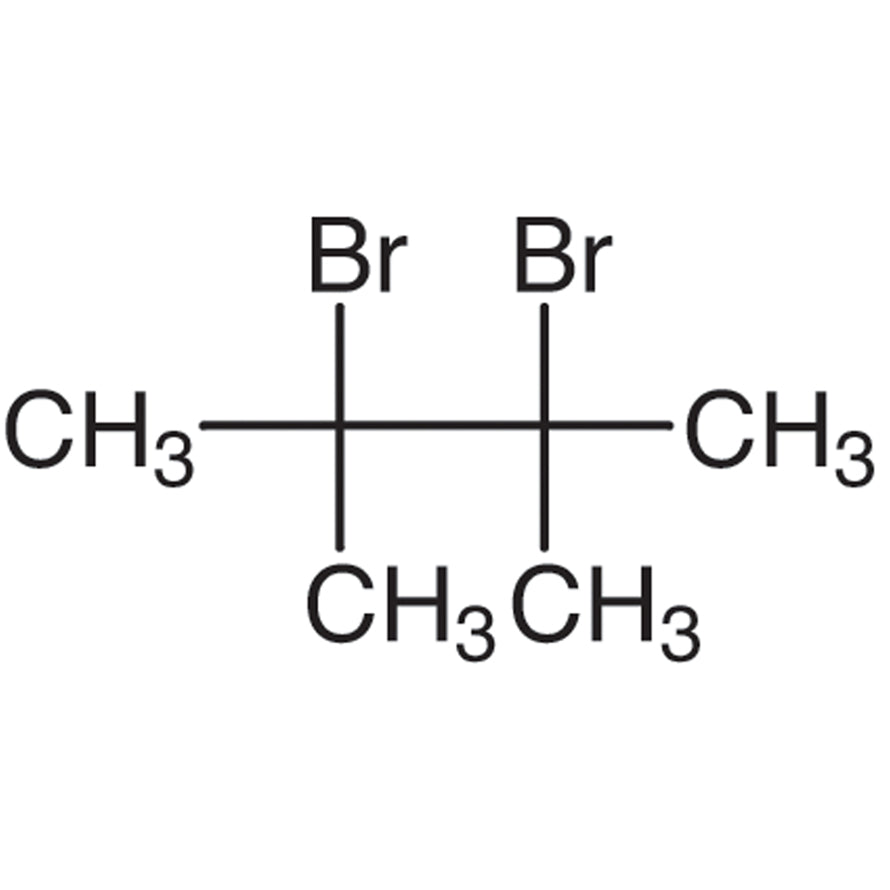
2,3-Dibromo-2,3-dimethylbutane is a chemical compound widely used in synthetic chemistry applications within laboratory settings. As a building block in organic chemistry, it serves as a fundamental component for constructing more complex molecular structures. This compound is particularly valuable in laboratory environments where controlled chemical reactions are required to produce a variety of organic derivatives. Its role in facilitating substitution reactions and other synthetic pathways makes it an essential tool for researchers.
The compound’s unique structure, featuring two bromine atoms on adjacent carbon atoms, gives it predictable chemical behavior and reactivity. This makes it a preferred choice for organic synthesis due to its ability to participate in various reaction mechanisms, such as nucleophilic substitution and elimination. Its stability and well-defined chemical properties allow for consistent results in experimental procedures, which is crucial for scientific reproducibility.
In Indonesian laboratories, 2,3-Dibromo-2,3-dimethylbutane is commonly used in research across multiple fields, including pharmaceuticals, food chemistry, and materials science. Its availability and reliability make it a go-to compound for experiments requiring specific reactivity. The compound’s role in supporting research and development is significant, especially in academic and industrial settings where synthetic chemistry is a core activity.
Related TCI products
- TCI B5948 1647-23-0 1-Bromo-3,3-dimethylbutane
- TCI B1905 3814-34-4 1-Bromo-2-ethylbutane (stabilized with Copper chip)
- TCI B0612 507-36-8 2-Bromo-2-methylbutane
- TCI I0530 616-14-8 1-Iodo-2-methylbutane (stabilized with Copper chip)
- TCI I0504 107-82-4 1-Bromo-3-methylbutane
- TCI I0061 541-28-6 1-Iodo-3-methylbutane (stabilized with Na2S2O3)
- Organic Synthesis: This compound is ideal for creating complex molecules through substitution reactions, offering predictable outcomes in synthetic pathways.
- Pharmaceutical Research: Its reactivity supports the development of new drugs by enabling the synthesis of various organic intermediates.
- Food Chemistry Studies: It is used in the analysis and modification of food-related compounds, contributing to the development of safe and nutritious products.
- Material Science Investigations: The compound aids in the creation of new materials by participating in reactions that form functional polymers and coatings.
- Analytical Chemistry: Its stable properties make it suitable for use as a standard in analytical procedures, ensuring accurate and reliable results.
| Brand | TCI |
|---|---|
| CAS number | 594-81-0 |
| Molecular formula | — |
| Purity | — |
| Category | Chemistry > Building Blocks > Non-Heterocyclic Building Blocks |
| Pack sizes | Available in various quantities as per standard laboratory supply formats |
| Physical form | Liquid |
| Storage | Store in a cool, dry place away from direct sunlight and incompatible materials |
This compound should be stored in a cool, dry location, away from direct sunlight and sources of heat. It is recommended to use airtight containers made of materials that are chemically inert, such as glass or high-density polyethylene, to prevent contamination and evaporation. Due to its bromine content, it should be kept away from incompatible substances like flammable materials and strong oxidizers. Always ensure proper ventilation when handling the compound to minimize exposure. Laboratory personnel should wear appropriate personal protective equipment, including gloves and safety goggles, to ensure safe handling and reduce the risk of chemical contact.
—
Produk Terkait
-
1-Bromo-3,3-dimethylbutane TCI B5948
Regular price From Rp 1.246.350,00Regular price -
1-Bromo-2-ethylbutane(stabilizedwithCopperchip) TCI B1905
Regular price From Rp 1.035.300,00Regular price -
2-Bromo-2-methylbutane TCI B0612
Regular price Rp 3.180.450,00Regular price -
1-Iodo-2-methylbutane(stabilizedwithCopperchip) TCI I0530
Regular price Rp 3.021.900,00Regular price -
1-Bromo-3-methylbutane TCI I0504
Regular price From Rp 637.350,00Regular price -
1-Iodo-3-methylbutane(stabilizedwithNa2S2O3) TCI I0061
Regular price Rp 4.108.650,00Regular price -
1-Chloro-2-methylbutane TCI C1459
Regular price Rp 637.350,00Regular price -
2-Chloro-2-methylbutane TCI C0200
Regular price From Rp 1.538.250,00Regular price


