

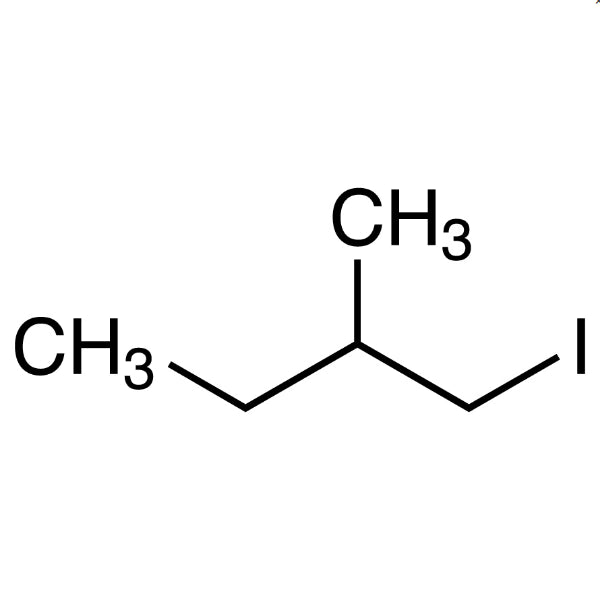
TCI I0530 1-Iodo-2-methylbutane is a short-chain, branched alkyl iodide supplied in a stabilized state, with a copper chip included inside the bottle. The compound functions as an alkylating reagent, meaning a material that donates a 2-methylbutyl group to nucleophiles such as amines, alkoxides, thiolates, or carbanions. In everyday laboratory practice, a reagent of this kind is the most direct way to extend the carbon skeleton of a molecule while simultaneously introducing deliberate branching, without having to work through a longer stepwise reaction sequence that is more complicated and lowers the overall yield.
The property that makes it the preferred choice is the quality of iodide as the best leaving group among the alkyl halides. The carbon–iodine bond is relatively weak and the iodide ion is very stable once it departs, so nucleophilic substitution proceeds far more quickly than with the corresponding bromide or chloride, even at mild temperatures and with bases that are not especially harsh. The methyl branch at the two position provides a stereogenic centre together with mild steric hindrance, both of which are useful to the molecular designer. The copper chip supplied with the material acts as a stabilizer: the copper scavenges the free iodine that forms slowly on exposure to light and air, keeping the reagent usable over its working life.
In Indonesian laboratories, this reagent is typically found in synthetic organic chemistry groups at universities and research institutes, in pharmaceutical and agrochemical development work, and in laboratories preparing reference materials or intermediates on a small scale. Because it is a building block rather than a bulk solvent, it is normally ordered in modest research quantities, kept in a dedicated cool cabinet for light-sensitive reagents, and handled inside a fume hood as part of routine multistep synthesis planning.
Related TCI products
- TCI B1905 3814-34-4 1-Bromo-2-ethylbutane (stabilized with Copper chip)
- TCI B0612 507-36-8 2-Bromo-2-methylbutane
- TCI I0504 107-82-4 1-Bromo-3-methylbutane
- TCI I0061 541-28-6 1-Iodo-3-methylbutane (stabilized with Na2S2O3)
- TCI D1067 594-81-0 2,3-Dibromo-2,3-dimethylbutane
- TCI C1459 616-13-7 1-Chloro-2-methylbutane
- Nucleophilic substitution reactions: the weak carbon–iodine bond and the stability of the departing iodide ion make this reagent react cleanly and quickly with amines, alkoxides, and thiolates under mild conditions.
- Carbon skeleton extension in multistep synthesis: it attaches a 2-methylbutyl group in a single step, avoiding the longer reaction sequences that complicate a route and reduce the overall yield.
- N-alkylation of amines: the high reactivity of the alkyl iodide allows amine nitrogen to be alkylated without forcing conditions, which protects sensitive functional groups elsewhere in the substrate molecule.
- Introduction of branching and a stereogenic centre: the methyl group at the two position gives molecular designers both a defined branch point and a controlled, mild degree of steric hindrance.
- C-alkylation of carbanions: stabilized carbanion nucleophiles react efficiently with this iodide, letting chemists build branched carbon frameworks in enolate and related alkylation chemistry.
| Brand | TCI (Tokyo Chemical Industry) |
|---|---|
| CAS number | 616-14-8 |
| Molecular formula | — |
| Purity | — |
| Category | Chemistry > Building Blocks > Non-Heterocyclic Building Blocks |
| Pack sizes | available in standard TCI research pack sizes; please confirm the currently listed sizes when ordering |
| Physical form | — |
| Storage | keep protected from light and air, in a cool storage area |
- Product code: I0530
- Stabilizer: supplied stabilized with a copper chip inside the bottle
Store the bottle tightly closed in its original light-protecting container, in a cool, well-ventilated area away from direct sunlight and heat sources. The copper chip must remain in the bottle, since it is what scavenges free iodine formed on exposure to light and air; do not filter it out or transfer the material into an unprotected clear container. Handle the reagent inside a fume hood, wearing gloves, safety glasses, and a laboratory coat, and keep it away from strong oxidizing agents and from strong bases that are not part of the intended reaction. Withdraw only the quantity required for each reaction and reseal the bottle promptly to limit exposure to air. Discolouration toward yellow or brown indicates liberated iodine, and the material should be assessed before use.
—
Produk Terkait
-
1-Bromo-2-ethylbutane(stabilizedwithCopperchip) TCI B1905
Regular price From Rp 1.035.300,00Regular price -
2-Bromo-2-methylbutane TCI B0612
Regular price Rp 3.180.450,00Regular price -
1-Bromo-3-methylbutane TCI I0504
Regular price From Rp 637.350,00Regular price -
1-Iodo-3-methylbutane(stabilizedwithNa2S2O3) TCI I0061
Regular price Rp 4.108.650,00Regular price -
2,3-Dibromo-2,3-dimethylbutane TCI D1067
Regular price From Rp 1.565.550,00Regular price -
1-Chloro-2-methylbutane TCI C1459
Regular price Rp 637.350,00Regular price -
2-Chloro-2-methylbutane TCI C0200
Regular price From Rp 1.538.250,00Regular price -
1-Chloro-3-methylbutane TCI C0199
Regular price From Rp 1.485.750,00Regular price


