

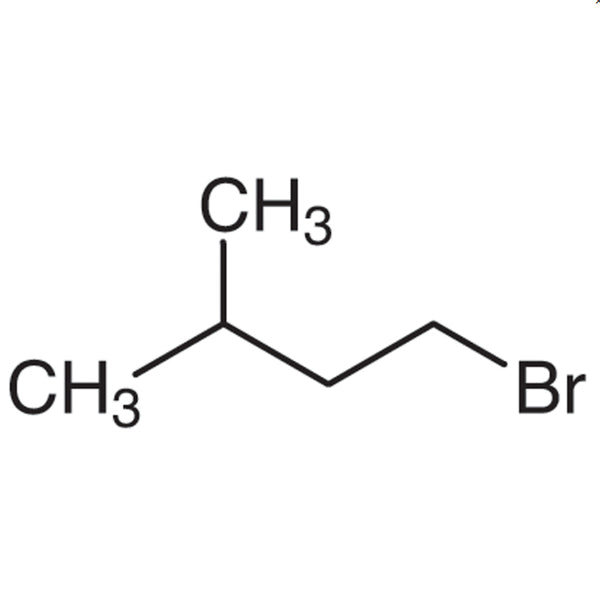
1-Bromo-3-methylbutane is a chemical compound widely used in organic synthesis. It serves as a key building block in the construction of complex molecular structures. In laboratory settings, this compound is frequently employed as a reagent in nucleophilic substitution and elimination reactions. Its reactivity makes it a preferred choice for various chemical experiments. The compound's simple molecular structure plays a crucial role in the development of organic compounds, making it essential for both academic and industrial research. Due to its versatility, it is commonly found in chemical laboratories across different sectors.
This compound is valued for its solubility in organic solvents such as ethylamine and ethyl acetate. These properties facilitate efficient separation and reaction processes in the laboratory. Its stability under certain conditions allows for reliable use in both small-scale and large-scale experiments. The ease of handling and predictable behavior make it a reliable material for chemists working in diverse environments. Its availability and cost-effectiveness further enhance its appeal for routine and advanced chemical applications.
In Indonesian laboratories, 1-Bromo-3-methylbutane is used in a variety of chemical research projects, both in academic institutions and research organizations. It is a fundamental component in teaching and experimental setups, supporting both basic and advanced chemistry courses. Its widespread use reflects its importance in the development of new chemical compounds and processes within the country's scientific community.
Related TCI products
- TCI B0612 507-36-8 2-Bromo-2-methylbutane
- TCI B1905 3814-34-4 1-Bromo-2-ethylbutane (stabilized with Copper chip)
- TCI I0530 616-14-8 1-Iodo-2-methylbutane (stabilized with Copper chip)
- TCI I0061 541-28-6 1-Iodo-3-methylbutane (stabilized with Na2S2O3)
- TCI D1067 594-81-0 2,3-Dibromo-2,3-dimethylbutane
- TCI C1459 616-13-7 1-Chloro-2-methylbutane
- Organic synthesis reactions benefit from 1-Bromo-3-methylbutane due to its reactivity and solubility in organic solvents, making it ideal for nucleophilic substitution processes.
- It is commonly used in elimination reactions where its structural properties allow for controlled and predictable chemical transformations.
- In teaching laboratories, this compound is a valuable tool for demonstrating fundamental organic chemistry concepts and reaction mechanisms.
- Research institutions utilize it for the development of new compounds and the study of chemical behavior under various conditions.
- Its stability and solubility make it suitable for use in both small-scale experiments and industrial-scale chemical processes.
| Brand | TCI |
|---|---|
| CAS number | 107-82-4 |
| Molecular formula | — |
| Purity | — |
| Category | Chemistry > Building Blocks > Non-Heterocyclic Building Blocks |
| Pack sizes | Available in various quantities as per supplier specifications |
| Physical form | Liquid |
| Storage | Store in a cool, dry place away from direct sunlight |
This compound should be stored in a cool, dry place away from direct sunlight to maintain its stability and prevent degradation. It is recommended to use airtight containers made of glass or polyethylene to avoid contamination and ensure safe handling. Due to its reactivity, it should be kept away from incompatible substances such as strong oxidizing agents. Proper ventilation is essential when handling this material to minimize exposure. Laboratory personnel should wear appropriate personal protective equipment, including gloves and safety goggles, to ensure safe handling. Regular monitoring of storage conditions is advised to maintain the integrity of the compound and ensure safe usage in experimental settings.
—
Produk Terkait
-
2-Bromo-2-methylbutane TCI B0612
Regular price Rp 3.180.450,00Regular price -
1-Bromo-2-ethylbutane(stabilizedwithCopperchip) TCI B1905
Regular price From Rp 1.035.300,00Regular price -
1-Iodo-2-methylbutane(stabilizedwithCopperchip) TCI I0530
Regular price Rp 3.021.900,00Regular price -
1-Iodo-3-methylbutane(stabilizedwithNa2S2O3) TCI I0061
Regular price Rp 4.108.650,00Regular price -
2,3-Dibromo-2,3-dimethylbutane TCI D1067
Regular price From Rp 1.565.550,00Regular price -
1-Chloro-2-methylbutane TCI C1459
Regular price Rp 637.350,00Regular price -
2-Chloro-2-methylbutane TCI C0200
Regular price From Rp 1.538.250,00Regular price -
1-Chloro-3-methylbutane TCI C0199
Regular price From Rp 1.485.750,00Regular price


