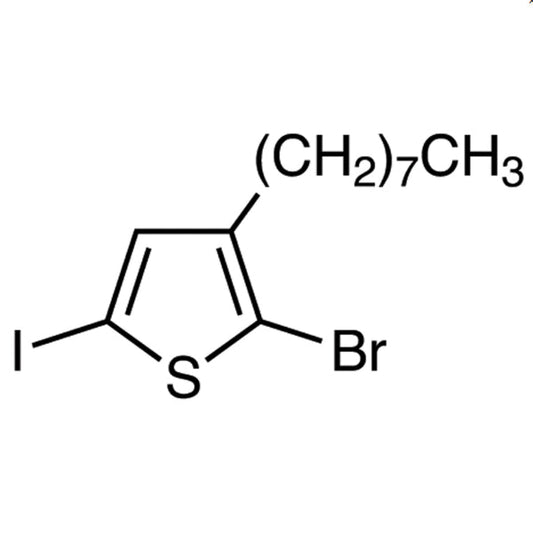
2-Bromo-5-n-octylthiophene is an organic compound widely utilized in semiconductor material research. This compound plays a crucial role in the development of organic films and electronic components, which are integral to materials science studies. In laboratory settings, it serves as a foundational building block for the synthesis of complex molecules with specific chemical properties. Its versatility makes it a valuable resource for researchers exploring advanced electronic and optoelectronic applications.
The compound’s unique chemical structure, featuring a thiophene ring and a bromo group, contributes to its high reactivity in chemical reactions. This reactivity, combined with its stability under controlled conditions, makes it a preferred choice for precise chemical modifications in semiconductor synthesis. Its ability to participate in various synthetic pathways enables the creation of materials with tailored properties for display technologies, sensors, and lightweight electronic devices.
In Indonesian laboratories, 2-Bromo-5-n-octylthiophene is commonly used in organic semiconductor research, particularly in the development of display technologies and sensor applications. Researchers at educational institutions and research organizations frequently rely on this compound for experiments requiring specific chemical properties. Its role in advancing material science applications is well recognized in both academic and industrial research contexts.
TCI brochures (PDF)
- Thiophenes 2026-06-29 · p. 3
- Building Blocks for Organic Semiconductor 2026-03-24 · p. 25
Related TCI products
- TCI B3733 145543-83-5 2-Bromo-3-n-octylthiophene
- TCI B4584 1085181-82-3 2-Bromo-5-iodo-3-n-octylthiophene (stabilized with Copper chip)
- TCI B5475 925899-21-4 2-Bromo-5-(2-ethylhexyl)thiophene
- TCI B5458 704890-84-6 2-[(5'-Bromo-[2,2'-bithiophen]-5-yl)methylene]malononitrile
- TCI B5457 176787-96-5 5'-Bromo-[2,2'-bithiophene]-5-carbonitrile
- TCI B5456 1308671-90-0 3-(5-Bromo-2-thienyl)-2,5-bis(2-ethylhexyl)-6-(2-thienyl)pyrrolo[3,4-c]pyrrole-1,4-dione
- Organic Semiconductor Synthesis: This compound is ideal for creating organic semiconductor materials due to its reactivity and structural versatility.
- Display Technology Development: It is used in the fabrication of organic light-emitting diodes (OLEDs) and other display technologies requiring precise chemical modifications.
- Sensor Fabrication: Its chemical properties make it suitable for developing sensors that detect environmental or biological changes with high sensitivity.
- Electronic Device Prototyping: Researchers use it to design lightweight and flexible electronic components, leveraging its chemical stability and reactivity.
- Material Science Research: It serves as a key building block for exploring new materials with unique electronic and optical properties.
| Brand | TCI |
|---|---|
| CAS number | 172514-63-5 |
| Molecular formula | — |
| Purity | — |
| Category | Materials Science > Material Building Blocks > Small Molecule Semiconductor Building Blocks |
| Pack sizes | Available in various quantities as per standard laboratory supply options |
| Physical form | Solid, typically in crystalline or powder form |
| Storage | Store in a cool, dry place away from direct sunlight and moisture |
This compound should be stored in a cool, dry environment to maintain its chemical stability. It is recommended to keep it in a sealed container to prevent exposure to moisture and air. When handling, it is advisable to use appropriate personal protective equipment, such as gloves and safety goggles, to ensure safety. The compound should be stored away from incompatible substances to avoid any chemical reactions. Proper ventilation should be maintained in the laboratory workspace to minimize inhalation risks. Regular monitoring of storage conditions ensures the compound remains in optimal condition for research applications.
—
Produk Terkait
-
2-Bromo-3-n-octylthiophene TCI B3733
Regular price Rp 2.571.450,00Regular priceRp 1.813.350,00Sale price Rp 2.571.450,00 -
2-Bromo-5-iodo-3-n-octylthiophene(stabilizedwithCopperchip) TCI B4584
Regular price Rp 2.439.150,00Regular priceRp 1.720.950,00Sale price Rp 2.439.150,00 -
2-Bromo-5-(2-ethylhexyl)thiophene TCI B5475
Regular price From Rp 3.180.450,00Regular priceRp 2.239.650,00Sale price From Rp 3.180.450,00 -
2-[(5'-Bromo-[2,2'-bithiophen]-5-yl)methylene]malononitrile TCI B5458
Regular price From Rp 1.351.350,00Regular priceRp 960.750,00Sale price From Rp 1.351.350,00 -
5'-Bromo-[2,2'-bithiophene]-5-carbonitrile TCI B5457
Regular price From Rp 2.013.900,00Regular priceRp 1.423.800,00Sale price From Rp 2.013.900,00 -
3-(5-Bromo-2-thienyl)-2,5-bis(2-ethylhexyl)-6-(2-thienyl)pyrrolo[3,4-c]pyrrole-1,4-dione TCI B5456
Regular price Rp 7.075.950,00Regular priceRp 4.963.350,00Sale price Rp 7.075.950,00 -
2-Bromo-3-cyclohexylthiophene TCI B5420
Regular price From Rp 3.815.700,00Regular priceRp 2.683.800,00Sale price From Rp 3.815.700,00 -
2-Bromo-3-octadecylthiophene TCI B5410
Regular price Rp 2.306.850,00Regular priceRp 1.628.550,00Sale price Rp 2.306.850,00