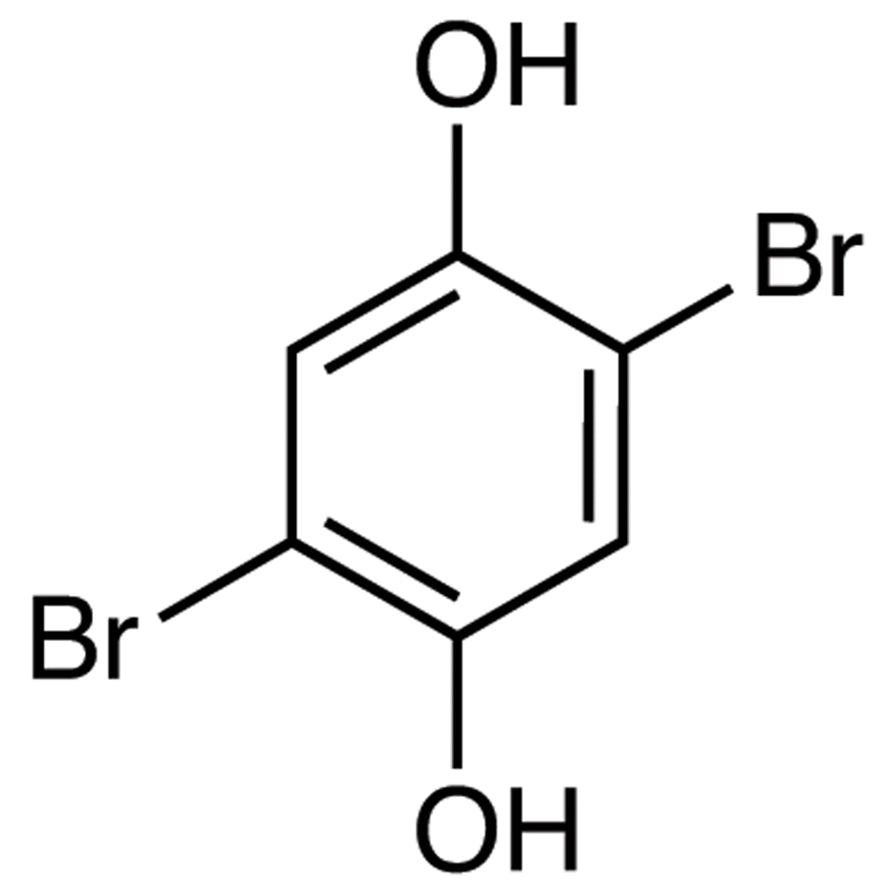
TCI D4067 2,5-Dibromohydroquinone is a hydroquinone derivative carrying two bromine atoms at the 2 and 5 positions of the benzene ring, alongside two phenolic hydroxyl groups in the para arrangement. This symmetrical structure, with four reactive points on a single aromatic core, makes it a highly useful non-heterocyclic building block in organic synthesis and materials chemistry laboratories. The hydroxyl groups are readily alkylated into alkoxy ethers, while the bromine atoms are immediately available for cross-coupling reactions, so the compound frequently serves as a starting point for preparing doubly substituted aromatic monomers.
The key characteristic that makes this compound a preferred choice is its ability to deliver substituted phenylene frameworks in a controlled manner. Once both hydroxyl groups are converted into long-chain ethers, the resulting compound gains substantially better solubility in organic solvents, an essential requirement for solution-based processing of conjugated polymers. The two symmetrically arranged bromine atoms allow linear chain-growth polymerisation through Suzuki, Stille, Sonogashira, or Gilch routes. In addition, the pair of phenolic hydroxyls confers the characteristic redox behaviour of hydroquinone, which is exploited in further research work.
In Indonesian laboratories, this building block is typically used in university and institutional research groups working on organic synthesis, polymer chemistry, and materials development. It is commonly handled at bench scale for monomer preparation, etherification steps, and subsequent coupling chemistry, and is stored as a research-grade reagent alongside other aromatic intermediates. Researchers generally order it in small quantities appropriate to synthetic screening work and multi-step route development, where a reliable, well-defined symmetrical intermediate is required.
- Conjugated polymer monomer synthesis: the symmetrical dibromo substitution supports linear chain growth, giving well-defined polymer backbones for materials research and solution-processable device studies.
- Etherification and alkylation chemistry: the two para phenolic hydroxyl groups are readily converted into alkoxy ethers, tailoring solubility of the resulting aromatic intermediate in organic solvents.
- Palladium-catalysed cross-coupling: both bromine positions participate in Suzuki, Stille, and Sonogashira reactions, allowing controlled construction of extended substituted phenylene frameworks.
- Gilch route polymerisation studies: the symmetrical bromine placement suits this classical polymerisation pathway for preparing phenylene-based polymer structures in materials chemistry laboratories.
- Redox-related investigations: the phenolic hydroxyl pair provides the characteristic hydroquinone redox behaviour, making the compound useful in research exploring electron-transfer-active aromatic systems.
| Brand | TCI |
|---|---|
| CAS number | 14753-51-6 |
| Molecular formula | — |
| Purity | — |
| Category | Chemistry > Building Blocks > Non-Heterocyclic Building Blocks |
| Pack sizes | available in standard research pack sizes; please confirm the required packing when ordering |
| Physical form | — |
| Storage | store in a cool, dry place in a tightly closed container, protected from light |
- Product Code: D4067
Store the container tightly closed in a cool, dry, well-ventilated area away from direct sunlight and sources of ignition, and keep it separated from strong oxidising agents. Amber glass bottles or the original manufacturer packaging are suitable, since phenolic compounds can be sensitive to prolonged light and air exposure. Handle the material inside a fume hood using nitrile gloves, safety goggles, and a laboratory coat, and avoid generating or inhaling dust during weighing and transfer. Close the container promptly after use, label any secondary containers clearly, and consult the manufacturer's safety data sheet before handling or disposal.
—
Produk Terkait
-
Bromohydroquinone TCI B1600
Regular price From Rp 3.949.050,00Regular price -
Tetrabromohydroquinone TCI T1790
Regular price From Rp 1.988.700,00Regular price -
Chlorohydroquinone TCI C0185
Regular price From Rp 1.167.600,00Regular price -
Tetrachlorohydroquinone TCI T0067
Regular price From Rp 1.008.000,00Regular price -
2,5-Di-tert-butylhydroquinone TCI D0940
Regular price From Rp 557.550,00Regular price -
Methoxyhydroquinone TCI M0539
Regular price From Rp 1.115.100,00Regular price -
Hydroquinone TCI H0186
Regular price From Rp 477.750,00Regular price -
PotassiumHydroquinonesulfonate TCI H0593
Regular price From Rp 505.050,00Regular price