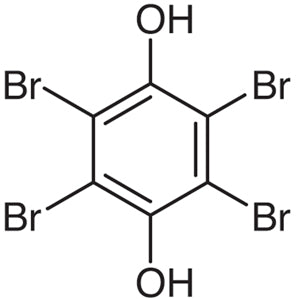
Tetrachlorohydroquinone from TCI is a hydroquinone derivative in which all four positions of the aromatic ring carry chlorine atoms, while its two hydroxyl groups sit in the para positions. It is classed as a non-heterocyclic building block and is the reduced form of the chloranil–tetrachlorohydroquinone redox pair. In the laboratory it is used in organic synthesis, in electrochemical and redox studies, and in biochemical and toxicological research, for example as a metabolite of organochlorine compounds such as pentachlorophenol.
Researchers choose this compound mainly for its well-defined redox behaviour. Tetrachlorohydroquinone can be oxidised to chloranil (tetrachloro-1,4-benzoquinone), and chloranil can in turn be reduced back to it. The four electron-withdrawing chlorine atoms shift its redox potential and the acidity of its hydroxyl groups compared with ordinary hydroquinone. This makes it a useful model for studying how substituents affect electron transfer and the formation of semiquinone radicals, and it also gives synthetic chemists a predictable, fully substituted aromatic starting material.
In Indonesia, this material serves organic chemistry, electrochemistry, and environmental chemistry laboratories at universities and research institutions. Academic groups use it in teaching and research on quinone–hydroquinone redox systems. Environmental and toxicology laboratories use it as a reference compound when studying how organochlorine pollutants such as pentachlorophenol break down. Synthetic laboratories keep it as a chlorinated aromatic building block for preparing more complex molecules.
- Organic synthesis: as a fully chlorinated non-heterocyclic building block, it gives a defined aromatic core with two reactive hydroxyl groups for making more elaborate chlorinated compounds.
- Electrochemical and redox studies: its reversible conversion to and from chloranil makes it a clear model system for measuring redox potentials and electron-transfer behaviour.
- Substituent-effect research: the four electron-withdrawing chlorine atoms let researchers compare redox potential and hydroxyl acidity directly against unsubstituted hydroquinone.
- Semiquinone radical studies: its well-defined redox chemistry makes it well suited to investigating how semiquinone radical intermediates form and how stable they are.
- Biochemical and toxicological research: as a known metabolite of organochlorine compounds such as pentachlorophenol, it is relevant to metabolism and environmental fate studies.
| Brand | TCI |
|---|---|
| CAS number | 87-87-6 |
| Molecular formula | — |
| Purity | — |
| Category | Chemistry > Building Blocks > Non-Heterocyclic Building Blocks |
| Pack sizes | standard TCI pack sizes; please contact us for available options |
| Physical form | — |
| Storage | follow the TCI label and Safety Data Sheet (SDS) for recommended conditions |
- Product code: T0067
Store Tetrachlorohydroquinone in its original, tightly closed container in a cool, dry, well-ventilated place, away from direct light, moisture, and strong oxidising agents. Its oxidising agents matter because the compound is easily oxidised to chloranil. Always follow the storage conditions on the TCI label and the Safety Data Sheet. Handle it only in a fume hood or a well-ventilated area, and wear suitable gloves, safety glasses, and a lab coat. Avoid creating or breathing in dust, and avoid contact with skin and eyes. Because it is an organochlorine compound, dispose of waste according to local regulations for halogenated chemical waste.
—
Produk Terkait
-
Chlorohydroquinone TCI C0185
Regular price From Rp 1.167.600,00Regular priceRp 815.850,00Sale price From Rp 1.167.600,00 -
Bromohydroquinone TCI B1600
Regular price From Rp 3.949.050,00Regular priceRp 2.761.500,00Sale price From Rp 3.949.050,00 -
2,5-Dibromohydroquinone TCI D4067
Regular price From Rp 1.829.100,00Regular priceRp 1.278.900,00Sale price From Rp 1.829.100,00 -
2,5-Di-tert-butylhydroquinone TCI D0940
Regular price From Rp 610.050,00Regular priceRp 442.050,00Sale price From Rp 610.050,00 -
Methoxyhydroquinone TCI M0539
Regular price From Rp 1.167.600,00Regular priceRp 831.600,00Sale price From Rp 1.167.600,00 -
Tetrabromohydroquinone TCI T1790
Regular price From Rp 1.988.700,00Regular priceRp 1.390.200,00Sale price From Rp 1.988.700,00 -
Hydroquinone TCI H0186
Regular price From Rp 477.750,00Regular priceRp 333.900,00Sale price From Rp 477.750,00 -
Epichlorohydrin TCI E0012
Regular price From Rp 505.050,00Regular priceRp 352.800,00Sale price From Rp 505.050,00