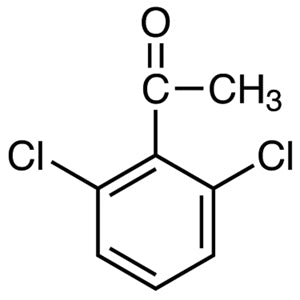
TCI D4119 2',6'-Dichloroacetophenone is an aromatic ketone that carries an acetyl group on a benzene ring bearing two chlorine atoms at both ortho positions. As a synthetic raw material, this compound is widely used in organic chemistry laboratories as a starting point for constructing a variety of molecular frameworks, particularly heterocyclic systems. Its ketone carbonyl group serves as a versatile reactive centre that can undergo condensation, reduction, nucleophilic addition, and alpha-position halogenation, while the two chlorine atoms on the ring provide options for further modification through substitution reactions or transition-metal-catalysed cross-coupling.
The property that makes this compound a preferred choice is its highly distinctive 2,6-substitution pattern. The two ortho chlorine atoms force the acetyl group to twist out of the plane of the aromatic ring, so that conjugation between the carbonyl and the aromatic system is reduced. As a result, the carbonyl behaves more like an aliphatic ketone, and its reactivity toward nucleophiles differs from that of ordinary acetophenone — a characteristic that is useful for controlling reaction selectivity. In addition, the chlorine atoms are electron-withdrawing, which increases the acidity of the alpha protons and facilitates enolate formation.
In Indonesian laboratories, this material is typically used in organic synthesis and medicinal chemistry research groups at universities and research institutes, as well as in industrial R&D laboratories that develop new molecular frameworks. It is generally handled at the bench scale for exploratory synthesis, route development, and the preparation of intermediates, where a well-defined building block with predictable and controllable reactivity is required to keep multi-step sequences reproducible.
Related TCI products
- Heterocyclic synthesis — the reactive ketone carbonyl and acidic alpha protons make this compound a convenient entry point for building heterocyclic ring systems from a single, well-defined starting material.
- Condensation reactions — the carbonyl group readily participates in condensation chemistry, allowing researchers to extend the carbon skeleton and assemble larger molecular frameworks in a controlled manner.
- Alpha-halogenation chemistry — the electron-withdrawing chlorine atoms increase alpha-proton acidity, so alpha-halogenated derivatives can be prepared and carried forward into subsequent substitution steps.
- Transition-metal-catalysed cross-coupling — the two aryl chlorine atoms serve as handles for metal-catalysed coupling, giving chemists a route to further functionalise the aromatic ring after the ketone chemistry.
- Selectivity studies in nucleophilic addition — the twisted, less-conjugated carbonyl reacts differently from ordinary acetophenone, which makes it useful for probing and controlling reaction selectivity.
| Brand | TCI |
|---|---|
| CAS number | 2040-05-3 |
| Molecular formula | — |
| Purity | — |
| Category | Chemistry > Building Blocks > Non-Heterocyclic Building Blocks |
| Pack sizes | — |
| Physical form | — |
| Storage | store in a closed original container in a cool, dry, well-ventilated area away from incompatible materials |
- Product code: D4119
- Chemical class: aromatic ketone (2,6-dichloro-substituted acetophenone)
Store the container tightly closed in a cool, dry, well-ventilated place, away from direct sunlight, heat sources, ignition sources, and incompatible materials such as strong oxidising agents and strong bases. Keep the product in its original supplier container, or transfer it only to clean, chemically compatible and clearly labelled glass containers with secure closures. Handle in a fume hood, and wear appropriate personal protective equipment including safety goggles, chemically resistant gloves, and a laboratory coat. Avoid inhalation of vapours or dust and avoid contact with skin and eyes. Always consult the manufacturer's Safety Data Sheet before use, and dispose of residues and contaminated materials in accordance with applicable chemical waste regulations.
—
Produk Terkait
-
4'-Amino-3',5'-dichloroacetophenone TCI A1967
Regular price From Rp 1.115.100,00Regular price -
3',5'-Dichloroacetophenone TCI D5111
Regular price From Rp 903.000,00Regular price -
2',5'-Dichloroacetophenone TCI D2502
Regular price From Rp 477.750,00Regular price -
2',4'-Dichloroacetophenone TCI D1490
Regular price Rp 903.000,00Regular price -
2,2-Dichloroacetophenone TCI D1122
Regular price Rp 2.597.700,00Regular price -
3',4'-Dichloroacetophenone TCI D0311
Regular price Rp 1.776.600,00Regular price -
2',3',4'-Trichloroacetophenone TCI T2306
Regular price Rp 848.400,00Regular price -
2,3',4'-Trichloroacetophenone TCI T1965
Regular price Rp 2.068.500,00Regular price