

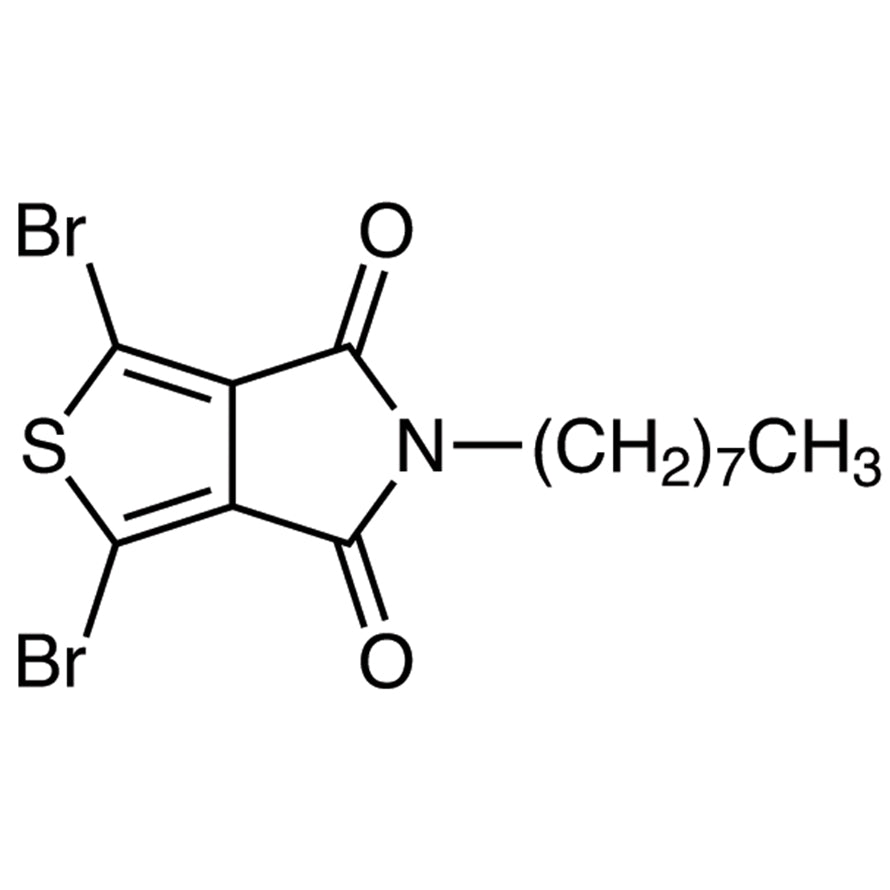
TCI D4219 2,5-Dibromo-N-n-octyl-3,4-thiophenedicarboximide is a semiconductor building block that combines a thiophene core, a cyclic imide group at the 3 and 4 positions, and two bromine atoms at the 2 and 5 positions. In materials science, this compound serves as a key monomer for constructing acceptor-type conjugated polymers. The two bromine atoms provide ready-to-use connection points for cross-coupling polymerization reactions, allowing researchers to insert this electron-withdrawing unit into donor–acceptor polymer chains in a repeated and controlled manner.
The properties that make it a preferred choice are its electronic character and its processability. The dicarboximide group is strongly electron-withdrawing, which lowers the orbital energy levels of the polymer and promotes n-type or ambipolar charge transport behaviour, something relatively rare and highly sought after in organic materials. The planar imide structure also supports orderly chain packing and good interchain stacking interactions, factors that are important for charge carrier mobility. Meanwhile, the n-octyl chain on the nitrogen atom acts as a solubilizing chain that keeps the polymer soluble and coatable from solution.
In Indonesian laboratories, this building block is typically used within university and institutional research groups working on organic electronics and polymer materials. It is handled at the synthesis bench for the preparation of conjugated polymers, then carried forward into solution-based film deposition and device characterisation work. Because it functions as a defined monomer unit, it fits research programmes that require reproducible incorporation of an acceptor segment into a polymer backbone across repeated experimental batches.
Related TCI products
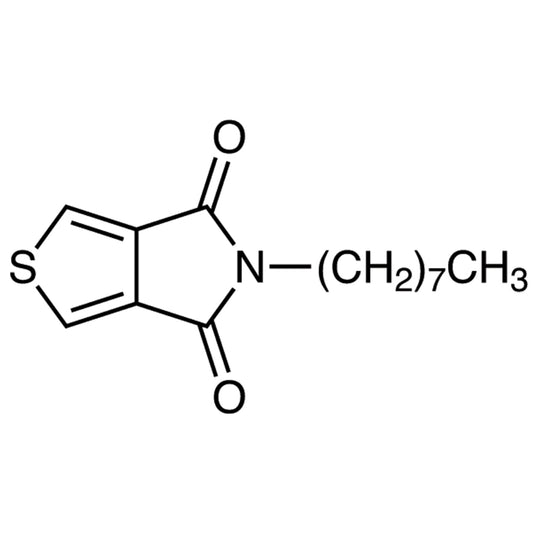
- TCI O0394 773881-43-9 N-n-Octyl-3,4-thiophenedicarboximide
- TCI D5742 1334295-79-2 6,6'-Dibromo-1,1'-di(n-octyl)isoindigo
- TCI D5021 1231160-83-0 2,5-Dibromo-N-(2-ethylhexyl)-3,4-thiophenedicarboximide
- TCI D4946 926643-78-9 2,6-Dibromo-N,N'-di-n-octyl-1,8:4,5-naphthalenetetracarboxdiimide
- TCI D4592 1336893-15-2 2,6-Dibromo-4,8-bis[(2-butyl-n-octyl)oxy]benzo[1,2-b:4,5-b']dithiophene
- TCI E1040 1237479-38-7 2-Ethylhexyl 4,6-Dibromo-3-fluorothieno[3,4-b]thiophene-2-carboxylate
- Donor–acceptor conjugated polymer synthesis: the two bromine positions act as reliable coupling handles, letting researchers build alternating polymer backbones with a controlled acceptor unit in every repeat.
- N-type organic semiconductor development: the strongly electron-withdrawing dicarboximide group lowers polymer orbital energy levels, supporting electron transport behaviour that is difficult to achieve with conventional donor materials.
- Organic field-effect transistor material research: the planar imide framework encourages ordered chain packing and interchain stacking, conditions that directly support higher charge carrier mobility in thin films.
- Ambipolar semiconductor studies: pairing this acceptor monomer with donor comonomers allows research groups to tune polymers toward balanced hole and electron transport within a single material system.
- Solution-processed thin film fabrication: the n-octyl solubilizing chain keeps the resulting polymers dissolvable, so films can be deposited from solution using standard laboratory coating methods.
| Brand | TCI |
|---|---|
| CAS number | 566939-58-0 |
| Molecular formula | — |
| Purity | — |
| Category | Materials Science > Material Building Blocks > Polymer/Macromolecule Semiconductor Building Blocks |
| Pack sizes | available in standard TCI research-scale catalogue pack sizes; please confirm the required size when ordering |
| Physical form | — |
| Storage | keep in the tightly closed original container, protected from light and moisture |
- Chemical name: 2,5-Dibromo-N-n-octyl-3,4-thiophenedicarboximide
Store the product in its original tightly closed container in a cool, dry and well-ventilated area, protected from direct light, moisture and incompatible materials. Amber glass or the supplier's original packaging is suitable, and the container should be resealed promptly after each use to limit exposure to air and humidity. Handle the compound in a fume hood using standard laboratory personal protective equipment, including safety glasses, gloves and a laboratory coat. Avoid generating dust, avoid contact with skin and eyes, and wash hands thoroughly after handling. Always consult the manufacturer's safety data sheet before use, and dispose of residues and contaminated materials through the laboratory's chemical waste procedure.
—
Produk Terkait
-
N-n-Octyl-3,4-thiophenedicarboximide TCI O0394
Regular price From Rp 1.776.600,00Regular price -
6,6'-Dibromo-1,1'-di(n-octyl)isoindigo TCI D5742
Regular price Rp 3.870.300,00Regular price -
2,5-Dibromo-N-(2-ethylhexyl)-3,4-thiophenedicarboximide TCI D5021
Regular price From Rp 1.961.400,00Regular price -
2,6-Dibromo-N,N'-di-n-octyl-1,8:4,5-naphthalenetetracarboxdiimide TCI D4946
Regular price From Rp 6.784.050,00Regular price -
2,6-Dibromo-4,8-bis[(2-butyl-n-octyl)oxy]benzo[1,2-b:4,5-b']dithiophene TCI D4592
Regular price Rp 4.611.600,00Regular price -
2-Ethylhexyl4,6-Dibromo-3-fluorothieno[3,4-b]thiophene-2-carboxylate TCI E1040
Regular price Rp 4.213.650,00Regular price -
6,6'-Dibromo-1,1'-bis(2-exylhexyl)isoindigo TCI D5766
Regular price From Rp 2.862.300,00Regular price -
6,6'-Dibromo-1,1'-bis(2-decyltetradecyl)isoindigo TCI D5740
Regular price Rp 4.611.600,00Regular price



![2,6-Dibromo-4,8-bis[(2-butyl-n-octyl)oxy]benzo[1,2-b:4,5-b']dithiophene (CAS 1336893-15-2) - TCI D4592 - AMI Scientific](http://amiscientific.com/cdn/shop/files/TCI2510D4592.jpg?v=1768818149&width=533)
![2-Ethylhexyl 4,6-Dibromo-3-fluorothieno[3,4-b]thiophene-2-carboxylate (CAS 1237479-38-7) - TCI E1040 - AMI Scientific](http://amiscientific.com/cdn/shop/files/TCI2510E1040.jpg?v=1768818773&width=533)

