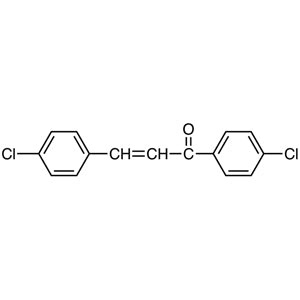
TCI D4846 4,4'-Dichlorochalcone is a member of the chalcone family, a class of alpha-beta unsaturated aromatic ketones in which two benzene rings are joined through a conjugated three-carbon bridge. In this particular compound, each aromatic ring carries a single chlorine atom at the para position. Chalcones are widely recognised as the core scaffold of flavonoid biosynthesis and, at the same time, as highly productive intermediates in synthetic organic laboratories, because their conjugated enone system opens routes toward a broad range of heterocyclic compound classes of value in medicinal chemistry research.
What makes this compound so widely used is the clear and easily controlled reactivity of its enone system. The double bond conjugated to the carbonyl group makes it a good Michael acceptor, so that a variety of nucleophiles can be added selectively at the beta position. The carbonyl group itself is ready to react with hydrazine, hydroxylamine, or urea to form pyrazolines, isoxazolines, and pyrimidines. The chlorine substituents on both rings withdraw electron density, sharpening the electrophilicity of the enone system while also providing handles that can be developed further through coupling reactions.
In Indonesian laboratories, this building block is typically encountered in university and institutional research settings where synthetic organic chemistry and medicinal chemistry programmes are carried out. It is commonly used at bench scale for exploratory reaction work, for the preparation of heterocyclic derivative libraries, and for postgraduate research projects that require a well-defined, reproducible chalcone starting material. Its predictable behaviour makes it equally suitable for method development work and for teaching advanced synthesis at the laboratory level.
- Michael addition chemistry — the conjugated double bond acts as a reliable Michael acceptor, allowing nucleophiles to be added selectively at the beta position under controlled conditions.
- Pyrazoline synthesis — reaction of the carbonyl group with hydrazine gives access to pyrazoline ring systems that are frequently targeted in medicinal chemistry research programmes.
- Isoxazoline preparation — condensation with hydroxylamine converts the enone framework into isoxazoline derivatives, providing a straightforward route to this heterocyclic class.
- Pyrimidine construction — treatment with urea builds pyrimidine rings from the same enone system, making this compound a convenient entry point for nitrogen heterocycle work.
- Coupling reaction substrates — the para chlorine atoms on both aromatic rings serve as points for further elaboration through coupling chemistry toward more complex molecular architectures.
| Brand | TCI |
|---|---|
| CAS number | 19672-59-4 |
| Molecular formula | — |
| Purity | — |
| Category | Chemistry > Building Blocks > Non-Heterocyclic Building Blocks |
| Pack sizes | — |
| Physical form | — |
| Storage | store according to the manufacturer's stated conditions on the product label and safety data sheet |
- Product code: D4846
- Chemical name: 4,4'-Dichlorochalcone
Store the material in its original tightly closed container, kept in a cool, dry, and well-ventilated area away from direct sunlight, heat sources, and incompatible chemicals. Keep containers sealed when not in use to limit exposure to moisture and air. Handle in a fume hood using standard laboratory personal protective equipment, including safety goggles, gloves, and a laboratory coat, and avoid the generation of dust as well as contact with skin and eyes. Always consult the manufacturer's safety data sheet before use, and follow institutional procedures for waste collection and disposal.
—
Produk Terkait
-
4'-Chlorochalcone TCI C3259
Regular price From Rp 795.900,00Regular price -
3-Nitrochalcone TCI N0936
Regular price Rp 1.035.300,00Regular price -
4-Nitrochalcone TCI N0839
Regular price From Rp 1.035.300,00Regular price -
4-Butyl-4'-hydroxychalcone TCI B2741
Regular price Rp 3.922.800,00Regular price -
(E)-4'-Methylchalcone TCI M2777
Regular price From Rp 2.279.550,00Regular price -
4-Methoxychalcone TCI M1409
Regular price Rp 3.207.750,00Regular price -
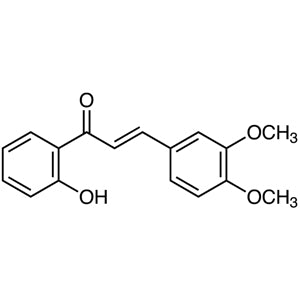
(E)-2'-Hydroxy-3,4-dimethoxychalcone TCI H1598
Regular price Rp 8.162.700,00Regular price -
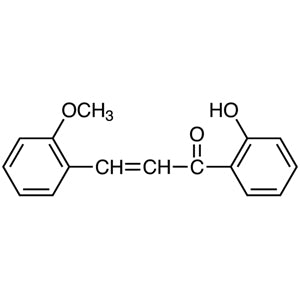
2'-Hydroxy-2-methoxychalcone TCI H1493
Regular price Rp 2.889.600,00Regular price