![2-[3-(9,9-Dimethyl-9H-fluoren-2-yl)phenyl]-4,4,5,5-tetramethyl-1,3,2-dioxaborolane (CAS 1005771-03-8) - TCI D5800 - AMI Scientific](http://amiscientific.com/cdn/shop/files/TCI2510D5800.jpg?v=1769142139&width=1946)
![2-[3-(9,9-Dimethyl-9H-fluoren-2-yl)phenyl]-4,4,5,5-tetramethyl-1,3,2-dioxaborolane (CAS 1005771-03-8) - TCI D5800 - AMI Scientific](http://amiscientific.com/cdn/shop/files/TCI2510D5800.jpg?v=1769142139&width=1445)
TCI D5800, 2-[3-(9,9-Dimethyl-9H-fluoren-2-yl)phenyl]-4,4,5,5-tetramethyl-1,3,2-dioxaborolane (CAS 1005771-03-8), is an organoboron reagent in the form of a pinacol boronate ester carrying a biphenyl-fluorene unit. In the synthesis laboratory, this compound serves as the nucleophilic partner in cross-coupling reactions, supplying the aromatic fragment that is joined to an aryl halide or triflate. The 9,9-dimethylfluorene unit it carries is a structural motif well known in materials chemistry, because its framework is rigid and conjugated, while the dimethyl groups at position 9 help maintain solubility and prevent molecular aggregation.
The property that makes this reagent the preferred choice is its ester form. Compared with free boronic acids, which are often hygroscopic and prone to protodeboronation or to forming boroxines, pinacol esters are generally solids that are far more stable in storage, easy to weigh out accurately, and more tolerant of routine handling at the bench. The ester nevertheless remains reactive under standard Suzuki–Miyaura conditions with a palladium catalyst and a base. The long, partly planar fluorene-phenyl framework contributes the desired optoelectronic character, such as a wide band gap and rigidity along the conjugated backbone.
In Indonesian laboratories, a reagent of this type is typically used in university and institutional research groups working on organic synthesis and organic electronic materials, where aryl building blocks are assembled step by step into larger conjugated structures. Its stable ester form suits laboratories that receive shipments over long distances and store reagents for extended periods before use, and it fits naturally into small-scale Suzuki–Miyaura work carried out on a Schlenk line or in a standard inert-atmosphere setup.
TCI brochures (PDF)
- Boron Compounds 2025-10-07 · p. 17
- Building Blocks for Organic Semiconductor 2026-03-24 · p. 15
Related TCI products
- TCI S0994 1161009-89-7 2-(9,9'-Spirobi[fluoren]-4-yl)-4,4,5,5-tetramethyl-1,3,2-dioxaborolane
- TCI S0980 884336-44-1 2-(9,9'-Spirobi[fluoren]-7-yl)-4,4,5,5-tetramethyl-1,3,2-dioxaborolane
- TCI P2562 1346007-05-3 2-(9,9'-Spirobi[fluoren]-3-yl)-4,4,5,5-tetramethyl-1,3,2-dioxaborolane
- TCI F1245 922706-40-9 2-(9H-Fluoren-2-yl)-4,4,5,5-tetramethyl-1,3,2-dioxaborolane
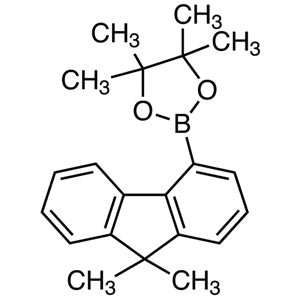
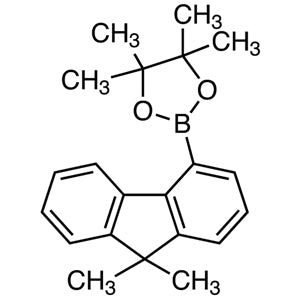
- TCI D5408 1365692-79-0 2-(9,9-Dimethyl-9H-fluoren-4-yl)-4,4,5,5-tetramethyl-1,3,2-dioxaborolane
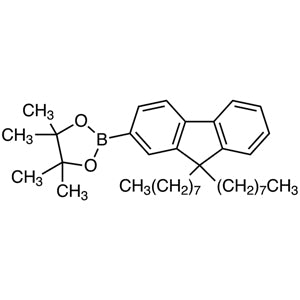
- TCI D5371 302554-81-0 2-(9,9-Di-n-octyl-9H-fluoren-2-yl)-4,4,5,5-tetramethyl-1,3,2-dioxaborolane
- Suzuki–Miyaura cross-coupling: the pinacol boronate is the nucleophilic partner that transfers its aryl fragment to an aryl halide or triflate under palladium catalysis with a base, which is precisely the transformation this reagent is designed for.
- Synthesis of conjugated organic electronic materials: the rigid, conjugated 9,9-dimethylfluorene framework is a recognised motif in materials chemistry, making this building block suitable for constructing backbones with a wide band gap.
- Construction of extended biaryl architectures: the compound already contains a biphenyl-fluorene unit, so a single coupling step installs a long, partly planar aromatic segment instead of requiring several separate ring-forming operations.
- Preparation of soluble, aggregation-resistant conjugated systems: the dimethyl substitution at position 9 of the fluorene helps maintain solubility and prevents molecular aggregation, which matters when target materials must be processed from solution.
- Reference and comparison work in organoboron methodology: because the pinacol ester resists protodeboronation and boroxine formation better than a free boronic acid, it is a dependable substrate for reproducible coupling studies and condition screening.
| Brand | TCI (Tokyo Chemical Industry) |
|---|---|
| CAS number | 1005771-03-8 |
| Molecular formula | — |
| Purity | — |
| Category | Chemistry > Organometallic Reagents > Organoboron [Organometallic Reagents] |
| Pack sizes | research-scale packaging as offered by the manufacturer; please confirm the available pack size when ordering |
| Physical form | pinacol boronate ester, generally supplied as a solid |
| Storage | keep in the tightly closed original container, cool, dry, and protected from moisture |
- Chemical name: 2-[3-(9,9-Dimethyl-9H-fluoren-2-yl)phenyl]-4,4,5,5-tetramethyl-1,3,2-dioxaborolane
Store the reagent in a cool, dry place inside its tightly closed original container, kept away from moisture, direct sunlight, and sources of heat or ignition. Amber glass or the manufacturer's supplied bottle is appropriate; for long-term storage or after repeated opening, keeping the container under an inert atmosphere and sealed with laboratory film helps limit exposure to atmospheric moisture. Handle the solid in a fume hood or a well-ventilated area, wearing safety glasses, nitrile gloves, and a laboratory coat, and avoid raising dust while weighing. Use clean, dry spatulas and glassware, since traces of water can compromise both the reagent and the coupling reaction. Segregate from strong oxidising agents, collect any spills as dry chemical waste, and consult the manufacturer's Safety Data Sheet before first use and for disposal.
—
Produk Terkait
-
2-(9,9'-Spirobi[fluoren]-4-yl)-4,4,5,5-tetramethyl-1,3,2-dioxaborolane TCI S0994
Regular price From Rp 1.724.100,00Regular price -
2-(9,9'-Spirobi[fluoren]-7-yl)-4,4,5,5-tetramethyl-1,3,2-dioxaborolane TCI S0980
Regular price Rp 1.961.400,00Regular price -
2-(9,9'-Spirobi[fluoren]-3-yl)-4,4,5,5-tetramethyl-1,3,2-dioxaborolane TCI P2562
Regular price From Rp 1.988.700,00Regular price -
2-(9H-Fluoren-2-yl)-4,4,5,5-tetramethyl-1,3,2-dioxaborolane TCI F1245
Regular price From Rp 2.837.100,00Regular price -
2-(9,9-Dimethyl-9H-fluoren-4-yl)-4,4,5,5-tetramethyl-1,3,2-dioxaborolane TCI D5408
Regular price From Rp 2.386.650,00Regular price -
2-(9,9-Di-n-octyl-9H-fluoren-2-yl)-4,4,5,5-tetramethyl-1,3,2-dioxaborolane TCI D5371
Regular price Rp 3.525.900,00Regular price -
2-(9,9-Diphenyl-9H-fluoren-4-yl)-4,4,5,5-tetramethyl-1,3,2-dioxaborolane TCI D5033
Regular price From Rp 1.749.300,00Regular price -
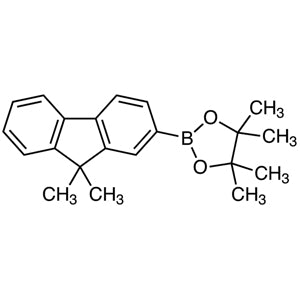
2-(9,9-Dimethyl-9H-fluoren-2-yl)-4,4,5,5-tetramethyl-1,3,2-dioxaborolane TCI D5018
Regular price From Rp 1.565.550,00Regular price
![1161009-89-7 2-(9,9'-Spirobi[fluoren]-4-yl)-4,4,5,5-tetramethyl-1,3,2-dioxaborolane - AMI Scientific](http://amiscientific.com/cdn/shop/files/TCI2510S0994.jpg?v=1769181254&width=533)
![884336-44-1 2-(9,9'-Spirobi[fluoren]-7-yl)-4,4,5,5-tetramethyl-1,3,2-dioxaborolane - AMI Scientific](http://amiscientific.com/cdn/shop/files/TCI2510S0980.jpg?v=1768206304&width=533)
![1346007-05-3 2-(9,9'-Spirobi[fluoren]-3-yl)-4,4,5,5-tetramethyl-1,3,2-dioxaborolane - AMI Scientific](http://amiscientific.com/cdn/shop/files/TCI2510P2562.jpg?v=1769143372&width=533)