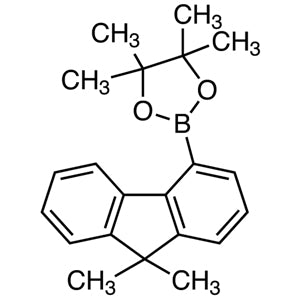
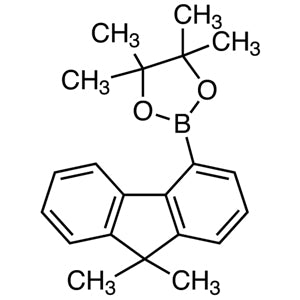
2-(9,9-Dimethyl-9H-fluoren-4-yl)-4,4,5,5-tetramethyl-1,3,2-dioxaborolane is an organoboron compound widely used in organic chemistry laboratories. As a key reagent in organometallic chemistry, it plays a crucial role in various synthetic processes, particularly in cross-coupling reactions. This compound is valued for its ability to participate in complex molecular transformations, making it an essential tool for researchers working on advanced organic synthesis. Its unique structure enables it to interact effectively with transition metals, enhancing the efficiency of chemical reactions.
The compound's stability and controlled reactivity make it a preferred choice for precision-based applications. It is known for its ability to remain intact under various reaction conditions while still being reactive enough to facilitate desired chemical transformations. This balance between stability and reactivity is critical in modern synthetic chemistry, where accuracy and reproducibility are paramount. Additionally, its compatibility with palladium-based catalysts makes it ideal for use in reactions such as Suzuki-Miyaura and Kumada-Corriu coupling.
In Indonesian laboratories, this compound is commonly used in organic chemistry research, especially in the synthesis of heterocyclic compounds and bioactive molecules. Its availability in the local market supports scientific research and development efforts, enabling researchers to conduct high-precision experiments. Its application in pharmaceutical and biochemical studies further highlights its importance in both academic and industrial settings.
TCI brochures (PDF)
- Boron Compounds 2025-10-07 · p. 17
- Building Blocks for Organic Semiconductor 2026-03-24 · p. 15
Related TCI products
- TCI S0994 1161009-89-7 2-(9,9'-Spirobi[fluoren]-4-yl)-4,4,5,5-tetramethyl-1,3,2-dioxaborolane
- TCI S0980 884336-44-1 2-(9,9'-Spirobi[fluoren]-7-yl)-4,4,5,5-tetramethyl-1,3,2-dioxaborolane
- TCI P2562 1346007-05-3 2-(9,9'-Spirobi[fluoren]-3-yl)-4,4,5,5-tetramethyl-1,3,2-dioxaborolane
- TCI F1245 922706-40-9 2-(9H-Fluoren-2-yl)-4,4,5,5-tetramethyl-1,3,2-dioxaborolane
- TCI D5800 1005771-03-8 2-[3-(9,9-Dimethyl-9H-fluoren-2-yl)phenyl]-4,4,5,5-tetramethyl-1,3,2-dioxaborolane
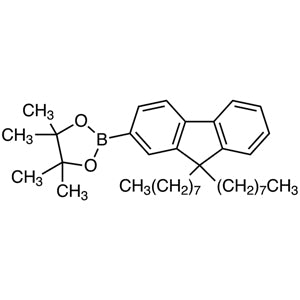
- TCI D5371 302554-81-0 2-(9,9-Di-n-octyl-9H-fluoren-2-yl)-4,4,5,5-tetramethyl-1,3,2-dioxaborolane
- Suzuki-Miyaura coupling reactions for the synthesis of heterocyclic compounds due to its compatibility with palladium catalysts and high reactivity.
- Kumada-Corriu coupling applications in the development of bioactive molecules, leveraging its ability to form stable carbon-metal bonds.
- Organic synthesis of complex molecules requiring precise chemical transformations, benefiting from its controlled reactivity and stability.
- Pharmaceutical research for the creation of drug candidates, as it supports the formation of diverse molecular structures.
- Biochemical studies involving the synthesis of active compounds, where its reactivity and structural versatility are highly advantageous.
| Brand | TCI |
|---|---|
| CAS number | 1365692-79-0 |
| Molecular formula | — |
| Purity | — |
| Category | Chemistry > Organometallic Reagents > Organoboron [Organometallic Reagents] |
| Pack sizes | Available in various quantities as per supplier specifications |
| Physical form | Solid or liquid, depending on formulation |
| Storage | Store in a cool, dry place away from moisture and direct light |
This compound should be stored in a cool, dry environment to maintain its stability and reactivity. It is recommended to keep it in a tightly sealed container to prevent exposure to moisture and air, which can affect its chemical integrity. Due to its potential reactivity with certain materials, it is best stored in a chemically inert container such as glass or polyethylene. Laboratory personnel should handle the compound with care, using appropriate personal protective equipment to ensure safety. Regular monitoring of storage conditions is advised to maintain optimal performance in experimental applications.
—
Produk Terkait
-
2-(9,9'-Spirobi[fluoren]-4-yl)-4,4,5,5-tetramethyl-1,3,2-dioxaborolane TCI S0994
Regular price From Rp 1.724.100,00Regular price -
2-(9,9'-Spirobi[fluoren]-7-yl)-4,4,5,5-tetramethyl-1,3,2-dioxaborolane TCI S0980
Regular price Rp 1.961.400,00Regular price -
2-(9,9'-Spirobi[fluoren]-3-yl)-4,4,5,5-tetramethyl-1,3,2-dioxaborolane TCI P2562
Regular price From Rp 1.988.700,00Regular price -
2-(9H-Fluoren-2-yl)-4,4,5,5-tetramethyl-1,3,2-dioxaborolane TCI F1245
Regular price From Rp 2.837.100,00Regular price -
2-[3-(9,9-Dimethyl-9H-fluoren-2-yl)phenyl]-4,4,5,5-tetramethyl-1,3,2-dioxaborolane TCI D5800
Regular price From Rp 1.565.550,00Regular price -
2-(9,9-Di-n-octyl-9H-fluoren-2-yl)-4,4,5,5-tetramethyl-1,3,2-dioxaborolane TCI D5371
Regular price Rp 3.525.900,00Regular price -
2-(9,9-Diphenyl-9H-fluoren-4-yl)-4,4,5,5-tetramethyl-1,3,2-dioxaborolane TCI D5033
Regular price From Rp 1.749.300,00Regular price -
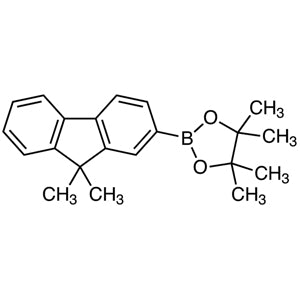
2-(9,9-Dimethyl-9H-fluoren-2-yl)-4,4,5,5-tetramethyl-1,3,2-dioxaborolane TCI D5018
Regular price From Rp 1.565.550,00Regular price
![1161009-89-7 2-(9,9'-Spirobi[fluoren]-4-yl)-4,4,5,5-tetramethyl-1,3,2-dioxaborolane - AMI Scientific](http://amiscientific.com/cdn/shop/files/TCI2510S0994.jpg?v=1769181254&width=533)
![884336-44-1 2-(9,9'-Spirobi[fluoren]-7-yl)-4,4,5,5-tetramethyl-1,3,2-dioxaborolane - AMI Scientific](http://amiscientific.com/cdn/shop/files/TCI2510S0980.jpg?v=1768206304&width=533)
![1346007-05-3 2-(9,9'-Spirobi[fluoren]-3-yl)-4,4,5,5-tetramethyl-1,3,2-dioxaborolane - AMI Scientific](http://amiscientific.com/cdn/shop/files/TCI2510P2562.jpg?v=1769143372&width=533)

![2-[3-(9,9-Dimethyl-9H-fluoren-2-yl)phenyl]-4,4,5,5-tetramethyl-1,3,2-dioxaborolane (CAS 1005771-03-8) - TCI D5800 - AMI Scientific](http://amiscientific.com/cdn/shop/files/TCI2510D5800.jpg?v=1769142139&width=533)