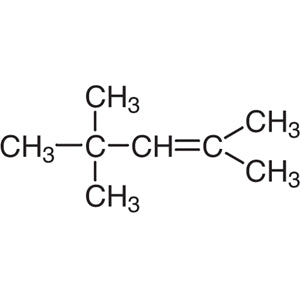
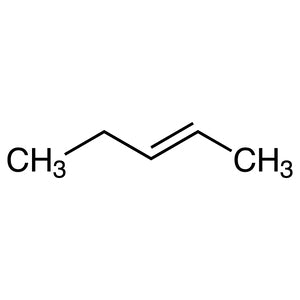
TCI E0158 3-Ethyl-2-pentene is a branched unsaturated hydrocarbon belonging to the alkene family. Its molecule contains a single carbon-carbon double bond with a high degree of substitution, which is why it is frequently treated as a model polysubstituted alkene in organic chemistry laboratories. As a non-heterocyclic building block, this compound serves not only as a synthetic intermediate but also as an experimental substrate for probing addition, oxidation, and catalysis reactions. Its skeleton is simple yet unsymmetrical, so reaction outcomes remain informative when researchers want to understand the selectivity of a newly developed method.
The characteristic that makes this compound a preferred choice is the combination of structural simplicity with the substitution level of its double bond. Alkenes carrying many substituents react with distinctive patterns of regioselectivity and stereoselectivity, making them well suited to testing how far a given reagent or catalyst can cope with steric hindrance. Because it is a volatile, non-polar hydrocarbon liquid, the compound dissolves readily in non-polar organic solvents, can be recovered easily by distillation, and does not interfere with gas chromatographic analysis. These volatile properties are part of what makes it convenient in routine bench work.
In Indonesian laboratories, materials of this type are typically found in university organic chemistry groups, catalysis research units, and industrial R&D laboratories that develop and validate synthetic methods. The compound is generally handled in small quantities on the bench, taken up in non-polar solvent systems, and monitored by gas chromatography. Its straightforward recovery by distillation suits laboratories that need to reuse substrates or verify mass balance across a series of trial reactions.
- Addition reaction studies — the highly substituted double bond gives clear regiochemical outcomes, so researchers can read off how a reagent orients itself across an unsymmetrical alkene.
- Oxidation method development — the single, well-defined carbon-carbon double bond acts as the only reactive site, letting analysts attribute observed products directly to oxidation of that bond.
- Catalysis screening and benchmarking — the steric bulk around the alkene makes this compound a demanding test substrate for judging whether a new catalyst tolerates hindered olefins.
- Selectivity and stereochemistry investigations — because the skeleton is unsymmetrical yet simple, product distributions report meaningfully on both regioselectivity and stereoselectivity of a method.
- Synthetic intermediate work — as a non-heterocyclic building block, it can be carried forward into further transformations while its volatility allows easy removal of excess material by distillation.
| Brand | TCI |
|---|---|
| CAS number | 816-79-5 |
| Molecular formula | — |
| Purity | — |
| Category | Chemistry > Building Blocks > Non-Heterocyclic Building Blocks |
| Pack sizes | available in standard TCI research and laboratory pack sizes; please confirm the size required when ordering |
| Physical form | volatile, non-polar hydrocarbon liquid |
| Storage | keep in a tightly closed container in a cool, well-ventilated area away from ignition sources |
Store this product in its original tightly closed container in a cool, dry, well-ventilated area, away from heat, sparks, open flames, and strong oxidising agents. Because the material is a volatile non-polar hydrocarbon, use containers with vapour-tight closures and avoid leaving vessels open on the bench longer than necessary. Handle in a fume hood, wear safety glasses, chemical-resistant gloves, and a laboratory coat, and ground equipment where flammable vapours may accumulate. Transfer only the quantity needed for immediate work, and consult the manufacturer's safety data sheet before use and disposal.
—
Produk Terkait
-
2,3,4-Trimethyl-2-pentene TCI T1080
Regular price Rp 1.246.350,00Regular price -
2,4,4-Trimethyl-2-pentene TCI T0780
Regular price From Rp 4.743.900,00Regular price -
2,4,4-Trimethyl-1-pentene TCI T0665
Regular price From Rp 1.405.950,00Regular price -
trans-2-Pentene TCI P0635
Regular price Rp 6.599.250,00Regular price -
1-Pentene TCI P0316
Regular price From Rp 955.500,00Regular price -
cis-2-Pentene TCI P0065
Regular price Rp 5.644.800,00Regular price -
2-Pentene(cis-andtrans-mixture) TCI P0064
Regular price From Rp 1.035.300,00Regular price -
3-Methyl-1-pentene TCI M0575
Regular price From Rp 1.405.950,00Regular price