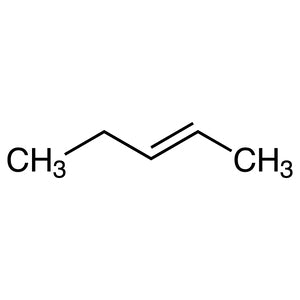
2-Pentene (cis- and trans- mixture) is a five-carbon alkene with a double bond between the second and third carbon atoms. This TCI product, catalogue number P0064 (CAS 109-68-2), belongs to the non-heterocyclic building block group and is supplied as a mixture of both geometric isomers. In the laboratory, 2-Pentene serves as a simple olefin substrate for many addition reactions, as a starting material for the synthesis of C5 compounds, and as a model compound in catalysis studies and in mechanistic studies of internal alkenes.
Chemists choose this material because its internal double bond reacts readily in many classic transformations, including hydrogenation, halogenation, hydrohalogenation, epoxidation, and ozonolysis. Because it is a mixture of cis and trans isomers, the product suits experiments that do not need a single isomer. It is also useful for studying how a catalyst or a set of reaction conditions changes the isomer ratio. The molecule is small and volatile, so reaction products are easy to monitor by gas chromatography. This makes it practical for quick reaction screening and for clear analysis of results.
In Indonesia, 2-Pentene is relevant to organic chemistry laboratories at universities, both for teaching practicals and for research on alkene reactions. Chemical engineering and petrochemical laboratories that study catalysts for isomerisation, metathesis, or hydrogenation can also use it as a representative internal olefin. Its simple structure and well-known reactivity make it a dependable reference substrate when researchers compare catalyst performance, check new reaction conditions, or show students the basic principles of alkene chemistry.
Related TCI products
- TCI P0635 646-04-8 trans-2-Pentene
- TCI M0395 4461-48-7 4-Methyl-2-pentene (cis- and trans- mixture)
- TCI M0394 674-76-0 trans-4-Methyl-2-pentene
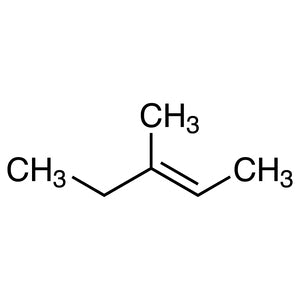
- TCI M0312 616-12-6 trans-3-Methyl-2-pentene
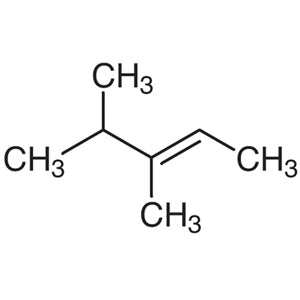
- TCI D1256 4914-92-5 trans-3,4-Dimethyl-2-pentene
- TCI P1841 504-60-9 1,3-Pentadiene (cis- and trans- mixture) (stabilized with TBC)
- Addition reaction studies: the reactive internal double bond takes part readily in hydrogenation, halogenation, and hydrohalogenation, so it works well as a simple olefin substrate for showing and studying addition chemistry.
- Epoxidation and ozonolysis experiments: the internal alkene undergoes these classic oxidative transformations, so researchers and students can study oxygen-transfer and bond-cleavage reactions on a small, easily handled molecule.
- Synthesis of C5 compounds: as a five-carbon building block, 2-Pentene is a convenient starting material for preparing C5 derivatives through standard alkene functionalisation routes in organic synthesis work.
- Catalysis and isomer-ratio studies: because it is supplied as a cis/trans mixture, it is well suited to examining how catalysts or reaction conditions shift the isomer ratio during isomerisation or related processes.
- Reaction monitoring by gas chromatography: its small, volatile molecular structure makes both the starting material and its products easy to separate and follow by GC, which supports kinetic and mechanistic studies.
| Brand | TCI (catalogue number P0064) |
|---|---|
| CAS number | 109-68-2 |
| Molecular formula | — |
| Purity | — |
| Category | Chemistry > Building Blocks > Non-Heterocyclic Building Blocks |
| Pack sizes | please refer to the available options on the product listing |
| Physical form | volatile material; store tightly closed in a cool, well-ventilated area away from ignition sources |
| Storage | — |
- Composition: mixture of cis- and trans- isomers of 2-Pentene
Keep 2-Pentene in its original, tightly sealed container in a cool, dry, well-ventilated place. Store it away from heat, sparks, open flames, and strong oxidising agents. Because the material is volatile, close containers right after use to limit evaporation and vapour build-up. Handle it in a fume hood and wear suitable personal protective equipment, including safety glasses, chemical-resistant gloves, and a laboratory coat. Ground equipment where needed, and avoid breathing vapours. Always read the supplier's Safety Data Sheet before use and follow local regulations for storage and waste disposal.
—
Produk Terkait
-
trans-2-Pentene TCI P0635
Regular price Rp 6.599.250,00Regular priceRp 4.614.750,00Sale price Rp 6.599.250,00 -
4-Methyl-2-pentene(cis-andtrans-mixture) TCI M0395
Regular price From Rp 1.988.700,00Regular priceRp 1.390.200,00Sale price From Rp 1.988.700,00 -
trans-4-Methyl-2-pentene TCI M0394
Regular price From Rp 2.121.000,00Regular priceRp 1.482.600,00Sale price From Rp 2.121.000,00 -
trans-3-Methyl-2-pentene TCI M0312
Regular price From Rp 2.016.000,00Regular priceRp 1.409.100,00Sale price From Rp 2.016.000,00 -
trans-3,4-Dimethyl-2-pentene TCI D1256
Regular price Rp 5.169.150,00Regular priceRp 3.614.100,00Sale price Rp 5.169.150,00 -
1,3-Pentadiene(cis-andtrans-mixture)(stabilizedwithTBC) TCI P1841
Regular price Rp 10.229.100,00Regular priceRp 7.152.600,00Sale price Rp 10.229.100,00 -
beta-Methylstyrene(cis-andtrans-mixture)(stabilizedwithTBC) TCI P0495
Regular price Rp 4.771.200,00Regular priceRp 3.335.850,00Sale price Rp 4.771.200,00 -
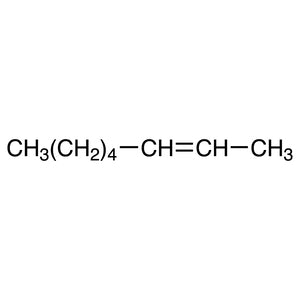
2-Octene(cis-andtrans-mixture) TCI O0042
Regular price From Rp 1.220.100,00Regular priceRp 852.600,00Sale price From Rp 1.220.100,00