

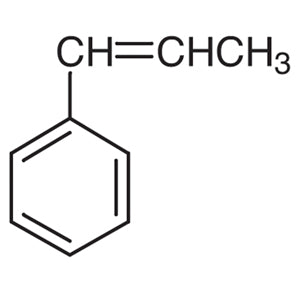
Beta-Methylstyrene (cis- and trans- mixture), also known as TCI P0495 637-50-3, is a chemical compound widely used in organic synthesis as a building block in laboratories. It is a versatile reagent that plays a crucial role in the development of complex organic molecules, including polymers, pharmaceuticals, and industrial chemicals. Its aromatic structure with a methyl group at the beta position contributes to its reactivity, making it a valuable component in various synthetic pathways. This compound is commonly used in research settings where the creation of new chemical structures is required.
The compound’s chemical stability, combined with its reactivity, makes it a preferred choice for chemists working on diverse reactions such as polymerization, substitution, and addition. Its ability to participate in multiple reaction types allows for the synthesis of a wide range of products. The stabilization with tert-Butylcatechol (TBC) ensures that the compound remains stable during storage and handling, reducing the risk of degradation. This makes it a reliable and consistent material for laboratory use.
In Indonesian laboratories, beta-methylstyrene is extensively used in chemical research and product development. It is a key component in the work of research institutions and manufacturing companies that focus on creating new materials and compounds. Its availability and stability make it a go-to reagent for many synthetic processes in both academic and industrial settings.
Related TCI products
- TCI M1175 873-66-5 trans-beta-Methylstyrene (stabilized with TBC)
- TCI M1174 766-90-5 cis-beta-Methylstyrene (stabilized with TBC)
- TCI M0428 622-97-9 4-Methylstyrene (stabilized with TBC)
- TCI M0259 611-15-4 2-Methylstyrene (stabilized with TBC)
- TCI I0132 97-54-1 Isoeugenol (cis- and trans- mixture)
- TCI B1550 76439-00-4 1,4-Bis(4-methylstyryl)benzene
- Organic synthesis is a primary application where beta-methylstyrene is used to create complex molecules due to its reactivity and structural versatility.
- Polymer research benefits from this compound as it can be used in polymerization reactions to form various types of polymers with specific properties.
- Pharmaceutical development often incorporates beta-methylstyrene as a building block in the synthesis of drug molecules and active pharmaceutical ingredients.
- Industrial chemical production utilizes this compound to manufacture a range of chemical products used in different sectors such as agriculture and manufacturing.
- Material science applications leverage beta-methylstyrene for the creation of new materials with tailored chemical and physical properties.
| Brand | TCI |
|---|---|
| CAS number | 637-50-3 |
| Molecular formula | — |
| Purity | — |
| Category | Chemistry > Building Blocks > Non-Heterocyclic Building Blocks |
| Pack sizes | Available in various quantities as per supplier specifications |
| Physical form | Liquid |
| Storage | Store in a cool, dry place away from direct sunlight and incompatible materials |
Beta-methylstyrene should be stored in a cool, dry place, away from direct sunlight and incompatible materials. It is recommended to use sealed containers made of materials compatible with the compound to prevent contamination and evaporation. Due to its reactivity, it should be handled in a well-ventilated area and with appropriate personal protective equipment. The presence of TBC as a stabilizer helps maintain its stability during storage, but it is still important to ensure that the compound is kept in a controlled environment to prevent degradation. Proper labeling and storage practices are essential to ensure safety and maintain the integrity of the compound in laboratory settings.
—
Produk Terkait
-
trans-beta-Methylstyrene(stabilizedwithTBC) TCI M1175
Regular price Rp 6.333.600,00Regular price -
cis-beta-Methylstyrene(stabilizedwithTBC) TCI M1174
Regular price Rp 5.592.300,00Regular price -
4-Methylstyrene(stabilizedwithTBC) TCI M0428
Regular price From Rp 955.500,00Regular price -
2-Methylstyrene(stabilizedwithTBC) TCI M0259
Regular price Rp 5.009.550,00Regular price -
Isoeugenol(cis-andtrans-mixture) TCI I0132
Regular price From Rp 505.050,00Regular price -
1,4-Bis(4-methylstyryl)benzene TCI B1550
Regular price Rp 5.194.350,00Regular price -
(mixtureof1H-and3H-form) TCI M1425
Regular price From Rp 3.287.550,00Regular price -
1,3-Pentadiene(cis-andtrans-mixture)(stabilizedwithTBC) TCI P1841
Regular price Rp 10.229.100,00Regular price


![2-Methylbenzo[e]indene (mixture of 1H- and 3H-form) - AMI Scientific](http://amiscientific.com/cdn/shop/files/TCI2510M1425.jpg?v=1767124955&width=533)
