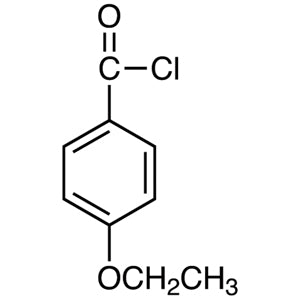
TCI E0700 4-Ethoxybenzoyl Chloride is an aromatic acid chloride carrying an ethoxy group at the para position of the benzene ring, supplied by TCI as a non-heterocyclic building block for acylation reactions. The compound is the activated form of 4-ethoxybenzoic acid, which allows researchers to transfer the aromatic acyl group directly onto a reaction partner without first introducing a separate activating agent. In synthetic laboratories, reagents of this type form the backbone of amide, ester, and aromatic ketone formation, particularly where a fast reaction, a high yield, and by-products that are easy to remove from the reaction mixture are required.
The principal characteristic that makes this reagent a preferred choice is the reactivity of the acyl chloride group, which far exceeds that of the corresponding carboxylic acid or its esters, because the chlorine atom is an excellent leaving group. Reactions with amines or alcohols proceed under mild conditions, generally requiring no more than an acid-scavenging base at low temperature. The electron-donating ethoxy group gives the aromatic ring its own distinctive electronic character while contributing an alkoxy chain that is frequently required in target molecules in the materials and pharmaceutical fields.
In Indonesian laboratories, this class of reagent is used in university and institutional organic synthesis groups, in medicinal chemistry programmes preparing substituted benzamide and benzoate series, and in materials research where para-alkoxy aromatic units are built into larger structures. Because it is supplied as a ready-activated acyl donor, it shortens multi-step routes and reduces the number of reagents that must be stocked, which is a practical advantage for laboratories working with limited consumable inventories.
- Amide bond formation — the acyl chloride reacts readily with primary and secondary amines under mild conditions, giving 4-ethoxybenzamide derivatives without requiring a separate coupling or activating reagent.
- Ester synthesis — alcohols and phenols can be acylated directly with this reagent in the presence of an acid-scavenging base, producing 4-ethoxybenzoate esters cleanly and in high yield.
- Friedel–Crafts acylation — as an activated aromatic acyl donor, it serves in the preparation of aromatic ketones where a para-ethoxy-substituted benzoyl fragment must be introduced onto another ring.
- Medicinal chemistry building block — the para-alkoxy aromatic unit is a recurring motif in pharmaceutical intermediates, making this reagent useful for assembling substituted benzamide and benzoate candidate series.
- Materials chemistry intermediates — researchers use it to install an aromatic core bearing a pendant ethoxy chain into larger target molecules, where such alkoxy-substituted aromatic units are frequently required.
| Brand | TCI (Tokyo Chemical Industry) |
|---|---|
| CAS number | 16331-46-7 |
| Molecular formula | — |
| Purity | — |
| Category | Chemistry > Building Blocks > Non-Heterocyclic Building Blocks |
| Pack sizes | available in standard TCI research-scale packaging; please confirm the pack size when ordering |
| Physical form | — |
| Storage | store in a tightly closed container under dry conditions, protected from moisture |
- Product code: E0700
Acyl chlorides are moisture-sensitive and react with water and atmospheric humidity, releasing hydrogen chloride. Store the container tightly closed in a cool, dry, well-ventilated place, away from water, alcohols, amines, and strong bases. Use containers made of material compatible with acid chlorides, keep them clearly labelled, and reseal immediately after each use; storage under an inert atmosphere is preferable for material that will be opened repeatedly. Handle in a fume hood using gloves, safety glasses, and a laboratory coat, since the compound and the hydrogen chloride generated on hydrolysis are corrosive and irritating to the eyes, skin, and respiratory tract. Transfer with dry glassware and dry syringes or cannulas, and dispose of residues as chemical waste in accordance with the institution's laboratory waste procedures.
—
Produk Terkait
-
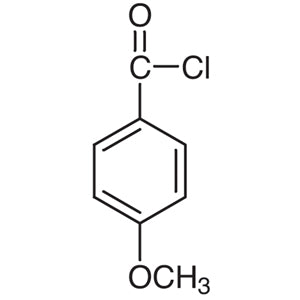
4-MethoxybenzoylChloride TCI M0721
Regular price From Rp 980.700,00Regular price -
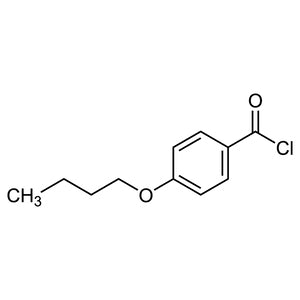
4-ButoxybenzoylChloride TCI B6724
Regular price Rp 3.312.750,00Regular price -
2-EthoxybenzoylChloride TCI E0676
Regular price Rp 1.696.800,00Regular price -
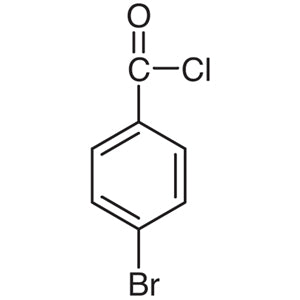
4-BromobenzoylChloride TCI B0558
Regular price From Rp 2.094.750,00Regular price -
p-ToluoylChloride TCI T0311
Regular price From Rp 557.550,00Regular price -
4-IodobenzoylChloride TCI I0508
Regular price From Rp 1.776.600,00Regular price -
4-HeptylbenzoylChloride TCI H0792
Regular price Rp 2.916.900,00Regular price -
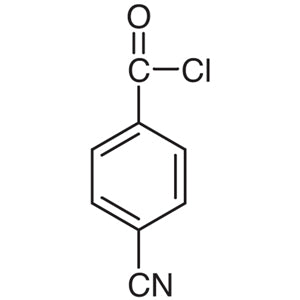
4-CyanobenzoylChloride TCI C1182
Regular price From Rp 2.094.750,00Regular price