

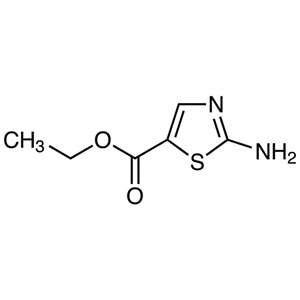
Ethyl 2-Aminothiazole-5-carboxylate is a chemical compound widely used as a building block in the synthesis of heterocyclic compounds. It plays a crucial role in organic chemistry laboratories by serving as a versatile intermediate in the creation of complex molecular structures. This compound is particularly valued for its ability to participate in various chemical reactions, making it an essential tool for researchers working on the development of new pharmaceuticals and industrial chemicals. Its unique structure, combining a thiazole ring with an amino group, allows for a wide range of functional group modifications, enhancing its utility in synthetic pathways.
The compound's stability and controlled reactivity make it a preferred choice for laboratory applications. Its predictable behavior under different reaction conditions ensures reliable results, which is vital in research settings where precision is key. Additionally, Ethyl 2-Aminothiazole-5-carboxylate exhibits good solubility in common organic solvents, facilitating its use in a variety of synthetic protocols. These properties contribute to its popularity among chemists seeking a dependable and adaptable reagent for their experiments.
In Indonesian laboratories, Ethyl 2-Aminothiazole-5-carboxylate is commonly used in organic chemistry research, especially in the development of bioactive compounds. It is frequently employed in academic and industrial research settings to support the synthesis of new materials and drug candidates. Its availability and reliability make it a standard reagent in many chemical laboratories across Indonesia, supporting both educational and applied research initiatives.
TCI brochures (PDF)
- Aminothiazole Building Blocks for the Synthesis of Bioactive Compounds 2025-06-26 · p. 1
Related TCI products
- TCI M2598 6633-61-0 Methyl 2-Aminothiazole-5-carboxylate
- TCI M2581 118452-04-3 Methyl 2-Aminothiazole-4-carboxylate
- TCI E1215 5398-36-7 Ethyl 2-Aminothiazole-4-carboxylate
- TCI A0633 96-50-4 2-Aminothiazole
- TCI A0936 3882-98-2 2-Aminothiazoline Hydrochloride
- TCI B5501 147804-30-6 tert-Butyl 1-Oxa-6-azaspiro[2.5]octane-6-carboxylate
- Organic synthesis of bioactive compounds due to its versatile functional groups and reactivity.
- Development of pharmaceutical intermediates because of its ability to undergo various chemical modifications.
- Research in heterocyclic chemistry as a building block for complex molecular structures.
- Industrial chemical production where stable and reactive compounds are required for process optimization.
- Academic research in medicinal chemistry for the exploration of new drug candidates and molecular frameworks.
| Brand | TCI |
|---|---|
| CAS number | 32955-21-8 |
| Molecular formula | — |
| Purity | — |
| Category | Chemistry > Building Blocks > Heterocyclic Building Blocks |
| Pack sizes | Available in various quantities as per standard laboratory supply formats |
| Physical form | Solid powder |
| Storage | Store in a cool, dry place away from direct sunlight and moisture |
Ethyl 2-Aminothiazole-5-carboxylate should be stored in a cool, dry environment to maintain its chemical integrity. It is recommended to keep the compound in a sealed container to prevent moisture absorption, which can affect its stability. Suitable storage containers include glass or high-density polyethylene bottles to ensure chemical compatibility. Avoid exposure to direct sunlight and heat sources to prevent degradation. In a laboratory setting, it is important to handle the compound with appropriate personal protective equipment, such as gloves and safety goggles, to ensure safe handling. Regular monitoring of storage conditions is advised to maintain the quality and usability of the compound in research applications.
—
Produk Terkait
-
Methyl2-Aminothiazole-5-carboxylate TCI M2598
Regular price From Rp 1.087.800,00Regular price -
Methyl2-Aminothiazole-4-carboxylate TCI M2581
Regular price From Rp 1.060.500,00Regular price -
Ethyl2-Aminothiazole-4-carboxylate TCI E1215
Regular price From Rp 1.115.100,00Regular price -
2-Aminothiazole TCI A0633
Regular price From Rp 530.250,00Regular price -
2-AminothiazolineHydrochloride TCI A0936
Regular price From Rp 1.431.150,00Regular price -
tert-Butyl1-Oxa-6-azaspiro[2.5]octane-6-carboxylate TCI B5501
Regular price From Rp 3.021.900,00Regular price -
tert-Butyl6-Oxa-3-azabicyclo[3.1.0]hexane-3-carboxylate TCI B5385
Regular price From Rp 689.850,00Regular price -
tert-Butyl3-Carbamoylpyrrolidine-1-carboxylate TCI B5248
Regular price From Rp 1.060.500,00Regular price


![147804-30-6 tert-Butyl 1-Oxa-6-azaspiro[2.5]octane-6-carboxylate - AMI Scientific](http://amiscientific.com/cdn/shop/files/TCI2510B5501_08674994-ba62-46fc-acd1-54c812460ed8.jpg?v=1767862194&width=533)
![114214-49-2 tert-Butyl 6-Oxa-3-azabicyclo[3.1.0]hexane-3-carboxylate - AMI Scientific](http://amiscientific.com/cdn/shop/files/TCI2510B5385_5494a0f2-ca27-4c7c-b2aa-345805a88f08.jpg?v=1767861794&width=533)
