

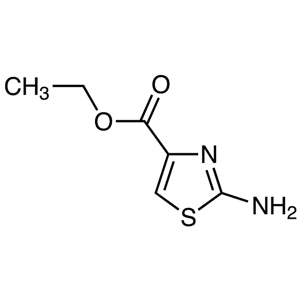
Ethyl 2-Aminothiazole-4-carboxylate is a chemical compound widely used as a building block in the synthesis of heterocyclic compounds. This versatile reagent plays a crucial role in organic chemistry laboratories, where it serves as a foundational material for creating complex molecular structures. Its unique chemical structure allows for a variety of chemical reactions, including substitution, condensation, and bond formation, making it an essential component in synthetic pathways. The compound is particularly valuable in the development of pharmaceuticals and other organic compounds due to its reactivity and structural adaptability.
One of the key properties that make Ethyl 2-Aminothiazole-4-carboxylate a preferred choice is its chemical stability under controlled conditions. It can react with a range of reagents such as acids, bases, and other organic compounds, enabling chemists to tailor its behavior for specific applications. Additionally, its heterocyclic structure provides inherent stability against oxidation and reduction, which is beneficial in experiments requiring controlled reactivity. These characteristics make it a reliable and adaptable reagent for various synthetic processes.
In Indonesian laboratories, Ethyl 2-Aminothiazole-4-carboxylate is commonly used in organic chemistry research, especially in pharmacological studies and the synthesis of new compounds. It is a staple in academic and research institutions, supporting experiments that aim to develop bioactive molecules and explore chemical reactivity. Its widespread use highlights its importance in both educational and applied research settings within the country.
Related TCI products
- TCI M2598 6633-61-0 Methyl 2-Aminothiazole-5-carboxylate
- TCI M2581 118452-04-3 Methyl 2-Aminothiazole-4-carboxylate
- TCI E0907 32955-21-8 Ethyl 2-Aminothiazole-5-carboxylate
- TCI A0633 96-50-4 2-Aminothiazole
- TCI A0936 3882-98-2 2-Aminothiazoline Hydrochloride
- TCI B5501 147804-30-6 tert-Butyl 1-Oxa-6-azaspiro[2.5]octane-6-carboxylate
- Organic synthesis of heterocyclic compounds due to its versatile reactivity and structural adaptability.
- Pharmaceutical research for the development of bioactive molecules and drug candidates.
- Academic teaching and research in chemistry, providing a foundational reagent for student experiments.
- Development of new organic compounds through controlled chemical reactions and bond formation.
- Investigation of chemical stability and reactivity in controlled laboratory environments.
| Brand | TCI |
|---|---|
| CAS number | 5398-36-7 |
| Molecular formula | — |
| Purity | — |
| Category | Chemistry > Building Blocks > Heterocyclic Building Blocks |
| Pack sizes | Available in various quantities as per supplier specifications |
| Physical form | Solid or crystalline, depending on the batch |
| Storage | Store in a cool, dry place away from direct sunlight and moisture |
Ethyl 2-Aminothiazole-4-carboxylate should be stored in a cool, dry environment to maintain its chemical stability. It is recommended to keep the compound in a sealed container to prevent exposure to moisture and air, which may affect its reactivity. Suitable storage containers include glass or high-density polyethylene (HDPE) bottles with tight-fitting lids. In laboratory settings, it is important to handle the compound with appropriate personal protective equipment (PPE) such as gloves and safety goggles to ensure safety during use. Avoid contact with strong acids or bases, as they may initiate unwanted reactions. Proper labeling of containers is also essential to ensure safe handling and prevent accidental exposure.
—
Produk Terkait
-
Methyl2-Aminothiazole-5-carboxylate TCI M2598
Regular price From Rp 1.087.800,00Regular price -
Methyl2-Aminothiazole-4-carboxylate TCI M2581
Regular price From Rp 1.060.500,00Regular price -
Ethyl2-Aminothiazole-5-carboxylate TCI E0907
Regular price From Rp 1.326.150,00Regular price -
2-Aminothiazole TCI A0633
Regular price From Rp 530.250,00Regular price -
2-AminothiazolineHydrochloride TCI A0936
Regular price From Rp 1.431.150,00Regular price -
tert-Butyl1-Oxa-6-azaspiro[2.5]octane-6-carboxylate TCI B5501
Regular price From Rp 3.021.900,00Regular price -
tert-Butyl6-Oxa-3-azabicyclo[3.1.0]hexane-3-carboxylate TCI B5385
Regular price From Rp 689.850,00Regular price -
tert-Butyl3-Carbamoylpyrrolidine-1-carboxylate TCI B5248
Regular price From Rp 1.060.500,00Regular price


![147804-30-6 tert-Butyl 1-Oxa-6-azaspiro[2.5]octane-6-carboxylate - AMI Scientific](http://amiscientific.com/cdn/shop/files/TCI2510B5501_08674994-ba62-46fc-acd1-54c812460ed8.jpg?v=1767862194&width=533)
![114214-49-2 tert-Butyl 6-Oxa-3-azabicyclo[3.1.0]hexane-3-carboxylate - AMI Scientific](http://amiscientific.com/cdn/shop/files/TCI2510B5385_5494a0f2-ca27-4c7c-b2aa-345805a88f08.jpg?v=1767861794&width=533)
