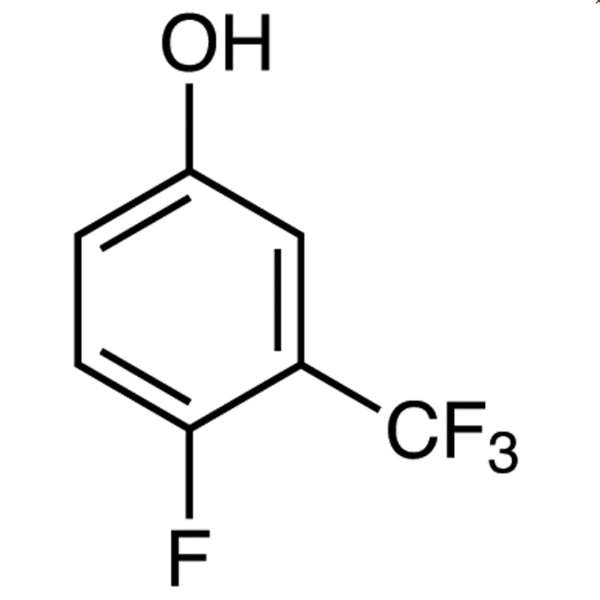
4-Fluoro-3-(trifluoromethyl)phenol is an aromatic phenol that carries both a single fluorine atom and a trifluoromethyl group on the benzene ring. The combination of these two fluorinated motifs makes it a high-value building block in modern organic synthesis. The phenolic hydroxyl group on this molecule serves as a reactive handle: it can be alkylated to form aryl ethers, acylated to form esters, converted into a triflate for transition-metal coupling reactions, or used directly in nucleophilic aromatic substitution reactions with suitably activated partners. Supplied by TCI, it reaches the bench as a ready-to-use intermediate for discovery-scale chemistry.
The main reason chemists select this compound is the electronic profile and lipophilicity it brings to a target structure. The trifluoromethyl group is one of the strongest electron-withdrawing substituents in common use among medicinal chemists, and its presence increases the acidity of the phenol, lowers the electron density of the ring, and improves the solubility of downstream derivatives in lipid phases. The additional fluorine atom reinforces these effects while also blocking metabolic oxidation at a ring position that is normally vulnerable. Because both groups are already installed from the outset, researchers avoid a separate trifluoromethylation step that demands expensive reagents and reaction conditions that are difficult to control.
In Indonesian laboratories, this building block is typically used in university research groups, pharmaceutical and agrochemical development units, and contract synthesis facilities that prepare fluorinated intermediates on a small to medium scale. It suits route-scouting work where a fluorinated aromatic core must be assembled quickly and reproducibly, and it fits well into the workflow of laboratories that rely on imported specialty reagents rather than in-house fluorination capability.
TCI brochures (PDF)
- Fluorination Reagents, Fluorinated Building Blocks 2026-03-18 · p. 19
Related TCI products
- TCI T1983 2787-79-3 2,3,5,6-Tetrafluoro-4-(trifluoromethyl)phenol
- TCI B4494 320-49-0 4-Bromo-3-(trifluoromethyl)phenol
- TCI B4493 50824-04-9 4-Bromo-2-(trifluoromethyl)phenol
- TCI B4492 81107-97-3 2-Bromo-4-(trifluoromethyl)phenol
- TCI B1869 349-58-6 3,5-Bis(trifluoromethyl)phenol
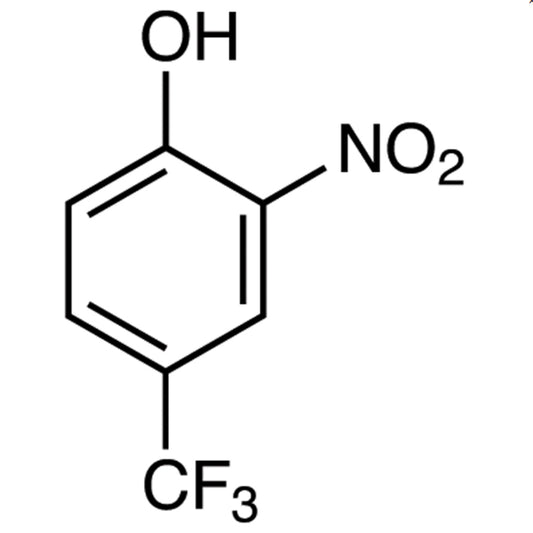
- TCI N0779 400-99-7 2-Nitro-4-(trifluoromethyl)phenol
- Aryl ether synthesis — the phenolic hydroxyl is readily alkylated under standard Williamson conditions, giving fluorinated aryl ethers without any need for prior functional group installation on the ring.
- Ester preparation — acylation of the hydroxyl group delivers phenolic esters in which the electron-poor ring alters hydrolytic behaviour, a property frequently exploited in prodrug and protecting-group strategies.
- Triflate formation for cross-coupling — converting the phenol into an aryl triflate provides a competent electrophilic partner for transition-metal-catalysed coupling reactions that build biaryl and heteroaryl frameworks.
- Nucleophilic aromatic substitution — the compound can be used directly with suitably activated partners, since the trifluoromethyl group lowers ring electron density and favours attack by nucleophiles.
- Medicinal chemistry scaffold construction — the pre-installed fluorine and trifluoromethyl groups raise lipophilicity and block metabolic oxidation, letting teams explore analogue series without running their own trifluoromethylation chemistry.
| Brand | TCI |
|---|---|
| CAS number | 61721-07-1 |
| Molecular formula | — |
| Purity | — |
| Category | Chemistry > Building Blocks > Fluorinated Building Blocks |
| Pack sizes | available in the pack sizes listed by the manufacturer for this catalogue number |
| Physical form | — |
| Storage | store as indicated on the manufacturer's label and safety data sheet |
- Catalogue number: F0754
- Chemical class: fluorinated aromatic phenol bearing one fluorine atom and one trifluoromethyl substituent
Keep the container tightly closed and store it in a cool, dry, well-ventilated place away from heat sources, direct sunlight, and incompatible materials, following the conditions stated on the manufacturer's label and safety data sheet. Original manufacturer packaging is the preferred container; if the material must be transferred, use clean, dry, chemically compatible glassware with a secure closure and label it fully. Handle the compound in a fume hood using safety glasses, chemically resistant gloves, and a laboratory coat, since phenols are generally corrosive to skin and eyes. Avoid inhaling dust or vapour, wash hands after handling, and consult the safety data sheet before beginning any work.
—
Produk Terkait
-
2,3,5,6-Tetrafluoro-4-(trifluoromethyl)phenol TCI T1983
Regular price Rp 2.306.850,00Regular price -
4-Bromo-3-(trifluoromethyl)phenol TCI B4494
Regular price From Rp 848.400,00Regular price -
4-Bromo-2-(trifluoromethyl)phenol TCI B4493
Regular price From Rp 1.908.900,00Regular price -
2-Bromo-4-(trifluoromethyl)phenol TCI B4492
Regular price From Rp 955.500,00Regular price -
3,5-Bis(trifluoromethyl)phenol TCI B1869
Regular price From Rp 1.060.500,00Regular price -
2-Nitro-4-(trifluoromethyl)phenol TCI N0779
Regular price From Rp 743.400,00Regular price -
4-Nitro-3-(trifluoromethyl)phenol TCI N0279
Regular price From Rp 2.466.450,00Regular price -
3-Fluoro-4-(trifluoromethoxy)phenol TCI F1009
Regular price Rp 4.743.900,00Regular price