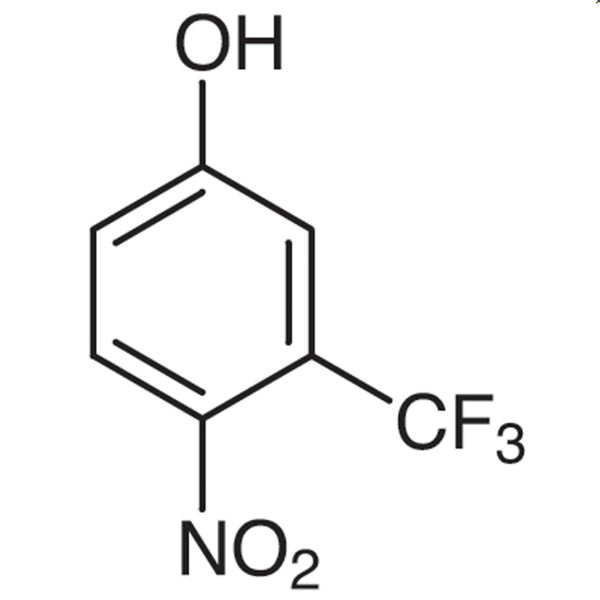
4-Nitro-3-(trifluoromethyl)phenol is a chemical compound widely used in organic synthesis reactions within laboratory settings. Its aromatic structure, combined with substituents such as nitro and trifluoromethyl, makes it a valuable building block for creating complex molecules. This compound plays a crucial role in the development of new chemical entities, particularly in pharmaceutical and organic chemistry research. Its unique molecular framework allows for versatile chemical transformations, making it a key reagent in various synthetic pathways.
The compound's properties, including the presence of a strongly electron-withdrawing trifluoromethyl group, contribute to its reactivity and polarity. These characteristics make it suitable for substitution and electrophilic reactions. Additionally, the nitro group imparts oxidative properties, influencing the stability and reactivity of the molecule. These combined features make 4-Nitro-3-(trifluoromethyl)phenol a preferred choice for researchers aiming to modify molecular structures with precision.
In Indonesian laboratories, this compound is commonly used in scientific research related to the synthesis of bioactive compounds, drug development, and the study of organic reactivity. Its structural versatility and functional groups make it a key component in the exploration of new chemical applications. The compound's role in advancing scientific understanding and innovation in the field of chemistry is well recognized among Indonesian researchers.
- Organic synthesis research benefits from this compound's structural versatility, enabling the creation of complex molecular frameworks.
- Pharmaceutical development utilizes its reactivity and functional groups to design new drug molecules with targeted biological activity.
- Bioactive compound synthesis leverages its unique electron-withdrawing properties for precise molecular modifications.
- Chemical reactivity studies employ its oxidative characteristics to explore reaction mechanisms and stability under various conditions.
- Industrial chemical processes use its stability and reactivity to optimize synthetic pathways and improve yield efficiency.
| Brand | TCI |
|---|---|
| CAS number | 88-30-2 |
| Molecular formula | — |
| Purity | — |
| Category | Chemistry > Building Blocks > Fluorinated Building Blocks |
| Pack sizes | Available in standard laboratory quantities as per supplier specifications |
| Physical form | Solid, typically in crystalline form |
| Storage | Store in a cool, dry place away from moisture and direct sunlight |
This compound should be stored in a cool, dry environment, away from moisture and direct sunlight to maintain its chemical integrity. It is recommended to use airtight containers made of materials resistant to chemical corrosion, such as glass or high-density polyethylene. Due to its reactivity and potential for interaction with moisture, it should be handled in a well-ventilated area, preferably under a fume hood. Proper personal protective equipment, including gloves and safety goggles, should be worn during handling to ensure laboratory safety. Regular monitoring of storage conditions is advised to prevent degradation and ensure the compound remains suitable for use in research applications.
—
Produk Terkait
-
2,3,5,6-Tetrafluoro-4-(trifluoromethyl)phenol TCI T1983
Regular price Rp 2.306.850,00Regular price -
4-Bromo-3-(trifluoromethyl)phenol TCI B4494
Regular price From Rp 848.400,00Regular price -
4-Bromo-2-(trifluoromethyl)phenol TCI B4493
Regular price From Rp 1.908.900,00Regular price -
2-Bromo-4-(trifluoromethyl)phenol TCI B4492
Regular price From Rp 955.500,00Regular price -
3,5-Bis(trifluoromethyl)phenol TCI B1869
Regular price From Rp 1.060.500,00Regular price -
2-Nitro-4-(trifluoromethyl)phenol TCI N0779
Regular price From Rp 743.400,00Regular price -
2-Fluoro-5-(trifluoromethyl)phenol TCI F0780
Regular price From Rp 980.700,00Regular price -
4-Fluoro-3-(trifluoromethyl)phenol TCI F0754
Regular price From Rp 1.378.650,00Regular price