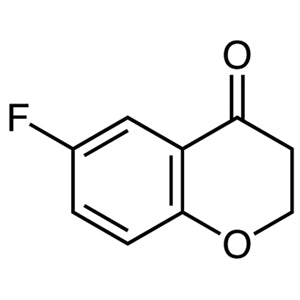
6-Fluoro-4-chromanone is a heterocyclic building block built around the chroman-4-one skeleton, a benzene ring fused to a six-membered pyran ring and carrying a ketone group. This framework is a close relative of the chromones and flavonoids that appear widely among natural products and pharmaceutical compounds. This fluorinated variant from TCI is used in the laboratory as a starting point for assembling chroman-core molecules that already carry a fluorine atom from the outset, so that researchers can focus directly on modifying the ketone group and the ring system without an additional and troublesome fluorination step.
The property that makes this material attractive is its cyclic ketone group, which is reactive yet controllable. The carbonyl at the four position can be reduced to an alcohol, converted into an oxime or a hydrazone, processed through aldol condensation, or used as an entry point for the construction of new rings such as pyrazoles and isoxazoles. The hydrogen atoms adjacent to the carbonyl are relatively easy to remove, which makes directed alkylation possible. The fluorine atom on the aromatic ring alters the electronic character of the system, increases lipophilicity in a measurable way, and often improves the metabolic stability of the final molecule.
As a solid material, this building block is convenient to weigh out and handle on the bench, which suits the working routine of Indonesian laboratories. It is typically found in academic and pharmaceutical research groups carrying out organic synthesis and medicinal chemistry work, where fluorinated intermediates are needed for the preparation of compound series. Its role is that of an intermediate rather than an end product, supplying the chroman core for subsequent synthetic steps.
TCI brochures (PDF)
- Fluorination Reagents, Fluorinated Building Blocks 2026-03-18 · p. 50
Related TCI products
- TCI F0271 88754-96-5 6-Fluoro-2-methyl-4-chromanone
- TCI B4810 168828-81-7 Benzyl (3-Fluoro-4-morpholinophenyl)carbamate
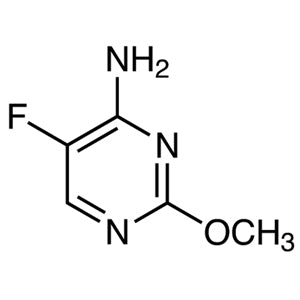
- TCI A2125 1993-63-1 4-Amino-5-fluoro-2-methoxypyrimidine
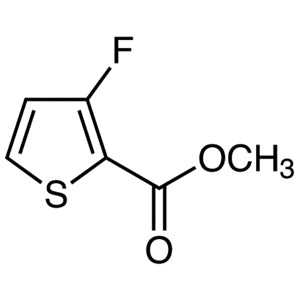
- TCI M2295 100421-52-1 Methyl 3-Fluoro-2-thiophenecarboxylate
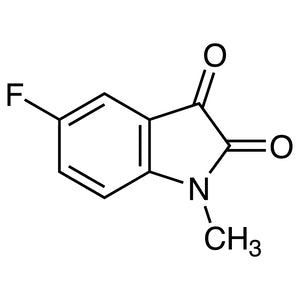
- TCI F1390 773-91-1 5-Fluoro-1-methylindoline-2,3-dione
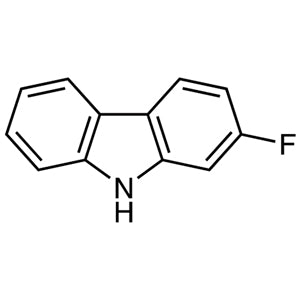
- TCI F1182 391-53-7 2-Fluoro-9H-carbazole
- Medicinal chemistry scaffold synthesis: the pre-installed fluorine and the reactive chroman-4-one core let researchers build fluorinated analogue series without performing a separate fluorination step themselves.
- Heterocycle construction: the four-position carbonyl serves as an entry point for forming new rings such as pyrazoles and isoxazoles fused to the existing chroman framework.
- Carbonyl derivatisation studies: the ketone can be converted into oximes or hydrazones, giving a straightforward route to families of derivatives from a single common intermediate.
- Reduction chemistry: the cyclic ketone can be reduced to the corresponding alcohol, which makes this material useful for teaching and for optimising reduction conditions on a chroman system.
- Directed alkylation work: hydrogen atoms next to the carbonyl are comparatively easy to remove, allowing controlled alkylation at that position for structure–activity exploration.
| Brand | TCI |
|---|---|
| CAS number | 66892-34-0 |
| Molecular formula | — |
| Purity | — |
| Category | Chemistry > Building Blocks > Fluorinated Building Blocks |
| Pack sizes | catalogue pack sizes available on request |
| Physical form | solid |
| Storage | store in a closed container under the conditions stated on the manufacturer's label |
Keep this building block in its original tightly closed container, protected from moisture and stored away from direct sunlight and heat sources. Amber glass or the supplied original packaging is suitable, and the container should be resealed promptly after each weighing so that the solid does not pick up atmospheric moisture. Handle the material in a fume hood using gloves, safety glasses, and a laboratory coat, and avoid generating dust when transferring the solid. Follow the manufacturer's safety data sheet for the specific hazard information and disposal route, and label any secondary containers clearly.
—
Produk Terkait
-
6-Fluoro-2-methyl-4-chromanone TCI F0271
Regular price Rp 1.644.300,00Regular price -
Benzyl(3-Fluoro-4-morpholinophenyl)carbamate TCI B4810
Regular price From Rp 664.650,00Regular price -
4-Amino-5-fluoro-2-methoxypyrimidine TCI A2125
Regular price Rp 2.491.650,00Regular price -
Methyl3-Fluoro-2-thiophenecarboxylate TCI M2295
Regular price Rp 2.068.500,00Regular price -
5-Fluoro-1-methylindoline-2,3-dione TCI F1390
Regular price From Rp 1.724.100,00Regular price -
2-Fluoro-9H-carbazole TCI F1182
Regular price From Rp 1.378.650,00Regular price -
4-Fluoro-1H-imidazole TCI F1157
Regular price Rp 10.838.100,00Regular price -
7-Fluoro-6-nitroquinazolin-4(1H)-one TCI F1091
Regular price Rp 1.140.300,00Regular price