

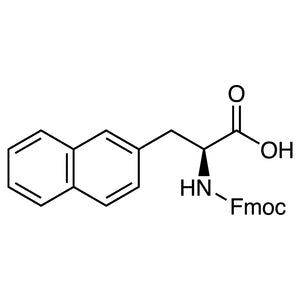
TCI F1323 112883-43-9 Fmoc-2-Nal-OH is a chemical compound used in peptide synthesis, specifically in solid-phase peptide synthesis. This compound is a modified amino nitrophenyl derivative with the Fmoc (9-fluorenylmethyloxycarbonyl) protecting group. The Fmoc group is widely used in peptide chemistry to protect amino acid side chains during synthesis, allowing for controlled deprotection under specific conditions. This compound plays a critical role in the development of bioactive peptides, including antimicrobial peptides, hormones, and therapeutic agents.
The chemical properties of Fmoc-2-Nal-OH make it a preferred choice for researchers. Its stability under various reaction conditions and its ability to selectively react with specific reagents contribute to its effectiveness in peptide synthesis. The structure of the molecule allows for efficient deprotection, which simplifies the synthesis process and improves the yield of the final peptide product. These characteristics make it a reliable and essential reagent in advanced chemical biology applications.
In Indonesian laboratories, Fmoc-2-Nal-OH is commonly used in research related to chemical biology and pharmacology. It is widely utilized by research institutions and universities to develop new therapeutic compounds with potential medical applications. Its role in biotechnology and organic chemistry research further highlights its importance in the scientific community. The compound is an essential tool for researchers aiming to create bioactive peptides with precise structural and functional properties.
- Peptide Synthesis: Fmoc-2-Nal-OH is ideal for solid-phase peptide synthesis due to its Fmoc protecting group, which allows controlled deprotection and efficient coupling reactions.
- Bioactive Peptide Development: This compound is used to create peptides with biological activity, such as antimicrobials and hormones, by enabling precise amino acid sequence assembly.
- Pharmaceutical Research: It supports the development of therapeutic peptides by providing a reliable building block for complex molecular structures.
- Organic Chemistry Studies: The compound's reactivity and stability make it suitable for exploring new synthetic pathways and chemical transformations.
- Biotechnology Applications: Fmoc-2-Nal-OH is integral to research in biotechnology, where it aids in the design of peptides for drug delivery and molecular recognition.
| Brand | TCI |
|---|---|
| CAS number | 112883-43-9 |
| Molecular formula | — |
| Purity | — |
| Category | Chemistry > Chemical Biology > Peptide Chemistry |
| Pack sizes | Available in standard chemical reagent quantities |
| Physical form | Solid powder |
| Storage | Store in a cool, dry place away from light and moisture |
Fmoc-2-Nal-OH should be stored in a cool, dry environment, away from direct sunlight and moisture to maintain its chemical stability. It is recommended to use airtight containers, such as glass or high-density polyethylene bottles, to prevent exposure to humidity and contaminants. Due to its chemical nature, it should be handled in a well-ventilated area, and appropriate personal protective equipment, such as gloves and safety goggles, should be worn. Avoid contact with incompatible substances, and ensure that storage conditions are consistent with standard chemical reagent safety guidelines. Proper storage ensures the compound remains effective for use in laboratory applications.
—
Produk Terkait
-
N-(tert-Butoxycarbonyl)-4-methoxy-D-phenylalanine TCI B5350
Regular price From Rp 1.670.550,00Regular price -
(1R,2S)-1-[(tert-Butoxycarbonyl)amino]-2-vinylcyclopropanecarboxylicAcid TCI B5322
Regular price From Rp 637.350,00Regular price -
N-(tert-Butoxycarbonyl)-N-methyl-D-phenylalanine TCI B5011
Regular price From Rp 1.590.750,00Regular price -
N-(tert-Butoxycarbonyl)-4-cyano-L-phenylalanine TCI B4877
Regular price From Rp 2.466.450,00Regular price -
N-(tert-Butoxycarbonyl)-4-trifluoromethyl-L-phenylalanine TCI B4369
Regular price Rp 6.253.800,00Regular price -
N-(tert-Butoxycarbonyl)-L-homophenylalanine TCI B4356
Regular price Rp 664.650,00Regular price -
N-(tert-Butoxycarbonyl)-4-phenyl-L-phenylalanine TCI B4289
Regular price Rp 2.571.450,00Regular price -
Boc-Cha-OH TCI B4244
Regular price From Rp 2.862.300,00Regular price

![159622-10-3 (1R,2S)-1-[(tert-Butoxycarbonyl)amino]-2-vinylcyclopropanecarboxylic Acid - AMI Scientific](http://amiscientific.com/cdn/shop/files/TCI2510B5322_7b687177-5993-48bc-b732-b8687acd11a9.jpg?v=1767861556&width=533)


