

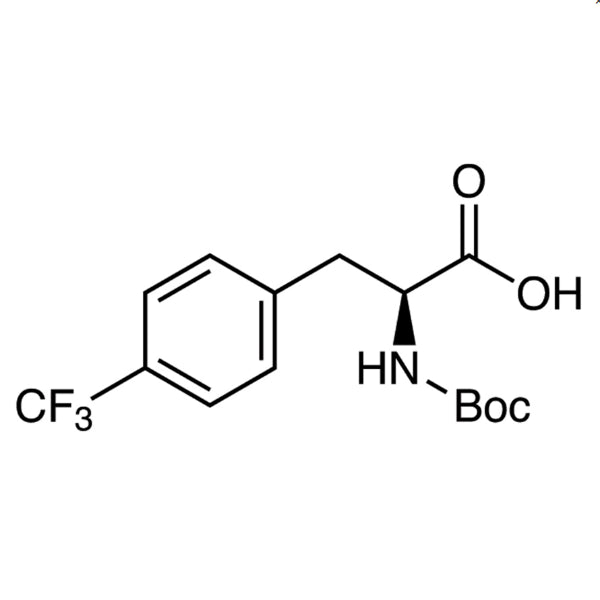
N-(tert-Butoxycarbonyl)-4-trifluoromethyl-L-phenylalanine is a specialized chemical compound used in peptide synthesis and biochemical research. This compound plays a crucial role in the development of bioactive molecules, particularly in the field of medicinal chemistry and biotechnology. Its unique molecular structure enables it to participate in various chemical reactions, making it an essential reagent for the synthesis of complex organic compounds. In laboratory settings, it serves as a building block for the creation of pharmaceuticals and bioactive peptides, supporting advanced research in both academic and industrial environments.
The compound's stability and reactivity make it a preferred choice for researchers working on high-precision chemical synthesis. Its ability to undergo specific chemical modifications allows for the design of molecules with tailored biological properties. The tert-butyloxycarbonyl (Boc) protecting group ensures controlled reactivity, which is vital for the synthesis of complex peptides and drug candidates. This characteristic makes it particularly useful in applications requiring precise chemical control and reproducibility.
In Indonesian laboratories, this compound is widely used in organic chemistry, pharmacology, and biotechnology research. It is a key component in experiments aimed at developing new therapeutic agents and understanding the biochemical mechanisms of various biological processes. Its availability in pure form facilitates efficient isolation and purification steps, supporting a wide range of scientific investigations.
TCI brochures (PDF)
- Amino Acids and Peptide Synthesis Reagents 2025-08-14 · p. 15
- Fluorination Reagents, Fluorinated Building Blocks 2026-03-18 · p. 39
Related TCI products
- TCI B5350 68856-96-2 N-(tert-Butoxycarbonyl)-4-methoxy-D-phenylalanine
- TCI B5011 85466-66-6 N-(tert-Butoxycarbonyl)-N-methyl-D-phenylalanine
- TCI B4877 131724-45-3 N-(tert-Butoxycarbonyl)-4-cyano-L-phenylalanine
- TCI B4289 147923-08-8 N-(tert-Butoxycarbonyl)-4-phenyl-L-phenylalanine
- TCI B3668 61280-75-9 N-(tert-Butoxycarbonyl)-4-nitro-D-phenylalanine
- TCI B3627 198474-90-7 N-(tert-Butoxycarbonyl)-3,4-difluoro-L-phenylalanine
- Peptide Synthesis: Ideal for constructing complex peptides due to its reactivity and stability, supporting drug development and protein engineering.
- Biochemical Research: Used in studies involving enzyme kinetics and molecular interactions due to its structural specificity and chemical versatility.
- Medicinal Chemistry: Serves as a building block for synthesizing bioactive compounds with potential therapeutic applications in pharmaceutical research.
- Organic Synthesis: Valuable in creating modified amino acids for use in advanced chemical reactions and compound derivatization.
- Biotecnological Studies: Applied in the development of biologically active molecules for use in biotechnology and bioengineering projects.
| Brand | TCI |
|---|---|
| CAS number | 114873-07-3 |
| Molecular formula | — |
| Purity | — |
| Category | Chemistry > Chemical Biology > Peptide Chemistry |
| Pack sizes | Available in various quantities as per standard laboratory supply formats |
| Physical form | Solid powder |
| Storage | Store in a cool, dry place away from light and moisture |
This compound should be stored in a cool, dry environment, away from direct light and moisture to maintain its chemical integrity. It is recommended to use airtight containers made of glass or high-density polyethylene to prevent contamination and degradation. Due to its reactivity, it should be handled with care using appropriate personal protective equipment such as gloves and safety goggles. Proper ventilation is essential when working with this material to minimize exposure. It is important to ensure that the storage area is secure and inaccessible to unauthorized personnel. Regular monitoring of storage conditions is advised to maintain optimal chemical stability and ensure safe laboratory practices.
—
Product Categories
- Chemical BiologyPeptide ChemistryAmino Acid Derivatives [Peptide Chemistry]
- Chemical BiologyPeptide ChemistryUnnatural Amino Acid Derivatives
- Pharmaceutical Development and Drug Discovery Research ReagentsPeptide ChemistryAmino Acid Derivatives [Peptide Chemistry]
- Pharmaceutical Development and Drug Discovery Research ReagentsPeptide ChemistryUnnatural Amino Acid Derivatives
Produk Terkait
-
N-(tert-Butoxycarbonyl)-4-methoxy-D-phenylalanine TCI B5350
Regular price From Rp 1.723.050,00Regular priceRp 1.220.100,00Sale price From Rp 1.723.050,00 -
N-(tert-Butoxycarbonyl)-N-methyl-D-phenylalanine TCI B5011
Regular price From Rp 1.643.250,00Regular priceRp 1.164.450,00Sale price From Rp 1.643.250,00 -
N-(tert-Butoxycarbonyl)-4-cyano-L-phenylalanine TCI B4877
Regular price From Rp 2.518.950,00Regular priceRp 1.776.600,00Sale price From Rp 2.518.950,00 -
N-(tert-Butoxycarbonyl)-4-phenyl-L-phenylalanine TCI B4289
Regular price Rp 2.623.950,00Regular priceRp 1.850.100,00Sale price Rp 2.623.950,00 -
N-(tert-Butoxycarbonyl)-4-nitro-D-phenylalanine TCI B3668
Regular price Rp 2.384.550,00Regular priceRp 1.683.150,00Sale price Rp 2.384.550,00 -
N-(tert-Butoxycarbonyl)-3,4-difluoro-L-phenylalanine TCI B3627
Regular price Rp 4.636.800,00Regular priceRp 3.258.150,00Sale price Rp 4.636.800,00 -
N-(tert-Butoxycarbonyl)-4-chloro-L-phenylalanine TCI B3614
Regular price From Rp 1.351.350,00Regular priceRp 960.750,00Sale price From Rp 1.351.350,00 -
N-(tert-Butoxycarbonyl)-4-fluoro-L-phenylalanine TCI B3304
Regular price From Rp 1.563.450,00Regular priceRp 1.108.800,00Sale price From Rp 1.563.450,00


