


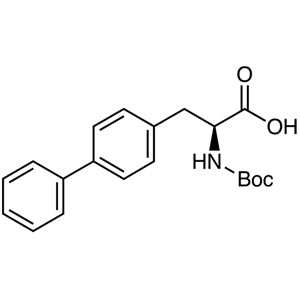
N-(tert-Butoxycarbonyl)-4-phenyl-L-phenylalanine is a chemical compound widely used in organic and biochemical research, particularly in peptide chemistry. This compound plays a crucial role in the synthesis of peptides and bioactive molecules, serving as a building block for the development of pharmaceuticals and biologically active substances. Its molecular structure enables specific chemical reactions, such as deprotection and coupling reactions, which are essential in the creation of complex molecular structures. In laboratory settings, it is a fundamental reagent for researchers working on drug development and molecular biology projects.
The compound is valued for its chemical stability under controlled conditions and its compatibility with a variety of reagents, including acids, bases, and organic solvents. These properties make it a reliable and versatile material for synthetic processes. Its ability to participate in precise chemical transformations, combined with its structural complexity, ensures that it is a preferred choice for advanced research applications. The solid form of the compound also facilitates easy handling and storage, enhancing its usability in laboratory environments.
In Indonesian laboratories, this compound is commonly used in pharmacological, biochemical, and medicinal chemistry research. Researchers from universities and research institutions rely on it for the development of new drugs and the study of molecular mechanisms. Its application in these fields highlights its importance in advancing scientific knowledge and innovation in the region.
TCI brochures (PDF)
- Amino Acids and Peptide Synthesis Reagents 2025-08-14 · p. 14
Related TCI products
- TCI B5350 68856-96-2 N-(tert-Butoxycarbonyl)-4-methoxy-D-phenylalanine
- TCI B5011 85466-66-6 N-(tert-Butoxycarbonyl)-N-methyl-D-phenylalanine
- TCI B4877 131724-45-3 N-(tert-Butoxycarbonyl)-4-cyano-L-phenylalanine
- TCI B4369 114873-07-3 N-(tert-Butoxycarbonyl)-4-trifluoromethyl-L-phenylalanine
- TCI B3668 61280-75-9 N-(tert-Butoxycarbonyl)-4-nitro-D-phenylalanine
- TCI B3627 198474-90-7 N-(tert-Butoxycarbonyl)-3,4-difluoro-L-phenylalanine
- Peptide Synthesis: This compound is ideal for peptide synthesis due to its ability to undergo deprotection and coupling reactions, making it essential for constructing complex peptide sequences.
- Drug Development: It is widely used in drug development to create bioactive molecules, supporting the design of new therapeutic agents with targeted pharmacological effects.
- Biochemical Research: Its role in biochemical studies enables the investigation of molecular interactions and biological processes, contributing to advancements in biotechnology.
- Medicinal Chemistry: The compound is a key reagent in medicinal chemistry, facilitating the synthesis of compounds with potential pharmaceutical applications.
- Structural Analysis: Its molecular complexity makes it suitable for structural analysis studies, aiding in the understanding of molecular behavior and reactivity.
| Brand | TCI |
|---|---|
| CAS number | 147923-08-8 |
| Molecular formula | — |
| Purity | — |
| Category | Chemistry > Chemical Biology > Peptide Chemistry |
| Pack sizes | Available in various pack sizes to meet different research needs |
| Physical form | Solid |
| Storage | Store in a cool, dry place away from light and moisture |
This compound should be stored in a cool, dry place, away from direct light and moisture to maintain its chemical stability. It is recommended to use airtight containers to prevent exposure to air and potential degradation. When handling, researchers should wear appropriate personal protective equipment, such as gloves and safety goggles, to ensure safety. The compound is generally stable under normal laboratory conditions but should be kept away from incompatible substances like strong acids or bases. Proper labeling and storage practices are essential to prevent cross-contamination and ensure safe handling in the laboratory environment.
—
Product Categories
- Chemical BiologyPeptide ChemistryAmino Acid Derivatives [Peptide Chemistry]
- Chemical BiologyPeptide ChemistryUnnatural Amino Acid Derivatives
- Pharmaceutical Development and Drug Discovery Research ReagentsPeptide ChemistryAmino Acid Derivatives [Peptide Chemistry]
- Pharmaceutical Development and Drug Discovery Research ReagentsPeptide ChemistryUnnatural Amino Acid Derivatives
Produk Terkait
-
N-(tert-Butoxycarbonyl)-4-methoxy-D-phenylalanine TCI B5350
Regular price From Rp 1.723.050,00Regular priceRp 1.220.100,00Sale price From Rp 1.723.050,00 -
N-(tert-Butoxycarbonyl)-N-methyl-D-phenylalanine TCI B5011
Regular price From Rp 1.643.250,00Regular priceRp 1.164.450,00Sale price From Rp 1.643.250,00 -
N-(tert-Butoxycarbonyl)-4-cyano-L-phenylalanine TCI B4877
Regular price From Rp 2.518.950,00Regular priceRp 1.776.600,00Sale price From Rp 2.518.950,00 -
N-(tert-Butoxycarbonyl)-4-trifluoromethyl-L-phenylalanine TCI B4369
Regular price Rp 6.306.300,00Regular priceRp 4.425.750,00Sale price Rp 6.306.300,00 -
N-(tert-Butoxycarbonyl)-4-nitro-D-phenylalanine TCI B3668
Regular price Rp 2.384.550,00Regular priceRp 1.683.150,00Sale price Rp 2.384.550,00 -
N-(tert-Butoxycarbonyl)-3,4-difluoro-L-phenylalanine TCI B3627
Regular price Rp 4.636.800,00Regular priceRp 3.258.150,00Sale price Rp 4.636.800,00 -
N-(tert-Butoxycarbonyl)-4-chloro-L-phenylalanine TCI B3614
Regular price From Rp 1.351.350,00Regular priceRp 960.750,00Sale price From Rp 1.351.350,00 -
N-(tert-Butoxycarbonyl)-4-fluoro-L-phenylalanine TCI B3304
Regular price From Rp 1.563.450,00Regular priceRp 1.108.800,00Sale price From Rp 1.563.450,00


