


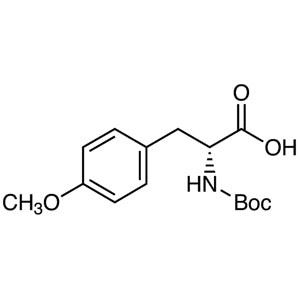
N-(tert-Butoxycarbonyl)-4-methoxy-D-phenylalanine is a chemical compound widely used in organic and biochemical research, particularly in peptide chemistry. This compound plays a crucial role in the synthesis of modified amino acids, which are essential for various biomedical and pharmacological studies. Its importance lies in its ability to serve as a building block for the creation of complex molecules with specific biological activities. In laboratory settings, it is a key reagent for the development of peptides, vaccines, and pharmaceutical compounds.
The compound is valued for its chemical stability and resistance to degradation under controlled conditions. Its inert nature allows it to be safely handled in a variety of chemical reactions without unwanted side reactions. This makes it a reliable and efficient choice for researchers aiming for consistent and reproducible results. Additionally, its high purity ensures that experimental outcomes remain accurate and dependable, which is critical in scientific research.
In Indonesian laboratories, this compound is commonly used in research related to peptides, vaccines, and drug development. Scientists and researchers rely on it to advance their studies in biochemistry and pharmacology. Its application spans across academic institutions and research centers, contributing to the development of new pharmaceutical products and the deepening of understanding of biological mechanisms.
TCI brochures (PDF)
- Amino Acids and Peptide Synthesis Reagents 2025-08-14 · p. 15
Related TCI products
- TCI B5011 85466-66-6 N-(tert-Butoxycarbonyl)-N-methyl-D-phenylalanine
- TCI B4877 131724-45-3 N-(tert-Butoxycarbonyl)-4-cyano-L-phenylalanine
- TCI B4369 114873-07-3 N-(tert-Butoxycarbonyl)-4-trifluoromethyl-L-phenylalanine
- TCI B4289 147923-08-8 N-(tert-Butoxycarbonyl)-4-phenyl-L-phenylalanine
- TCI B3668 61280-75-9 N-(tert-Butoxycarbonyl)-4-nitro-D-phenylalanine
- TCI B3627 198474-90-7 N-(tert-Butoxycarbonyl)-3,4-difluoro-L-phenylalanine
- Peptide Synthesis: This compound is ideal for peptide synthesis due to its stability and compatibility with standard solid-phase peptide synthesis protocols.
- Pharmaceutical Research: It is widely used in the development of new drugs, particularly in the design of modified amino acids for therapeutic applications.
- Vaccine Development: The compound supports the creation of peptide-based vaccines by providing a reliable source of modified amino acids.
- Biochemical Studies: Its use in biochemical research allows for the study of protein structures and interactions in controlled environments.
- Drug Discovery: It is a key reagent in the early stages of drug discovery, aiding in the synthesis of potential therapeutic agents.
| Brand | TCI |
|---|---|
| CAS number | 68856-96-2 |
| Molecular formula | — |
| Purity | — |
| Category | Chemistry > Chemical Biology > Peptide Chemistry |
| Pack sizes | Available in various quantities as per supplier specifications |
| Physical form | Solid |
| Storage | Store in a cool, dry place away from moisture and direct sunlight |
This compound should be stored in a cool, dry environment to maintain its chemical stability and prevent degradation. It is recommended to use airtight containers to protect it from moisture and contaminants. Due to its inert nature, it does not react readily with other chemicals, making it safe to handle in standard laboratory conditions. However, it is important to follow general safety protocols when working with chemical reagents, such as wearing appropriate personal protective equipment. Proper labeling of containers is essential for safe handling and to prevent accidental exposure. The compound should be kept away from heat sources and direct sunlight to ensure long-term stability and usability in research applications.
—
Product Categories
- Chemical BiologyPeptide ChemistryAmino Acid Derivatives [Peptide Chemistry]
- Chemical BiologyPeptide ChemistryUnnatural Amino Acid Derivatives
- Pharmaceutical Development and Drug Discovery Research ReagentsPeptide ChemistryAmino Acid Derivatives [Peptide Chemistry]
- Pharmaceutical Development and Drug Discovery Research ReagentsPeptide ChemistryUnnatural Amino Acid Derivatives
Produk Terkait
-
N-(tert-Butoxycarbonyl)-N-methyl-D-phenylalanine TCI B5011
Regular price From Rp 1.643.250,00Regular priceRp 1.164.450,00Sale price From Rp 1.643.250,00 -
N-(tert-Butoxycarbonyl)-4-cyano-L-phenylalanine TCI B4877
Regular price From Rp 2.518.950,00Regular priceRp 1.776.600,00Sale price From Rp 2.518.950,00 -
N-(tert-Butoxycarbonyl)-4-trifluoromethyl-L-phenylalanine TCI B4369
Regular price Rp 6.306.300,00Regular priceRp 4.425.750,00Sale price Rp 6.306.300,00 -
N-(tert-Butoxycarbonyl)-4-phenyl-L-phenylalanine TCI B4289
Regular price Rp 2.623.950,00Regular priceRp 1.850.100,00Sale price Rp 2.623.950,00 -
N-(tert-Butoxycarbonyl)-4-nitro-D-phenylalanine TCI B3668
Regular price Rp 2.384.550,00Regular priceRp 1.683.150,00Sale price Rp 2.384.550,00 -
N-(tert-Butoxycarbonyl)-3,4-difluoro-L-phenylalanine TCI B3627
Regular price Rp 4.636.800,00Regular priceRp 3.258.150,00Sale price Rp 4.636.800,00 -
N-(tert-Butoxycarbonyl)-4-chloro-L-phenylalanine TCI B3614
Regular price From Rp 1.351.350,00Regular priceRp 960.750,00Sale price From Rp 1.351.350,00 -
N-(tert-Butoxycarbonyl)-4-fluoro-L-phenylalanine TCI B3304
Regular price From Rp 1.563.450,00Regular priceRp 1.108.800,00Sale price From Rp 1.563.450,00


