


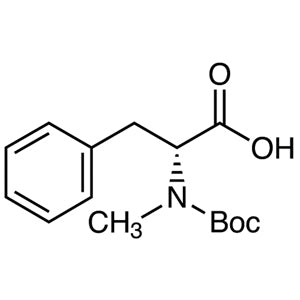
N-(tert-Butoxycarbonyl)-N-methyl-D-phenylalanine is a chemical compound widely used in peptide synthesis and biochemical research. It serves as a key building block in the creation of amino acid derivatives, particularly in the formation of peptides with specific structural configurations. This compound is essential for laboratories engaged in protein research and the development of complex organic molecules. Its role in constructing peptide chains is critical for advancing studies in biological and pharmacological sciences.
The compound is chemically stable and participates in peptide bond formation reactions, making it a reliable reagent in synthetic processes. It exhibits good solubility in organic solvents, which facilitates synthesis and purification steps. These properties ensure consistent performance and reproducibility in laboratory settings. Its stability and solubility characteristics make it a preferred choice for researchers requiring precision and reliability in their experiments.
In Indonesian laboratories, this compound is commonly used in biochemical, pharmaceutical, and biotechnology research. It supports studies involving protein structure, drug development, and molecular biology. Its versatility and effectiveness in various experimental setups make it a valuable resource for scientists working in these fields. The compound’s resistance to degradation also ensures long-term usability and efficiency in research applications.
TCI brochures (PDF)
- Amino Acids and Peptide Synthesis Reagents 2025-08-14 · p. 15
Related TCI products
- TCI B5350 68856-96-2 N-(tert-Butoxycarbonyl)-4-methoxy-D-phenylalanine
- TCI B4877 131724-45-3 N-(tert-Butoxycarbonyl)-4-cyano-L-phenylalanine
- TCI B4369 114873-07-3 N-(tert-Butoxycarbonyl)-4-trifluoromethyl-L-phenylalanine
- TCI B4289 147923-08-8 N-(tert-Butoxycarbonyl)-4-phenyl-L-phenylalanine
- TCI B3668 61280-75-9 N-(tert-Butoxycarbonyl)-4-nitro-D-phenylalanine
- TCI B3627 198474-90-7 N-(tert-Butoxycarbonyl)-3,4-difluoro-L-phenylalanine
- Peptide Synthesis: This compound is ideal for constructing peptides with defined structures due to its role in forming peptide bonds and its chemical stability.
- Biochemical Research: It supports studies on amino acid derivatives and their interactions, providing a reliable source for molecular investigations.
- Pharmaceutical Development: Used in the synthesis of drug molecules, it aids in the creation of compounds with specific biological activities.
- Protein Structure Analysis: It contributes to the study of protein folding and function by serving as a building block in synthetic peptides.
- Organic Chemistry Experiments: Its solubility in organic solvents makes it suitable for a wide range of synthetic and analytical procedures.
| Brand | TCI |
|---|---|
| CAS number | 85466-66-6 |
| Molecular formula | — |
| Purity | — |
| Category | Chemistry > Chemical Biology > Peptide Chemistry |
| Pack sizes | Available in various quantities as per standard laboratory supply |
| Physical form | Solid |
| Storage | Store in a cool, dry place away from moisture and direct sunlight |
This compound should be stored in a cool, dry environment to maintain its chemical stability. It is recommended to keep it in a tightly sealed container to prevent exposure to moisture and air. Due to its organic nature, it is best stored in a glass or plastic container that is resistant to chemical degradation. Avoid storing near heat sources or in areas with high humidity. Proper labeling of containers is essential for safe handling and to prevent cross-contamination. Regular inspection of storage conditions ensures the compound remains in optimal condition for use in laboratory applications.
—
Product Categories
- Chemical BiologyPeptide ChemistryAmino Acid Derivatives [Peptide Chemistry]
- Chemical BiologyPeptide ChemistryUnnatural Amino Acid Derivatives
- Pharmaceutical Development and Drug Discovery Research ReagentsPeptide ChemistryAmino Acid Derivatives [Peptide Chemistry]
- Pharmaceutical Development and Drug Discovery Research ReagentsPeptide ChemistryUnnatural Amino Acid Derivatives
Produk Terkait
-
N-(tert-Butoxycarbonyl)-4-methoxy-D-phenylalanine TCI B5350
Regular price From Rp 1.723.050,00Regular priceRp 1.220.100,00Sale price From Rp 1.723.050,00 -
N-(tert-Butoxycarbonyl)-4-cyano-L-phenylalanine TCI B4877
Regular price From Rp 2.518.950,00Regular priceRp 1.776.600,00Sale price From Rp 2.518.950,00 -
N-(tert-Butoxycarbonyl)-4-trifluoromethyl-L-phenylalanine TCI B4369
Regular price Rp 6.306.300,00Regular priceRp 4.425.750,00Sale price Rp 6.306.300,00 -
N-(tert-Butoxycarbonyl)-4-phenyl-L-phenylalanine TCI B4289
Regular price Rp 2.623.950,00Regular priceRp 1.850.100,00Sale price Rp 2.623.950,00 -
N-(tert-Butoxycarbonyl)-4-nitro-D-phenylalanine TCI B3668
Regular price Rp 2.384.550,00Regular priceRp 1.683.150,00Sale price Rp 2.384.550,00 -
N-(tert-Butoxycarbonyl)-3,4-difluoro-L-phenylalanine TCI B3627
Regular price Rp 4.636.800,00Regular priceRp 3.258.150,00Sale price Rp 4.636.800,00 -
N-(tert-Butoxycarbonyl)-4-chloro-L-phenylalanine TCI B3614
Regular price From Rp 1.351.350,00Regular priceRp 960.750,00Sale price From Rp 1.351.350,00 -
N-(tert-Butoxycarbonyl)-4-fluoro-L-phenylalanine TCI B3304
Regular price From Rp 1.563.450,00Regular priceRp 1.108.800,00Sale price From Rp 1.563.450,00


