


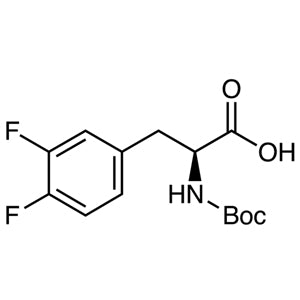
N-(tert-Butoxycarbonyl)-3,4-difluoro-L-phenylalanine is a chemical compound widely used in chemical biology, particularly in peptide chemistry. This compound serves as a key building block in the synthesis of bioactive molecules, including pharmaceuticals and analytical reagents. Its role in the laboratory is critical for creating complex structures that require precise modifications to amino acid chains. As a protected amino acid derivative, it is essential in the development of peptides with specific biological functions. Its utility extends to research focused on drug discovery and molecular design, where its structural properties enable the creation of compounds with targeted therapeutic effects.
The compound's stability and reactivity make it a preferred choice for synthetic chemists. The presence of the tert-butoxycarbonyl (Boc) group allows for controlled deprotection, enabling the synthesis of more complex peptides with high specificity. Its chemical properties ensure compatibility with various reaction conditions, making it a versatile reagent in laboratory settings. The compound's ability to undergo selective transformations supports its use in advanced chemical synthesis, particularly in the development of bioactive molecules. Its reliability and consistent performance contribute to its widespread adoption in scientific research.
In Indonesian laboratories, N-(tert-Butoxycarbonyl)-3,4-difluoro-L-phenylalanine is commonly used in pharmacological, biochemical, and organic chemistry research. It plays a vital role in the development of new therapeutic agents and analytical tools. Its application is particularly relevant in studies involving peptide-based drugs and molecular structure analysis. Researchers in Indonesia rely on this compound to achieve precise and reproducible results in their experiments, making it an essential component of modern chemical research.
TCI brochures (PDF)
- Amino Acids and Peptide Synthesis Reagents 2025-08-14 · p. 14
Related TCI products
- TCI B5350 68856-96-2 N-(tert-Butoxycarbonyl)-4-methoxy-D-phenylalanine
- TCI B5011 85466-66-6 N-(tert-Butoxycarbonyl)-N-methyl-D-phenylalanine
- TCI B4369 114873-07-3 N-(tert-Butoxycarbonyl)-4-trifluoromethyl-L-phenylalanine
- TCI B4289 147923-08-8 N-(tert-Butoxycarbonyl)-4-phenyl-L-phenylalanine
- TCI B3668 61280-75-9 N-(tert-Butoxycarbonyl)-4-nitro-D-phenylalanine
- TCI B3614 68090-88-0 N-(tert-Butoxycarbonyl)-4-chloro-L-phenylalanine
- Peptide Synthesis: This compound is ideal for synthesizing peptides with specific functional groups, as its Boc group allows for controlled deprotection during the synthesis process.
- Drug Discovery: It is used in the development of pharmaceutical compounds due to its ability to form stable intermediates that can be further modified into bioactive molecules.
- Biochemical Research: Its role in amino acid modification makes it a valuable tool for studying protein structures and enzyme interactions.
- Organic Chemistry Studies: It supports the creation of complex organic molecules, facilitating the exploration of new chemical reactions and synthetic pathways.
- Analytical Chemistry: It is employed in the preparation of standards and reagents for analytical techniques such as HPLC and mass spectrometry.
| Brand | TCI |
|---|---|
| CAS number | 198474-90-7 |
| Molecular formula | — |
| Purity | — |
| Category | Chemistry > Chemical Biology > Peptide Chemistry |
| Pack sizes | Available in various quantities as per supplier specifications |
| Physical form | Solid powder |
| Storage | Store in a cool, dry place away from moisture and direct sunlight |
This compound should be stored in a cool, dry environment to maintain its chemical stability. It is recommended to keep it in a tightly sealed container to prevent exposure to moisture and air. Due to its chemical nature, it should be handled with appropriate personal protective equipment, such as gloves and safety goggles. Avoid direct contact with skin or inhalation of dust. Proper ventilation is essential in the laboratory to minimize exposure risks. The compound is not classified as hazardous under standard handling conditions, but standard laboratory safety protocols should always be followed.
—
Product Categories
- Chemical BiologyPeptide ChemistryAmino Acid Derivatives [Peptide Chemistry]
- Chemical BiologyPeptide ChemistryUnnatural Amino Acid Derivatives
- Pharmaceutical Development and Drug Discovery Research ReagentsPeptide ChemistryAmino Acid Derivatives [Peptide Chemistry]
- Pharmaceutical Development and Drug Discovery Research ReagentsPeptide ChemistryUnnatural Amino Acid Derivatives
Produk Terkait
-
N-(tert-Butoxycarbonyl)-4-methoxy-D-phenylalanine TCI B5350
Regular price From Rp 1.723.050,00Regular priceRp 1.220.100,00Sale price From Rp 1.723.050,00 -
N-(tert-Butoxycarbonyl)-N-methyl-D-phenylalanine TCI B5011
Regular price From Rp 1.643.250,00Regular priceRp 1.164.450,00Sale price From Rp 1.643.250,00 -
N-(tert-Butoxycarbonyl)-4-trifluoromethyl-L-phenylalanine TCI B4369
Regular price Rp 6.306.300,00Regular priceRp 4.425.750,00Sale price Rp 6.306.300,00 -
N-(tert-Butoxycarbonyl)-4-phenyl-L-phenylalanine TCI B4289
Regular price Rp 2.623.950,00Regular priceRp 1.850.100,00Sale price Rp 2.623.950,00 -
N-(tert-Butoxycarbonyl)-4-nitro-D-phenylalanine TCI B3668
Regular price Rp 2.384.550,00Regular priceRp 1.683.150,00Sale price Rp 2.384.550,00 -
N-(tert-Butoxycarbonyl)-4-chloro-L-phenylalanine TCI B3614
Regular price From Rp 1.351.350,00Regular priceRp 960.750,00Sale price From Rp 1.351.350,00 -
N-(tert-Butoxycarbonyl)-4-fluoro-L-phenylalanine TCI B3304
Regular price From Rp 1.563.450,00Regular priceRp 1.108.800,00Sale price From Rp 1.563.450,00


